There Is No Position 7 in AI Search. And That Changes Everything About How You Need to Be Found
The argument this post makes: Traditional search returns a ranked list. AI search does not. It generates a direct answer, selects the sources it trusts, and presents a synthesized response. Either your business is in that response or it is not. There is no position seven. There is cited, and there is invisible — and the gap between them is not a ranking gap. It is a credibility gap.
Read alongside: From Invisibility to AI Citations: The Complete AI Search Optimization Guide — the 12-step implementation guide for crossing the AI search credibility threshold.
Open your Google Search Console right now. Find your rankings report. Somewhere in that list — maybe position four, maybe position eleven, maybe position seven — is a keyword that matters to your business.
That number has meaning. You know exactly what it costs to move it upward. You know the approximate click-through rate it is currently earning. You know what a move from position seven to position three would mean for your traffic. The entire discipline of search engine optimization has been built around understanding and improving that number.
Now open ChatGPT. Type the question your ideal customer would ask when looking for a business like yours. Read the response.
Is your business in it?
If it is not — and for most businesses, it is not — no position number tells you that. No rank tracker captures it. No Search Console report surfaces it. Your rankings are fine. Your visibility in the fastest-growing form of search is zero.
This is the gap that most businesses do not know exists. And the reason they do not know is that they are using the wrong mental model to understand modern search visibility.
The mental model is the ranked list. It has been the correct mental model for thirty years. It is now incomplete — and for an increasingly large category of search queries, it is simply wrong.
This post makes the case for a different mental model, explains why the shift matters more than most practitioners realize, and gives you the concrete strategy change that the new model requires.
The Mental Model We Have All Been Using — and Why It Needs to Change
Where did the ranked list mental model come from?
It came from Google — specifically from PageRank, the algorithm that Larry Page and Sergey Brin introduced in 1998 that changed search forever.
Before PageRank, search engines returned lists of pages that matched your query keywords. PageRank added a revolutionary layer: it ranked those pages by how many other credible pages linked to them. The result was a ranked list — not just any list, but a list ordered by authority and relevance. The ten blue links.
That ranked list became the interface through which billions of people navigated the internet for three decades. And it shaped how every business, marketer, and search professional thought about online visibility.
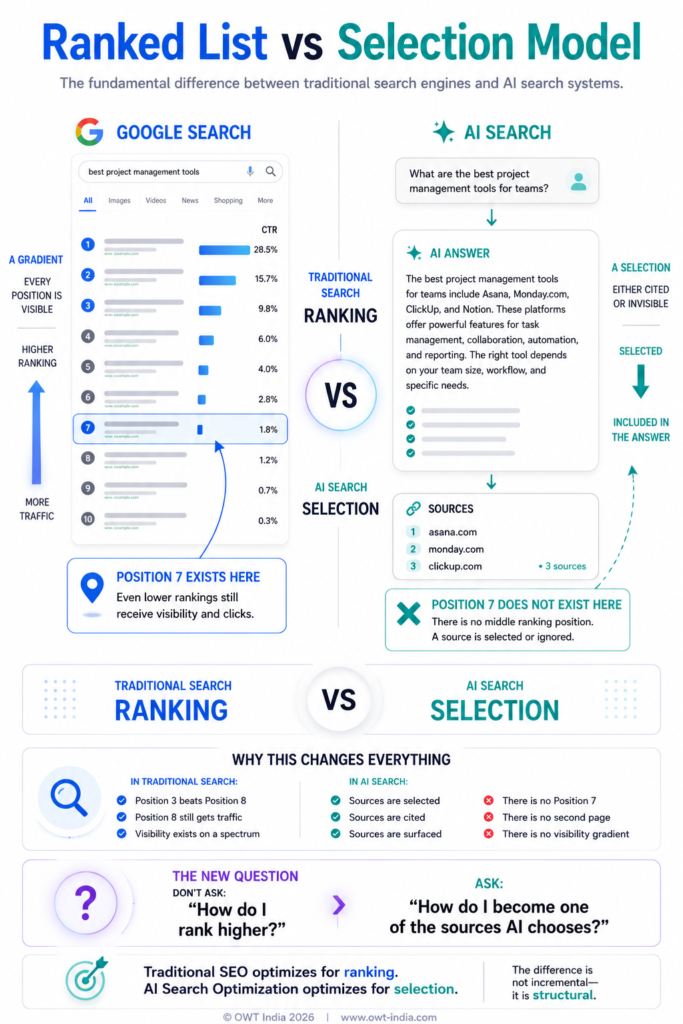
The model was elegant and clear: search returns a list, users see the list, users choose from the list. Your goal is to be as high on the list as possible. The higher you are, the more people choose you. The entire discipline of SEO was built to serve this one objective — move up the list.
Why did this mental model become so deeply embedded?
Because it was correct. For thirty years, it described reality accurately.
Every tool in the SEO practitioner’s arsenal reflects the ranked list model. Rank trackers monitor your position number. SERP analysis tools show what the list looks like for your target keywords. Click-through rate research tells you what percentage of searchers click each position. Content optimization tools help you write pages that rank higher. Link building services help you acquire the signals that push your position upward.
The mental model was not just assumed — it was institutionalized. Agency contracts specified ranking targets. Client reporting was organized around position numbers. Success was defined as moving from position seven to position three.
And then AI search arrived and began doing something the ranked list model has no category for.
What does AI search do differently that breaks the ranked list model?
It does not return a list.
When someone asks ChatGPT “Which are the best AI search optimization agencies in India?” — no list appears. The AI generates a direct answer. It names two or three businesses, describes their positioning, and offers a synthesized recommendation. The user reads the answer. They may never see a list at all.
When someone asks Perplexity “What is the best approach to schema markup for a small business website?” — the AI generates a comprehensive answer with specific, actionable steps. It cites sources. Those sources appear as small numbered references in the text. The user may follow one or two of those citations. Or they may simply read the answer and close the tab.
When someone searches Google and an AI Overview appears at the top of the results — the answer is already assembled before the user ever reaches the ten blue links below it. The AI has done the evaluation. The AI has done the selection. The list is still there, but the user already has an answer.
In all three cases, the ranked list model has no useful category for what happened. You cannot be in position seven of an AI-generated answer. There are no positions. There is only — was your business selected as a trusted source or was it not?
What Actually Happens When Someone Asks an AI a Question About Your Business
What is the process by which an AI constructs a generated answer?
Understanding this process is what allows you to stop guessing about AI search and start optimizing for it deliberately. The mechanics are not mysterious — they follow a logical sequence that, once understood, makes the optimization strategy obvious.
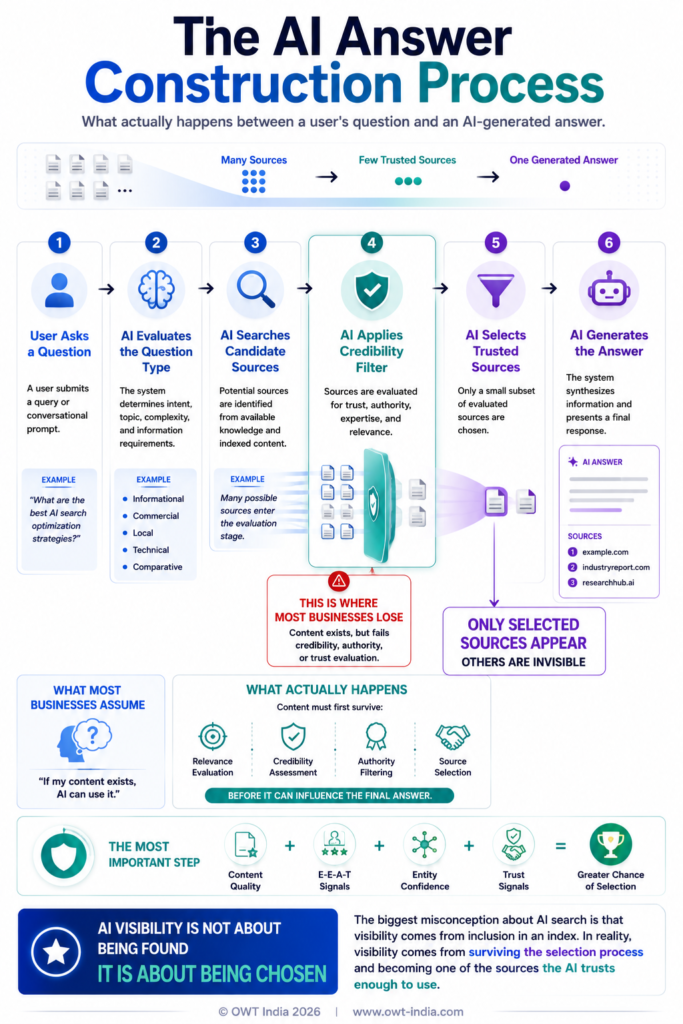
Step 1 — The user asks a natural language question. Not a keyword. A complete sentence, spoken or typed the way a person actually thinks. “What digital marketing agency should I hire for AI search in Jaipur?” This is fundamentally different from typing “digital marketing agency Jaipur” into a search box.
Step 2 — The AI evaluates the question type. Is this a factual query requiring a specific answer? A recommendation query requiring evaluation of options? A how-to query requiring procedural steps? The question type determines what kind of answer the AI will construct and what kind of sources it needs.
Step 3 — The AI searches for candidate sources. Depending on the platform and configuration, this draws from training data, from a real-time web search, or from both. The AI identifies a pool of candidate sources that are relevant to the query topic.
Step 4 — The AI applies a credibility filter. This is the step that determines everything. The AI evaluates each candidate source against its credibility assessment framework — checking entity recognition, content structural quality, topical authority signals, and external corroboration. Sources that meet the credibility threshold advance. Sources that do not are set aside — regardless of their content’s relevance or quality.
Step 5 — The AI selects the sources it will draw from. From the pool of sources that passed the credibility filter, the AI selects those most relevant to the specific query. These become the cited sources — the ones that appear as references in the generated answer.
Step 6 — The AI generates and presents the answer. The selected sources are synthesized into a direct, coherent response. The user sees the answer. They may or may not see the citations. They may or may not click through to any source.
Where in this process do most businesses lose their AI search visibility?
Step 4. The credibility filter.
Not because their content is bad. Not because their website is slow. Not because they have not done their SEO homework. They lose at the credibility filter because the signals AI systems use to evaluate credibility are different from the signals that drive Google rankings — and most businesses have only invested in the latter.
A business with excellent Google rankings, a well-optimized website, and strong backlink authority can still fail the AI credibility filter if it lacks named author attribution, if its Organization schema is absent or incomplete, if its content is written to rank rather than to be extracted, or if it has no verifiable external citations corroborating its expertise.
The business fails the credibility filter. It is set aside. The user never encounters it. And the rank tracker still shows position four.
What does it mean to be cited versus not cited?
Being cited means your content passed the credibility filter, was selected as a trusted source, and was incorporated into the synthesized answer. On Perplexity, your URL appears as a numbered citation in the response. On Google AI Overviews, your page appears in the source panel below the answer. On ChatGPT with web browsing, your content is referenced in the response body. On Bing Copilot, your page appears in the inline citation and source panel.
Being cited generates brand impressions without requiring a click. Users who read AI-generated answers containing your brand name develop brand familiarity even if they never visit your website. That familiarity compounds over time into higher direct traffic, higher branded search volume, and higher conversion rates from every channel.
Not being cited means none of that happens. Not a reduced version of it. None of it. The user asking the question about your service category will receive an answer that names your competitors and not you. They will contact the businesses the AI named. They will not contact you — not because they rejected you, but because they never encountered you.
That is what “not cited” means. It is not position seven. It is absence.
Cited or Invisible — Understanding the Binary Reality of AI Search Visibility
Why is “binary” the right word for AI search visibility?
In traditional search, visibility exists on a spectrum. Position one delivers maximum visibility. Position seven delivers moderate visibility. Position twenty delivers minimal visibility. Position one hundred delivers near-zero visibility. But every position is some visibility — a number greater than zero. The spectrum is continuous.
AI search does not work on a spectrum. It works on a threshold. Below the credibility threshold: zero visibility, regardless of how close to the threshold you are or how good your content is. Above the credibility threshold: some visibility, with prominence within citations varying based on relevance and authority.
The threshold is binary. You cross it or you do not. Zero or some. Invisible or cited.
This is why the word “binary” is correct — and why it matters for strategy. On a spectrum, incremental improvement always produces incremental gains. On a threshold, incremental improvement produces no visible result until the threshold is crossed — and then produces a step-change improvement.
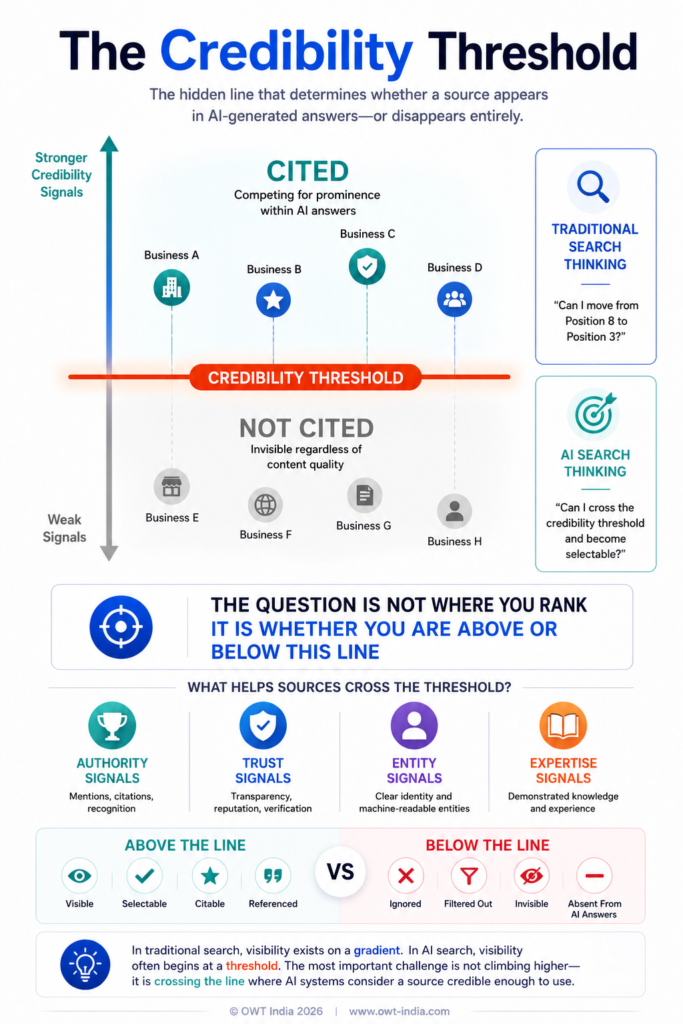
What is the credibility threshold made of?
The threshold is not a score. It is not a number you can look up. It is a combination of signals across five dimensions — and weakness in any one dimension can prevent a business from crossing it regardless of strength in the others.
Entity clarity — AI systems need to be able to verify who you are. Not just read your homepage, but cross-reference what your homepage says against what your Google Business Profile says, what your LinkedIn says, what industry directories say, and what Wikidata records if one exists. Inconsistency between these sources creates entity uncertainty. Entity uncertainty suppresses the AI’s confidence in citing you.
Content extractability — AI systems need to be able to identify a clean, self-contained answer to the query within your page. Content that buries its conclusions, requires linear reading, or mixes multiple topics in a single undifferentiated section is harder to extract from. Content structured around direct questions with immediate, self-contained answers in the first sentences of each section is significantly more extractable.
Topical authority — AI systems need to associate your domain with genuine expertise on the specific topic being queried. One article on a topic does not establish topical authority. A structured library of interconnected, deep content on a topic cluster does. The system is asking: has this domain demonstrated sustained, comprehensive knowledge of this subject? Or has it written one post that happens to be relevant?
Structured data — AI systems prefer explicit declarations to inferences. Schema markup removes ambiguity by providing machine-readable declarations about your business type, your content type, your author credentials, and your entity relationships. Without schema, the AI infers. Inferences carry uncertainty. Uncertainty suppresses citation confidence.
External credibility — AI systems cross-reference your claimed expertise against what third parties say about you. Press mentions, industry directory listings, guest articles under your byline, citations of your content by other sources — these are the external corroboration signals that convert self-declaration into verified credibility.
A business strong on all five dimensions is above the threshold. A business with one critical weakness in any of the five may be below it — regardless of how strong the other four are.
What is the false comfort of traditional search rankings?
The false comfort is this: you check your rankings, see position four, and conclude that your search visibility is good. Meanwhile, AI search is invisible in that report — and for an increasing proportion of queries in your category, AI Overviews are appearing at the top of the Google results page, absorbing the search intent before any user reaches the ten blue links below.
Position four in a query with an AI Overview may be delivering a fraction of the traffic it delivered before the Overview appeared. The rank has not changed. The visibility has. The rank tracker cannot see the difference.
This is the specific trap that many well-optimized businesses are in right now. Their traditional metrics look healthy. Their AI search metrics — if they are even measuring them — tell a different story. The ranked list mental model is producing false confidence at the exact moment when the shift to AI search is accelerating.
Why Position 7 Is Real in Google — and Does Not Exist in AI Search
What makes position 7 meaningful in Google?
Position seven in Google has a measurable, consistent click-through rate. Research consistently shows approximately two to three percent of searchers click the seventh organic result. That is not high — position one captures roughly twenty-eight percent, position three captures roughly ten percent — but it is meaningful. It is real traffic. It is a real number.
More importantly, the relationship between position and traffic is predictable and improvable. Moving from position seven to position four roughly doubles click-through rate. Moving from position seven to position one roughly multiplies it by ten. The gradient is clear. The reward for improvement is clear. The investment in optimization has a clear expected return.
This is why position seven is a useful strategic concept in traditional SEO. It tells you where you are. It tells you what the gap to the top looks like. It tells you approximately what improvement in traffic to expect from moving upward. It is the foundation of every SEO roadmap built around keyword ranking targets.
Why does position seven not exist in AI search?
Because there is no list.
An AI-generated answer is not a ranked list with a slot for every business that did well enough to appear but not well enough to appear first. It is a synthesized response built from a small number of selected sources — typically two to five — presented as a coherent, direct answer.
If you were not selected, you are not in position seven of that answer. You are not in it at all. There is no seventh slot. There is a cited section and an absence. You are in one or the other.
This is not a semantic distinction. It has concrete strategic implications. In the ranked list model, the goal is continuous upward movement — every improvement in signals produces some improvement in position produces some improvement in visibility. In the AI search model, the goal is threshold crossing — signals must accumulate until the threshold is cleared, at which point visibility changes from zero to some. Incremental signal improvements below the threshold produce no visible change in AI citation rates — and then produce a meaningful change when the threshold is finally crossed.
What is the click-through rate displacement effect?
When an AI Overview appears for a query that used to drive traffic to position seven, something specific happens to that traffic.
The AI Overview appears above the fold, often taking up significant screen real estate. It provides a direct answer. Many users read the answer and do not scroll down to the ten blue links below. Those users — the ones who were going to click position seven — never reach it.
Position seven does not disappear from the SERP. The rank tracker still shows it. But the users who used to click it are being absorbed by the AI Overview above it. The position is the same. The traffic is different.
This effect is not hypothetical. It is measurable in Google Search Console — the pattern appears as impressions remaining stable while click-through rate falls for affected queries. The rank is unchanged. The visibility is reduced. The rank tracker says nothing has changed. The AI Overview has changed everything.
The businesses not in the AI Overview are invisible to the users who read it. The businesses that are in it — the sources cited — receive the equivalent of prime visibility for those users. Not position one of a ranked list. Something more like the only result that matters for users who take their answer from the AI response and do not scroll further.
The Five Reasons Strong SEO Does Not Automatically Transfer to AI Search
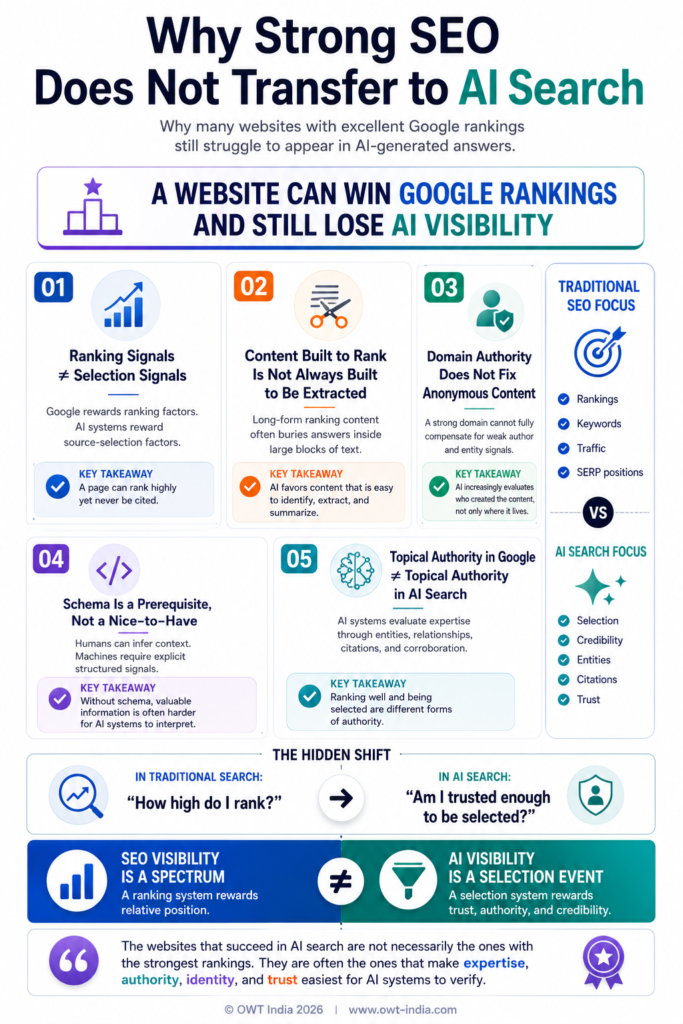
The businesses most surprised by AI search invisibility are often those with the strongest traditional SEO. Their rankings are strong. Their traffic is healthy. Their technical foundation is solid. And they are completely absent from AI-generated answers in their category.
This happens for five specific, structural reasons.
Reason 1 — Ranking signals and selection signals are different sets
Traditional SEO ranking signals are well-documented: keyword relevance, backlink authority, page speed, Core Web Vitals, mobile usability, structured data for rich results, click-through rate signals. Search professionals have spent thirty years learning to optimize for these signals. They are real, they are measurable, and they work.
AI search selection signals are a different set: entity clarity, content extractability, topical authority, structured data as machine-readable declarations, and external credibility corroboration. Some overlap with ranking signals exists — domain authority built through quality backlinks contributes to both. But the divergence is significant.
A page that is technically perfect from an SEO perspective — fast, mobile-friendly, keyword-optimized, well-linked — can still fail AI selection if it lacks named author attribution, if its Organization schema is absent or misconfigured, if its content structure buries rather than leads with answers, or if the business has no verifiable external citations. The ranking signals are all present. The selection signals are missing. The page ranks well. The page is not cited.
Reason 2 — Content optimized to rank is often not optimized for extraction
Content written to rank well for a keyword has a specific structural logic: it covers the topic comprehensively, establishes topical authority through breadth of coverage, and earns backlinks through the quality and depth of its treatment. This is legitimate, effective content strategy for traditional SEO.
It is often the wrong structure for AI extraction.
AI systems extract from the beginning of sections — evaluating the first 80 to 120 words of each section with disproportionate weight. Content written to rank often builds toward its conclusions: it establishes context, presents evidence, addresses counterarguments, and arrives at its answer in the final sentences of each section. This structure is excellent for human readers approaching content linearly. It is poor for AI extraction, which needs the answer immediately — in the opening sentence — not after the build-up.
The same piece of content that earns a featured snippet (which has a similar first-sentence-priority extraction logic) tends to perform well in AI search. Content that ranks well without earning featured snippets often does not. This correlation is not coincidental — it reflects the structural alignment between featured snippet optimization and AI extraction optimization.
Reason 3 — Domain authority does not compensate for anonymous content
Strong domain authority is a valuable signal for both traditional SEO and AI search. A domain with a strong backlink profile, a long history of quality content, and high topical authority starts from an advantaged position in both ranking and selection.
But domain authority is a domain-level signal. AI selection operates at the intersection of domain-level and content-level signals. When content is anonymous — published without a named author, attributed to a generic team name, or carrying no byline at all — the content-level credibility evaluation has a critical gap: AI systems cannot verify the expertise of the person who wrote it.
A high-authority domain publishing anonymous content is a partially credible source. A high-authority domain publishing content attributed to a named, credentialed, externally verifiable author is a fully credible source. The domain authority is the same. The AI selection rate is different.
This is why adding named author attribution to existing content — connecting every byline to a complete, externally linked author profile page — is one of the highest-impact changes most established businesses can make immediately. The domain authority is already there. The author credibility layer was missing.
Reason 4 — Schema markup is a prerequisite for AI trust, not an enhancement
In traditional SEO, schema markup helps with rich results — star ratings in search results, FAQ dropdowns, event listings, product price display — but is not considered a direct ranking factor. Businesses that skip schema markup generally still rank if their other signals are strong.
In AI search, schema markup serves a different and more fundamental function. It converts inference into declaration. Without schema, AI systems must infer everything about your page — your business type, your content topic, your author’s credentials, your organizational affiliation, your review rating. Those inferences introduce uncertainty. Uncertainty suppresses selection confidence. The AI is less likely to cite a source it has had to guess about than one that has told it directly.
With Organization schema, the AI does not guess your business identity — you have declared it. With Person schema and named author attribution, the AI does not guess your author’s credentials — you have declared them. With FAQPage schema, the AI does not guess which sections of your page are question-and-answer format — you have declared it. Each declaration removes a layer of inference. Each removed layer of inference increases selection confidence.
For businesses with strong SEO but no schema: the SEO foundation is valuable. The schema layer is not optional for AI search. It is the layer that translates SEO authority into AI selection eligibility.
Reason 5 — Topical authority in Google and AI search are measured differently
Google measures topical authority through a combination of backlink patterns (do credible sites in your space link to you?), content coverage (do you have content on the related topics?), and on-page signals (does your content cover the topic comprehensively?).
AI systems measure topical authority differently — through the depth and interconnection of your published content specifically. The question they are asking is: does this domain answer every important question on this topic, at sufficient depth, with sufficient structural clarity that I can extract clean answers from any section?
A domain with strong Google topical authority for “digital marketing” may have weak AI topical authority for “AI search optimization” if its content on that specific topic is shallow, lacks structured FAQ sections, has no HowTo content on implementation steps, or is fragmented across posts that do not link to each other coherently.
The pillar-cluster content architecture — a comprehensive pillar post linked bidirectionally to deep cluster posts on every related topic — is the content structure that builds AI topical authority most directly. It is not the only structure traditional SEO uses, and it is not the structure most ranking-focused content strategies naturally produce.
What AI Systems Are Actually Looking For When They Select Sources
How do selection signals work together?
If ranking was about accumulating signals that moved you up a list, selection is about crossing a threshold that moves you from invisible to cited. The five selection signals — entity clarity, content extractability, topical authority, structured data, and external credibility — are not independent. They interact, they compound, and they are limited by the weakest among them.
Think of it as a chain. A chain is as strong as its weakest link. A business with excellent content structure, strong topical authority, and comprehensive schema — but no verified external citations — has a weak link in the external credibility dimension that suppresses its overall selection rate. Strengthening the already-strong dimensions does not compensate. Strengthening the weak link does.
This is the opposite of how ranking optimization typically works. In traditional SEO, strengthening your best signals — getting more backlinks if your link profile is already strong, adding more content if your content is already deep — continues to produce ranking improvements. In AI selection, strengthening already-strong signals while ignoring weak ones produces minimal improvement. The weak link limits the chain regardless.
What does crossing the threshold actually feel like in practice?
It does not feel gradual. That is the most important thing to understand about the threshold model.
When you are building signals below the threshold, your manual AI citation checks show consistent absence. You run your priority queries in ChatGPT and Perplexity every week. Your business does not appear. You implement schema. You add author attribution. You restructure your content. You still do not appear. Nothing appears to be working.
And then something changes. Not gradually — the threshold is crossed and citation patterns shift. Queries that returned no citation of your business begin returning citations. The shift can happen over days rather than months once the accumulated signals cross the threshold.
This is why the feedback loop for AI search optimization feels different from traditional SEO. Traditional SEO produces visible incremental progress — rankings move by one or two positions after a link building campaign, traffic ticks upward. AI search optimization produces no visible progress during the threshold-building phase and then a meaningful visible change when the threshold is crossed.
Understanding this prevents abandonment. Most businesses that start AI search optimization and do not see results within six weeks conclude that it does not work. They stop. What they were actually doing was building signal below the threshold — and the threshold was close. Stopping is the mistake.
How to Shift Your Strategy from Ranking Thinking to Selection Thinking
What does the strategy shift actually look like in practice?
The shift is not about abandoning traditional SEO. It is about adding a parallel strategy layer that addresses the selection signals traditional SEO does not build.
The clearest way to understand the shift is through four specific contrasts.
The visibility question changes. Old question: “Where do we rank for our target keywords?” New question: “Are we cited in the AI-generated answers for the queries our customers are asking?” These are different questions. They require different tools to answer. They point to different tactics to improve. A business that only asks the old question will have an incomplete picture of its search visibility — and an incomplete strategy for improving it.
The content structure goal changes. Old goal: write content that covers a topic comprehensively and earns backlinks through its quality and depth. New goal: write content that covers a topic comprehensively AND structures every section so that the direct answer appears in the opening sentence, so that every section is self-contained, and so that FAQ sections are present throughout with natural-language question headings. The content quality requirement is the same. The structural requirement is different.
The authority building approach changes. Old approach: acquire backlinks from high-authority domains to improve ranking signal. New approach: acquire external citations from credible sources to build the corroboration signal AI systems cross-reference. These overlap — an editorial backlink from a recognized publication serves both purposes. They diverge — a link from a low-quality directory contributes to ranking signals without contributing to AI credibility signals. A named expert quote in Search Engine Journal contributes to AI credibility signals with or without a link.
The technical priority set expands. Old technical priorities: page speed, Core Web Vitals, crawlability, mobile optimization. New priorities: all of the above, plus Organization schema with sameAs links, Person schema with knowsAbout and worksFor, Article and BlogPosting schema on all content pages, FAQPage schema on all FAQ-containing sections, HowTo schema on all step-by-step content, and ImageObject schema with creditText on featured images. The existing technical priorities remain necessary. The schema layer is additive.
What does running both strategies in parallel look like?
It looks like a two-track strategy that shares some tactics and diverges on others.
Shared tactics: producing genuinely high-quality content, building credible editorial backlinks, maintaining a technically sound website, publishing consistently on primary topic areas.
Traditional SEO-specific tactics: keyword research and position targeting, page-level optimization for specific ranking signals, link quantity building through scaled outreach, structured data for rich result types.
AI search-specific tactics: entity foundation building (GBP, About page, NAP consistency, Organization schema), named author attribution on all content, author profile pages with credentials and external links, content restructuring for answer-first extraction, FAQPage and HowTo schema implementation, share-of-AI-voice tracking, manual citation monitoring.
The investment split between the two tracks depends on where your current gaps are and where your target audience is in the AI search adoption curve. For B2B professional services, the urgency of AI search investment is high right now. For straightforward e-commerce transactional queries, the urgency is lower — but growing.
Where the Shift from Ranking to Selection Is Most Urgent
Which businesses are most affected by AI search’s binary visibility model right now?
The businesses where AI search is changing the competitive landscape fastest are those where buyers use AI assistants to research, shortlist, and validate vendors before making any contact. That research behavior is most advanced in B2B professional services and high-consideration B2C categories.
B2B professional services — digital marketing agencies, management consultants, legal firms, accounting practices, technology service providers. Decision-makers at these businesses are already using ChatGPT and Perplexity to research vendors before reaching out. The research pattern: ask the AI to recommend providers in a specific category, read the response, contact two or three of the businesses named. If your business is not named — if you are below the AI search credibility threshold — you are not in consideration. You are not not-chosen. You are simply not encountered.
Healthcare and medical services — patients and caregivers use AI assistants to research providers, understand treatment options, and validate choices before appointments. The YMYL standard applies here with full force. AI systems apply the strictest credibility evaluation to health content. Only sources with strong E-E-A-T signals across all four dimensions consistently appear in health-related AI answers.
Legal services — prospective clients research legal issues and potential attorneys via AI assistants. The research behavior: describe the legal situation, ask the AI which type of attorney to consult, sometimes ask which firms specialize in the relevant area. Firms below the AI search credibility threshold are absent from this research process entirely.
Educational and training services — prospective students ask AI assistants to recommend courses, certifications, and training programs. The AI’s answer shapes the shortlist. Providers not in the answer are not shortlisted.
Local service businesses — the AI local search opportunity is often underestimated. “Best digital marketing agency in Jaipur” typed into ChatGPT or appearing in a Google AI Overview represents a business that the AI has included in a local recommendation. The local AI search threshold is typically lower than the national or global threshold — because the competition is less intense and the specificity requirements are more achievable. This is the highest-opportunity area for businesses currently below the threshold: local AI search visibility is achievable with focused effort over weeks rather than months.
Where is the urgency lower — for now?
Transactional queries — “buy online,” ” price comparison,” “order [service] near me” — still produce traditional search results more reliably than AI answers for most categories. Users with clear purchasing intent and a specific product in mind often bypass AI answers and go directly to search or directly to a known retailer. The AI search threshold is less critical for these queries right now.
“For now” is the operative phrase. The AI search share of total query volume is growing quarterly. The categories where AI answers currently appear are expanding. Businesses in lower-urgency categories today should be building their AI search foundation now so that when the shift reaches their category more fully, they are already above the threshold.
Why the Businesses That Cross the AI Threshold Now Are Building an Advantage That Compounds
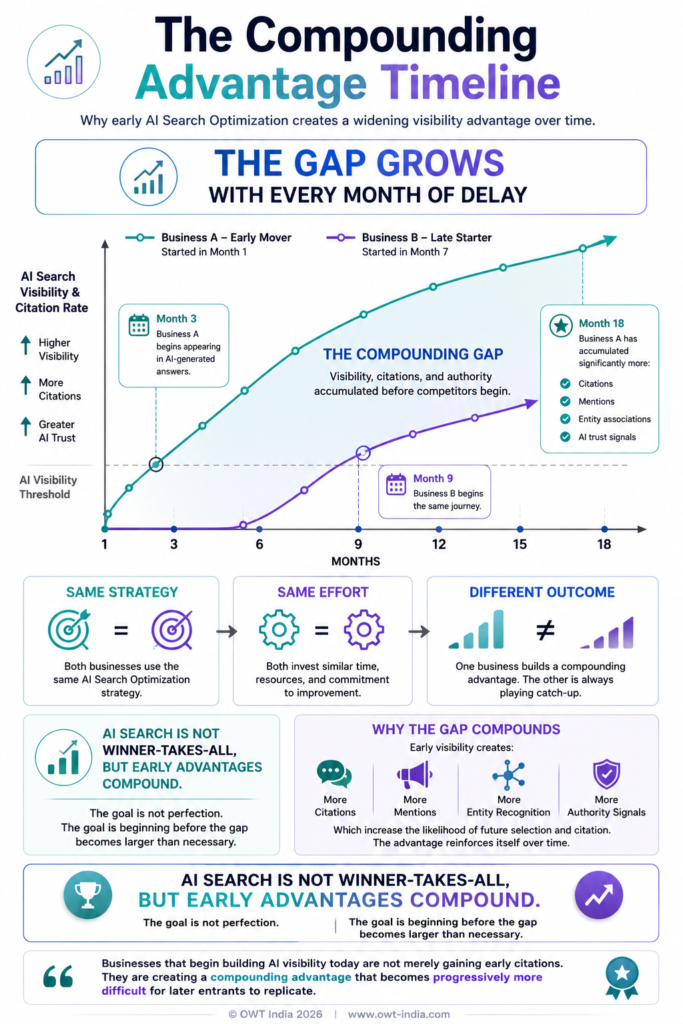
Why does AI search advantage compound in a way that traditional SEO advantage does not?
Traditional SEO advantage is real but erosible. A competitor who outinvests you in link building over eighteen months can close the ranking gap. The signals that drive rankings are continuously updated — new links, new content, new technical improvements — and the algorithm responds to those updates in near-real-time. The advantage of being in position one today does not permanently protect you from a competitor who reaches position one tomorrow.
AI search advantage has a compounding dimension that traditional SEO does not.
Citation history — AI systems that have consistently cited your content for specific topics develop a pattern of selection for those topics. This pattern is not a formal ranking signal, but it functions as a preference: a source that has been reliably useful for a topic is more likely to be selected again than a new source with equivalent signals. The business cited fifty times for “AI search optimization in Jaipur” has a selection advantage over a business cited zero times for the same query, even if their current signals are equal.
Brand familiarity without clicks — AI search creates brand impressions that traditional search does not. When a user reads an AI-generated answer that mentions your business by name — even without clicking through to your website — they register your brand. Over time, this AI-generated brand familiarity translates to higher direct traffic, higher branded search volume, and higher conversion rates from all channels. A business cited regularly in AI answers for six months has a brand familiarity that a business that just crossed the threshold cannot have — regardless of how strong the new entrant’s signals are.
Authority signals that compound — Each external citation makes the next external citation more likely. Each guest article makes the next one easier to place. Each press mention makes the next journalist more likely to seek you out. The authority signals that AI systems use for credibility evaluation compound — they build on each other in a way that makes the total much larger than the sum of its parts over time.
What is the cost of waiting?
Every month of AI search invisibility is a month of zero AI-generated brand impressions, zero citation history accumulation, and zero compounding authority building. That is the direct cost.
The indirect cost is the growing difficulty of closing the gap to competitors who started earlier. A business that begins AI search optimization today faces a different competitive landscape than the same business would have faced twelve months ago — and faces a less favorable landscape than it would if it started immediately. The gap grows with every month of delay. Not catastrophically — it is always closable. But always more slowly and expensively than it would have been if started earlier.
The competitive landscape in AI search is not yet locked. Most businesses in most categories have not yet crossed the credibility threshold. The window for building a meaningful first-mover advantage is still open. It is narrowing.
The Transition Roadmap — From Ranked List Thinking to Selection Thinking
The strategy shift described in this post is not a single project. It is a change in how you think about search visibility — and that change produces specific, concrete operational differences that play out over months.
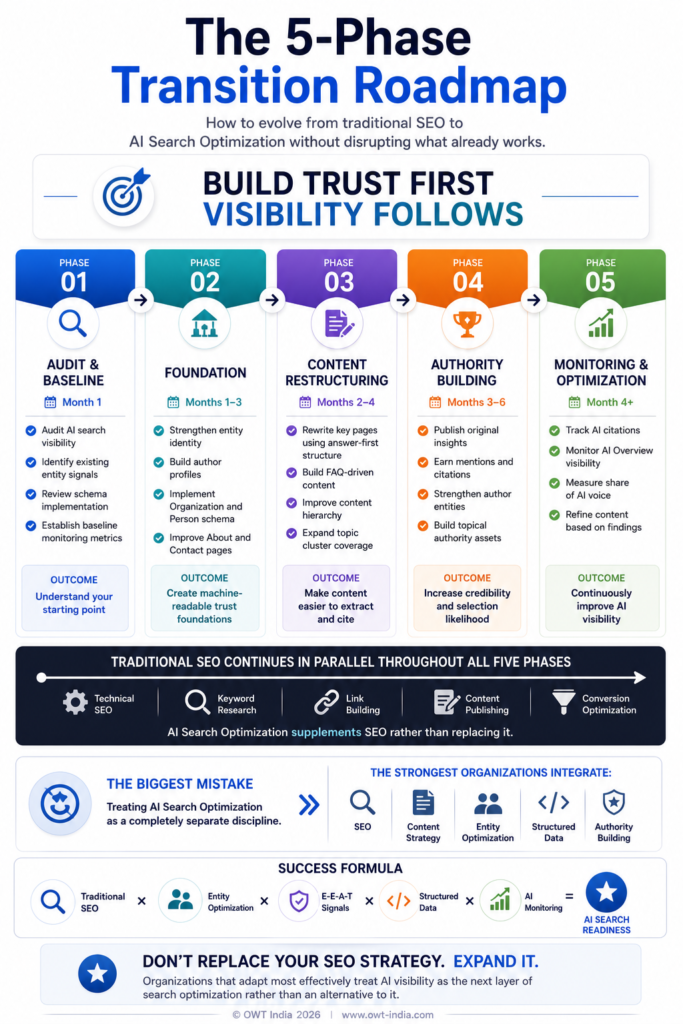
Phase 1 — Audit and baseline (Month 1)
Stop asking only “where do we rank?” and start asking “are we cited?” alongside it.
Run the AI visibility test for your ten most important queries across ChatGPT, Perplexity, Google AI Overviews, and Bing Copilot. Document the results in a spreadsheet. This is your AI search baseline — the starting point against which every subsequent month’s results will be measured. Without it, you cannot know whether your optimization is working.
Use the results to identify your most critical credibility gap across the five selection signal dimensions. Entity, content structure, topical authority, schema, external credibility — one of these will be weaker than the others. That weak link is your first priority.
Add AI Overview impressions and citations to your reporting dashboard alongside traditional rank tracking. Both sets of data matter. Neither is sufficient alone.
Phase 2 — Foundation (Months 1 to 3)
Build the entity and schema infrastructure that translates your existing authority into AI-readable credibility.
Complete your Google Business Profile — every field, maximum specificity. Rewrite your About page with verifiable facts rather than marketing copy. Run a NAP consistency audit across your top twenty citation sources and fix every inconsistency. Implement Organization schema with sameAs links to all verified external profiles. Implement Person schema on every author profile page with @id, worksFor, sameAs, and knowsAbout populated. Add named author attribution to every published piece of content that currently lacks it.
This phase does not require new content. It requires making the credibility you already have machine-readable — explicit rather than inferred.
Phase 3 — Content restructuring (Months 2 to 4)
Restructure your existing best-performing content for AI extraction without rebuilding it from scratch.
Audit your top twenty pages for answer-first structure. For each section, check whether the direct answer to the section’s implied question appears in the first sentence. If it does not, rewrite the section opening — move the conclusion to the front, let the evidence and context follow. Add FAQ sections to key pages where they are natural and relevant. Implement FAQPage schema on every page with FAQ content and HowTo schema on every step-by-step guide.
Begin producing new content using the answer-first structure from the start — so that everything published from this point forward is AI-extraction-ready by default.
Phase 4 — Authority building (Months 3 to 6 and ongoing)
Build the external credibility signals that convert good content from a self-declared source into a corroborated one.
Identify the publications most credible to your target audience and pitch guest articles with specific, relevant angles. Develop one piece of original research — even modest in scale — that produces data no other source has. Pursue at least two podcast appearances with shows that publish detailed show notes. Set up Google Alerts for your business name and your founders’ names and monitor for unlinked citations to convert.
This phase takes the longest and the results are least immediately visible. It is also the most defensible advantage — external authority signals are the hardest for competitors to replicate quickly.
Phase 5 — Monitoring and optimization (Month 4 onwards)
Establish the monitoring system that tells you whether your optimization is working and where to focus next.
Run weekly manual citation checks across all four platforms for your ten to fifteen priority queries. Pull Search Console AI Overview data monthly. Calculate your share of AI voice quarterly across your twenty to thirty priority queries. Record everything in a structured spreadsheet. Look for patterns: the queries where you have appeared for the first time, the queries where competitors have appeared where they previously had not, the queries where your citation description has changed.
The monitoring system is what transforms AI search optimization from a set of one-time implementation tasks into a continuously improving strategic program.
Frequently Asked Questions
Does AI search completely replace traditional Google search rankings?
No — not yet, and possibly not entirely. What is happening is that AI search is creating a parallel visibility layer alongside traditional search rather than replacing it. For many queries — particularly informational and recommendation queries — AI Overviews and AI assistants are increasingly the primary answer source, with traditional results playing a secondary role. For transactional queries with strong commercial intent, traditional search results remain the dominant format. Businesses need to optimize for both. The SEO foundation remains necessary. The AI search layer is additive — not a replacement.
How do I know if my business is being affected by AI search visibility loss right now?
Two diagnostic checks. First, run your most important informational and recommendation queries in ChatGPT and Perplexity — the queries where your ideal customer is asking for advice or recommendations in your category. If your business is absent from the answers and competitors are present, you are being affected. Second, check your Google Search Console for queries where impressions have remained stable but click-through rate has fallen over the past six months. That pattern — stable impressions, falling CTR — is the signature of AI Overview displacement. Both diagnostics together give you a clear picture of your current exposure.
If I rank first in Google for a query, does that guarantee I appear in Google AI Overviews for the same query?
No. Being in position one for a query does not guarantee inclusion in the AI Overview for that same query. Google’s AI Overview selection process evaluates source credibility and content extractability independently from the ranking algorithm. A page ranked first can be absent from the AI Overview if its content is not structured for extraction or if its E-E-A-T signals are insufficient for AI Overview standards. Conversely, a page in position four or five can appear in the AI Overview if it has superior content structure and stronger credibility signals for that specific query. Ranking and AI Overview inclusion are correlated but not identical.
How is AI search’s binary model different from featured snippets, which also produced a winner-takes-all effect?
Featured snippets were winner-takes-all in a specific way: one page occupied the featured snippet position for a given query, while all other pages appeared in the standard ranked list below. The difference is that in the featured snippet era, position two still existed. If you were not in the featured snippet, you were in position two. You still captured some traffic. The traditional gradient remained below the featured snippet. In AI search, the positions below the AI Overview are experiencing growing click-through rate pressure as users consume the AI answer and do not scroll further. The traffic below the threshold is not zero, but it is compressing. The binary effect of AI search is more profound than featured snippets precisely because it affects the entire user journey, not just the top slot.
Can a business be cited in AI search without ranking in traditional Google search?
Yes — this happens, particularly for very specific niche queries where content depth and entity clarity are stronger signals than traditional ranking factors. A business with strong schema, deep topical content, and verified entity signals can be selected for AI citation before it achieves strong traditional rankings. However, the correlation between traditional authority signals and AI citation rate is real and significant — the signals overlap enough that building for AI search tends to improve traditional rankings simultaneously, and vice versa. The most effective strategy builds both in parallel rather than treating them as alternatives.
How long does it take to cross the AI search credibility threshold?
The honest answer depends on your starting point. Businesses with strong existing domain authority, clear entity signals, and good content quality can cross the threshold within four to eight weeks of implementing schema and author attribution. Businesses starting with weak entity signals, no schema, anonymous content, and no external citations are typically looking at three to six months of consistent work before citation patterns change meaningfully. The threshold-building phase feels slow because there is no visible progress until it is crossed — and then there is a step-change. The discipline to continue building signals through the invisible phase is what separates businesses that achieve AI search visibility from those that give up just before the threshold would have been crossed.
Is AI search binary for all types of queries or only some?
The binary threshold applies most strongly to informational, recommendation, and advisory queries — the query types where AI assistants are designed to provide direct, synthesized answers. “What is the best schema markup type for a FAQ page?” “Which digital marketing agency should I hire in Jaipur?” “How should I structure my content for AI search?” — these are queries where the binary model applies in full. For navigational queries (“OWT India website”) and simple transactional queries (“buy running shoes size 9 online”), AI search behaves differently and the binary model is less applicable. The queries most critical for business discovery and consideration — the ones where buyers are forming their shortlists — are exactly the ones where the binary model applies most strongly.
What is the most common reason businesses fail to cross the threshold despite strong content?
Anonymous content. The most consistent pattern across businesses with strong content that is not being cited is the absence of named author attribution. AI systems evaluate content credibility at the intersection of domain signals and author signals. A business can have excellent domain signals — strong backlinks, long publishing history, good topical coverage — and still fail the author credibility evaluation because nothing on their website tells AI systems who wrote the content or what credentials that person has. Fixing this — adding named authors, building author profile pages, implementing Person schema — is often the single change that tips the threshold from not-yet-crossed to crossed.
Should businesses stop optimizing for Google rankings and focus entirely on AI search?
No. Traditional SEO and AI search optimization are parallel strategies that share a foundation. The domain authority built through quality content and editorial backlinks contributes to both ranking and AI selection. The technical foundation — crawlability, page speed, mobile optimization — matters for both. The content quality investment benefits both. What changes is the addition of AI-specific tactics: schema infrastructure, author attribution, answer-first content structure, share-of-AI-voice monitoring. These are added to an existing SEO strategy, not substituted for it. Abandoning traditional SEO to focus exclusively on AI search would sacrifice organic traffic from non-AI-mediated queries — which remains substantial and will remain important for the foreseeable future.
How will AI search visibility change over the next twelve months?
In one direction: it will matter more, for more queries, in more categories. The proportion of queries where AI answers appear is growing. The proportion of users who take their answer from the AI response without clicking further is growing. The proportion of B2B and high-consideration buying decisions being influenced by AI research is growing. None of these trends is reversing. The question for businesses is not whether AI search will matter more than it does today — it will. The question is whether they will have crossed the credibility threshold by the time it matters maximally for their category, or whether they will be trying to cross a threshold that their competitors have already built an 18-month compounding advantage on top of.
The Game Has Not Changed — The Board Has
The goal of search visibility has not changed. Be found by potential customers when they are looking for what you offer. Be visible at the moment of decision. Be the business that appears in the answer when a buyer asks who they should contact.
That goal is unchanged. Thirty years ago it required ranking on AltaVista. Twenty-five years ago it required ranking on Google. Today it requires both ranking in traditional search and being selected in AI-generated answers.
What has changed is the board the game is played on. The ranked list is still there. But a new, different surface has appeared alongside it — one without positions, one without gradients, one without incrementalism. A surface where you are either cited or invisible. Where there is no position seven.
The businesses that understand this are building their digital presence differently. They are asking different questions. They are measuring different things. They are investing in different tactics — not instead of their existing SEO, but alongside it.
The businesses that do not understand this are optimizing with precision for a game that is increasingly being played on a different surface. Their rank trackers are working perfectly. Their AI search metrics are silent. And the gap between their position four and their AI search absence is invisible to them — until the moment it becomes unmissable.
There is no position seven in AI search. There is only cited and not yet cited. Every business in the second category has the opportunity to move to the first. The window for doing so before the competitive landscape consolidates is still open. But it is narrowing — measurably, month by month.
Want to know exactly where your business stands in AI search — and what it will take to cross the credibility threshold in your category? The OWT India AI Search Optimization Audit assesses your current position across all five selection signal dimensions and provides a prioritized action plan for crossing the threshold and building citation prominence. Request your audit at owt-india.com/contact or reach the team at info@owt-india.com.
Companion resources: From Invisibility to AI Citations: The Complete AI Search Optimization Guide — the 12-step implementation guide for crossing the AI search credibility threshold The 5-Minute AI Visibility Test — run this first to establish your baseline E-E-A-T for AI Search: The Complete Guide — understanding the credibility framework AI systems apply