From Invisibility to AI Citations: The Complete AI Search Optimization Guide for Business Websites
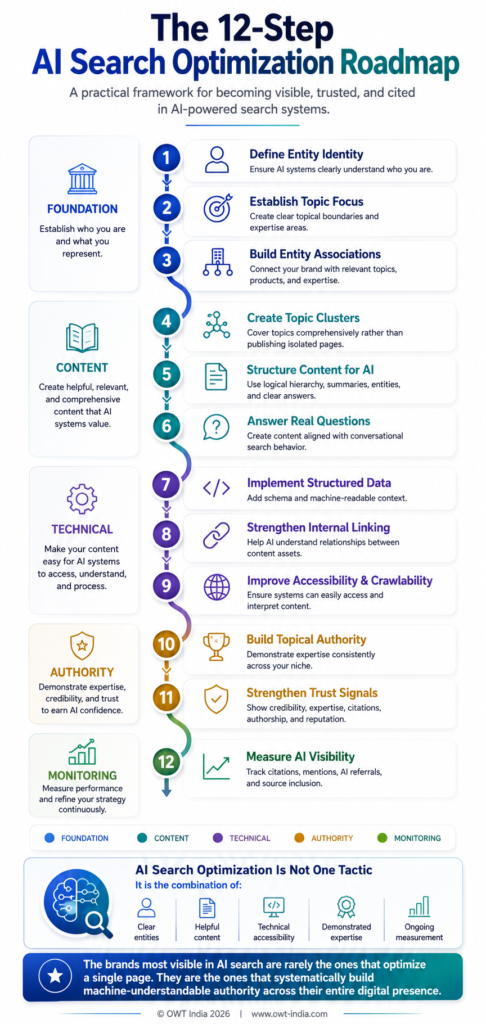
What this guide covers: Twelve implementation steps — in the exact order they should be completed — for taking a business website from invisible in AI search to consistently cited across ChatGPT, Perplexity, Google AI Overviews, and Bing Copilot. Every step builds on the last. Work through them in sequence.
Who this is for: Business owners managing their own web presence, marketing managers building an AI search strategy, SEO professionals adding AI optimization to their service offering, and agency teams implementing AI search for clients.
Read alongside: The 5-Minute AI Visibility Test — run this first to establish your baseline before starting Step 1.
There is a version of your website that AI assistants cite regularly. There is a version they ignore completely. The difference between the two is not the quality of your product or the strength of your brand — it is the presence or absence of specific, systematic signals that AI systems use to decide which sources to trust.
Those signals are buildable. They follow a logical sequence. And this guide walks through every one of them, in the order they should be implemented, from nothing to a website that AI search systems consistently select, cite, and recommend.
Twelve steps. Built in order. No shortcuts — because the shortcuts don’t hold.
How AI Search Actually Works — and Why It Requires a Different Approach
Before optimizing anything, you need a clear mental model of what you are optimizing for. Most businesses that struggle with AI search visibility are applying the wrong framework — they are trying to rank when they should be trying to be selected.
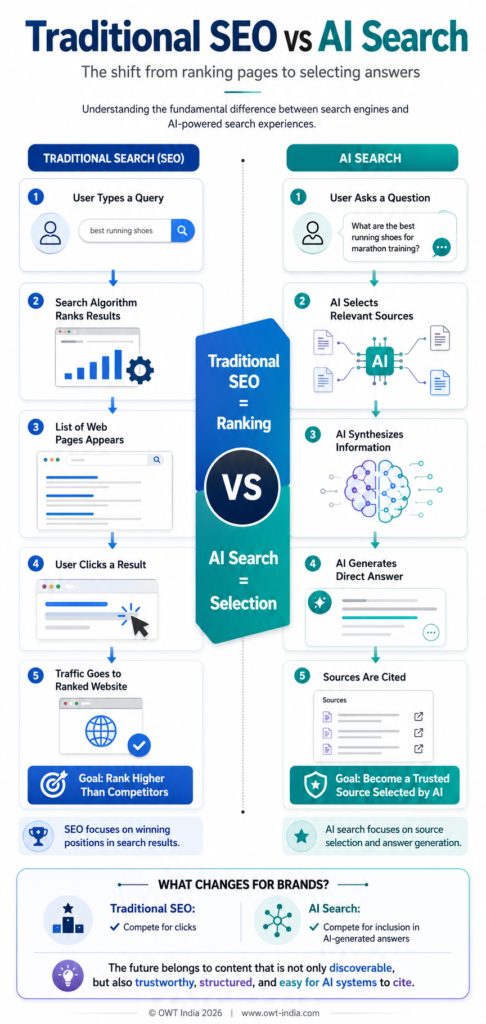
What is the difference between ranking and being selected by AI search?
In traditional Google search, the algorithm evaluates hundreds of signals and returns a ranked list of pages. The user sees the list and chooses which result to click. Your goal is to appear high enough on that list to earn the click. The entire discipline of SEO has been built around this model for thirty years.
AI search works differently at the fundamental level. When someone asks ChatGPT or Perplexity a question, the AI does not return a list of pages. It generates a direct answer. To generate that answer, it selects which sources it trusts enough to draw from, synthesizes their information, and presents a response — often without requiring the user to click anywhere. Your goal in AI search optimization is not to rank. It is to be one of the trusted sources the AI selects.
The selection criteria are different from ranking criteria. A website can rank first on Google for a query and still be completely absent from AI-generated answers about the same topic. That gap is the problem this guide solves.
What signals do AI systems use to select sources?
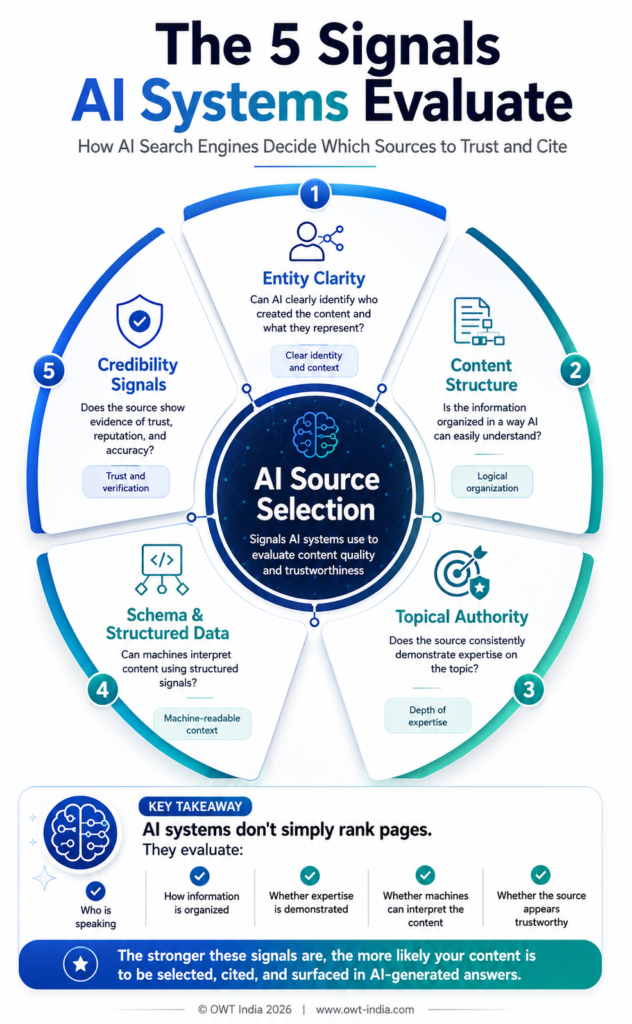
AI systems evaluate five primary signals when deciding whether to cite your content:
Entity clarity — Does the AI know who you are, and can it verify that identity through multiple corroborating sources? A business with a clear, consistent, well-documented presence across its website, Google Business Profile, LinkedIn, and industry directories is easier to verify than one with a sparse or inconsistent footprint.
Content structure — Can the AI extract a clean, direct, self-contained answer from your page? Content that buries its conclusions, requires linear reading to make sense, or mixes multiple topics in a single section is harder to extract from and less likely to be cited.
Topical authority — Does the AI associate your domain and your authors with genuine expertise on the specific subject being queried? A single well-written article on a topic rarely establishes this. A structured body of deep, interconnected content on a topic cluster does.
Schema and structured data — Have you given AI crawlers explicit, machine-readable declarations about your content? Schema markup removes ambiguity — instead of requiring AI to infer what your page is about, it tells AI systems directly. That certainty increases citation likelihood.
Credibility signals — Do third parties corroborate your expertise and identity? Press mentions, industry directory listings, external citations, and linked references from credible sources all function as votes of confidence that AI systems incorporate into their trust evaluation.
How are the major AI search platforms different from each other?
The four platforms that matter most in 2026 are ChatGPT by OpenAI, Perplexity, Google AI Overviews, and Bing Copilot. They differ in how they access information and how they select sources, but the underlying principles for being cited are consistent across all four.
ChatGPT draws from its training data and, with web browsing enabled, from real-time indexed content. It tends to favor sources with strong entity signals and well-structured content.
Perplexity is the most transparent about sourcing — it cites specific URLs in every response and actively searches the web for current content. Structured, recently updated content performs well here.
Google AI Overviews are embedded in Google Search results and draw heavily from Google’s existing index. E-E-A-T signals, schema markup, and content that has performed well in traditional Google search tend to translate most directly to AI Overview appearances.
Bing Copilot integrates with the Bing index and follows similar principles to Google for content quality and entity recognition.
Optimize for the principles that apply across all four — entity clarity, content structure, schema markup, topical authority — rather than for any single platform’s quirks. The principles converge.
Why does traditional SEO not automatically translate to AI search visibility?
Several things transfer: domain authority built through quality backlinks, content quality signals, and the indexation that comes from a well-maintained SEO foundation. These create a base that makes AI optimization faster and more effective.
What does not transfer automatically: content that is written well but structured for ranking rather than extraction, pages that have technical SEO in place but no schema markup, and authority signals that Google’s algorithm reads but AI systems cannot verify. The two disciplines overlap significantly but diverge in important ways. AI search optimization is not a replacement for traditional SEO — it is a layer that runs alongside it.
Step 1 — Run Your Baseline AI Visibility Test Before Touching Anything
The single most important thing you can do before starting any optimization work is to document exactly where you are right now. Every decision in the following eleven steps should be informed by your baseline results. Optimizing without a baseline is navigating without a map.
This step takes five minutes and costs nothing.
How do you run the baseline AI visibility test?
Open ChatGPT and Perplexity in separate browser tabs. Then run five specific queries — one at a time, documenting the results of each before moving to the next.
Query 1 — Business name recognition: Type “What do you know about [Your Business Name]?” in both ChatGPT and Perplexity. Note whether the AI recognizes your business, whether it describes your services accurately, and whether it cites your website or any of your published content. If it returns no information, or inaccurate information, your entity foundation is the first priority. This single result tells you more about your AI search starting point than any tool can.
Query 2 — Category query: Type the question your ideal customer would realistically ask when looking for a business like yours. For a digital marketing agency in Jaipur: “Which are the best digital marketing agencies in Jaipur?” or “Who should I hire for AI search optimization in India?” Run the same query in Perplexity, then in Google to check for an AI Overview panel. Does your business appear in any of these answers? Screenshot everything — AI answers change as new content is indexed, and you want a record of where you started.
Query 3 — Expertise topic queries: Think of two or three specific topics your business has published content about or has genuine expertise in. Search for them as natural questions: “How does schema markup help with AI search?” or “What is the difference between traditional SEO and AI search optimization?” Does your content, your website, or your name appear in the AI-generated response? If yes, note the context. If no, that topic is a content gap.
Query 4 — Local or sector-specific queries: If your business serves a specific geography or industry, test that dimension. “Best AI search optimization agency in Jaipur for small businesses” or “Who provides technical SEO for professional services firms in India?” Local and sector-specific queries are where many businesses have the greatest near-term opportunity, because the specificity of the answer required rewards structured, well-positioned content — and the competition to be cited is lower.
Query 5 — Competitor queries: Search for two or three competitors by name and by category. Note whether they appear, how they are described, and what topics they are associated with. If a competitor is consistently appearing in answers for queries you both compete on, their content, structure, or entity signals are doing something yours is not yet. That intelligence tells you specifically what to build toward.
How do you document and interpret your baseline results?
Create a simple spreadsheet with columns for: query, platform, result (appears / does not appear / inaccurate), context of appearance if relevant, and notes. Add a competitor tab with the same structure.
Four outcomes are possible, and each maps to a different first priority:
No recognition at all: AI tools return nothing, or generic filler, when you search your business name. Entity foundation is your entire focus for the first three weeks. Nothing else will work until the AI can verify who you are.
Named recognition but no category presence: AI knows your business exists but does not include you in recommendation queries. Topical authority and content structure are your gap. The entity signals are sufficient — the content signals need work.
Appears for some topics but not others: You have partial topical authority. The topics where you appear are your working model. The topics where you do not appear are your content roadmap. Fill them systematically.
Competitor appearing where you do not: Specific signal analysis is needed. Compare their cited content with yours for that specific query. The gap is usually in content depth, content structure, schema implementation, or the number of external sources referencing them on that topic.
Document your baseline and keep it. You will return to it at the end of each month to measure progress. Every improvement in AI citation rates maps back to a specific optimization made — and having the baseline lets you see exactly what is working.
Step 2 — Build Your Entity Foundation
Entity foundation is the most important step in this guide. Before any other optimization delivers consistent results, AI systems need to be able to identify, verify, and trust who you are. This step is the foundation everything else is built on. It should be completed before you optimize a single piece of content.
What is an entity and why does it matter for AI search?
An entity is a real-world thing that AI systems can recognize, verify, and reference — a business, a person, a location, a product. Your business is an entity. So are your founders, your key team members, your published books, your products, and your physical locations.
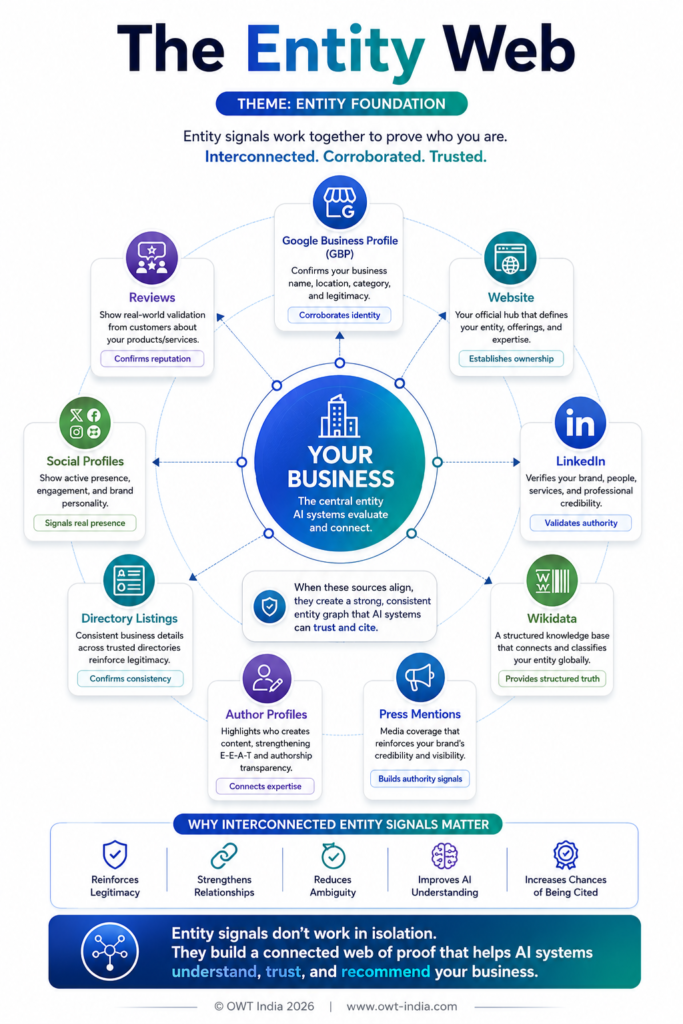
AI systems build knowledge about entities by cross-referencing information from multiple sources. When multiple credible sources describe your business consistently — your website, your Google Business Profile, your LinkedIn company page, industry directories, press mentions — the AI’s confidence in your entity increases. Higher entity confidence means higher citation likelihood for everything connected to that entity: your content, your services, your expertise, your people.
The inverse is also true. A business with sparse, inconsistent, or poorly structured entity signals is an entity the AI cannot verify with confidence. Unverifiable entities get cited less. The fix is systematic, not difficult, but it requires working through every element in the right sequence.
How do you establish your Organization entity?
Your Google Business Profile is the single most important external entity signal for a local or regional business. AI assistants actively draw from GBP data when constructing local and category-level answers. Complete every field: business name exactly as it appears on your website, primary category as the most specific applicable option, business description written for clarity and extraction rather than marketing appeal, all applicable services individually listed with descriptions, photos in every available category, questions and answers populated, hours accurate and updated for public holidays, and website URL linking to the correct page.
Your website’s About page is the primary machine-readable declaration of who you are. It should include your legal name, your trading name if different, your founding date, your founders and key team members by name, your physical address, the services you provide, the industries you serve, the geographic areas you cover, any credentials or certifications, and notable clients or projects where permissible. Write in clear, structured prose — not marketing copy. Every claim on this page should be verifiable by a third party looking for your business.
NAP consistency — your business name, address, and phone number — must be identical, character for character, across every platform where your business is listed: your website, your GBP, LinkedIn, Facebook, every industry directory, every citation source. Inconsistencies create conflicting entity signals. AI systems that encounter “OWT India” in one place and “Orca Web Technologies” in another without explicit connection between the two treat them as potentially different entities. Run a citation audit using Moz Local, BrightLocal, or a manual search of your top twenty citation sources. Fix every inconsistency before building further.
Social profiles — LinkedIn company page, Twitter/X, Facebook, Instagram — should be consistent with your GBP and website in name, description, and website URL. These become the sameAs links in your Organization schema, creating a web of corroborating identity signals.
The Knowledge Panel test is your progress check. Search your brand name in Google. If a Knowledge Panel appears on the right side of the results with your logo, description, and social links, your entity is recognized. If it does not exist, continue building the signals above — the Knowledge Panel is a consequence of sufficient entity clarity, not something you can request directly.
How do you establish author and Person entities?
The people who write your content are entities too, and their entity signals directly affect the trustworthiness of everything they publish. AI systems are significantly more likely to cite content from a named, verifiable author with a documented professional background than from anonymous content attributed to a generic “team.”
Every person who authors content on your website should have a dedicated profile page. That profile should include their full name and photo, their professional title and role within the organization, their credentials, qualifications, and relevant work history, links to their LinkedIn profile and any other professional profiles, a list of published articles or books if applicable, and contact information if appropriate. The profile page links to the Organization entity via the worksFor property in Person schema, creating a chain of verified affiliation.
For founders and senior team members, external authority signals compound the Person entity: being quoted in industry publications, appearing as a podcast guest, speaking at conferences, publishing books, and maintaining an active LinkedIn presence all strengthen the entity recognition of the individual — which transfers to everything they write or are associated with.
What role do third-party citations play in entity validation?
Third-party citations are external corroboration. When credible sources reference your business — industry directories, trade publications, partner websites, news articles, client testimonials on external platforms — they function as votes of entity confidence that AI systems incorporate into their trust evaluation.
The most valuable citation sources are those with their own strong entity signals: established industry publications, recognized professional directories (not generic link farms), government or official registrations, academic or research citations, and press coverage in reputable news outlets. A single mention in a credible industry publication is worth more than fifty listings in low-authority directories.
Wikidata is worth considering for established businesses and for named authors with published works. A Wikidata entry with accurate, well-sourced information directly strengthens entity recognition across AI systems that draw from the knowledge graph. Open Library is valuable for published authors — if Sachin Saxena has books listed on Open Library with an author profile, that external entity record strengthens the Person entity’s AI recognition.
Step 3 — Optimize Your Website Architecture for AI Navigation
With your entity foundation in place, the next step is ensuring your website is structured so that AI crawlers can navigate it logically, understand the relationships between your pages, and infer your topical expertise from the structure itself. Architecture is the invisible scaffolding that makes everything built on top of it more effective.
How should your URL structure be organized for AI search?
Clean, descriptive, hierarchical URLs serve two purposes simultaneously: they help users understand where they are on your site, and they give AI crawlers a structural map of how your content is organized and what it is about.
The principle is simple: every URL should be readable as a phrase that describes the page’s content and its position in your site hierarchy. /blog/ai-search-optimization/schema-markup-guide/ tells an AI crawler that this is a blog post, in the AI search optimization category, about schema markup. /page?id=2847 tells it nothing.
Build your URL structure to mirror your content clusters. Your primary topic categories become the first directory level. Individual posts and pages sit within the relevant category. This hierarchical structure, consistently applied, creates a URL-level map of your topical expertise that AI systems use alongside the content itself.
What core pages does every business website need for AI visibility?
Homepage: The entity declaration. Who you are, what you do, who you serve, where you operate. Concise, structured, machine-readable. Not a marketing brochure — a clear, verifiable description of your business that AI crawlers can extract and use.
About page: The entity detail. History, founders, credentials, mission, awards, significant clients. Everything that a credible AI citation might draw on to describe your business authoritatively.
Individual service pages: One page per service — not a single “services” page listing everything. Each service page is a topical authority signal for that specific service. It should answer: what is this service, who is it for, what does it involve, what does it cost, what results does it achieve, and what makes your delivery of it credible.
Team and author profile pages: Person entity pages for every named author and key team member. These are the foundation for author schema and the E-E-A-T signals that AI systems use to evaluate content credibility.
Location pages: For businesses operating in multiple locations or serving multiple geographic areas, one dedicated page per location — not a templated copy. Each location page should have unique content describing the local team, local clients, local expertise, and local context.
Contact page: Not just a form. NAP clearly displayed, service area defined, hours if applicable, multiple contact methods. The contact page is a credibility signal — an AI system that can verify your contact information has one more corroborating data point for your entity.
How does internal linking architecture affect AI search?
Internal links are the pathways AI crawlers use to understand the relationships between your pages. A page that is well-linked from related content on the same domain signals topical relevance and importance. A page that exists in isolation — no internal links pointing to it, no internal links from it — is effectively invisible to AI systems regardless of how good its content is.
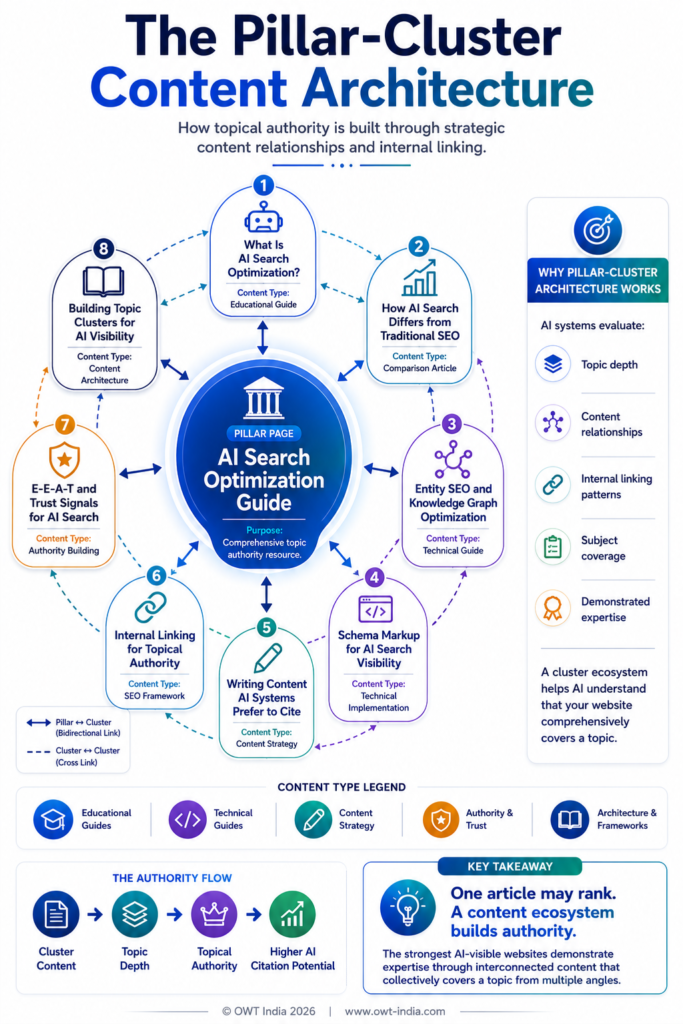
The pillar-cluster internal linking model is the most effective architecture for AI search. Every cluster post links back to the pillar using descriptive anchor text that signals the destination topic. The pillar links down to every relevant cluster post. This bidirectional linking creates a web of topical association that AI systems can traverse and interpret as evidence of topical depth.
Anchor text matters more for AI search than many practitioners realize. “Click here” and “read more” are meaningless signals. “Schema markup implementation guide” and “how to write content for AI citation” are topical signals that tell AI crawlers exactly what the linked page is about. Every internal link should use anchor text that accurately describes the destination page’s primary topic.
Step 4 — Implement Schema Markup Across Your Entire Website
Schema markup is the technical layer that converts your content from human language into machine-readable declarations. Without it, AI systems infer what your content means. With it, they receive explicit, structured information they can process with high confidence. That shift from inference to declaration consistently increases citation likelihood — and it is the most immediately impactful technical change most business websites can make.
Why is schema markup the highest-ROI technical investment in AI search?
Consider what happens without schema. An AI crawler lands on your service page. It reads the text. It infers that this appears to be a business, offering something, to someone, for some price. The confidence level of those inferences varies based on how clearly your content is written, how the page is structured, and how your domain authority compares to other sources on the same topic. Even with perfect content, there is uncertainty — and uncertainty reduces citation likelihood.
Now consider what happens with schema. The same AI crawler finds your @graph block. It reads explicit declarations: this is an Organization named OWT India with a verified entity at wikidata.org/wiki/Q139832321, offering a Service called AI Search Optimization, authored by Sachin Saxena who is affiliated with OWT India and verifiable at linkedin.com/in/sachindioxide, priced at a defined rate, available to clients across India. Zero inference required. The certainty is total. The citation likelihood is substantially higher.
The compound effect of layered schema — entity schema confirming who you are, content schema confirming what each piece of content covers, local schema confirming where you operate — creates a mutually reinforcing signal web that is significantly more powerful than any single schema type in isolation.
What format should you always use for schema markup?
Always JSON-LD. Google explicitly recommends it. Every major AI search system prefers it. Microdata and RDFa require embedding structured data directly into your HTML content tags, making it difficult to maintain and prone to breaking when page content changes. JSON-LD lives in a separate <script> block, entirely independent of your visible content. You can add, update, or remove it without touching a single word your readers see.
In WordPress, JSON-LD can be implemented through RankMath’s schema tab, Yoast’s structured data features, a custom Code Snippets plugin entry, or directly in your theme’s functions.php. The @graph approach — placing all schema types for a given page in a single script block, cross-referenced via @id — is the most powerful implementation pattern because it allows every entity to reference every other entity, creating a connected graph rather than isolated schema islands.
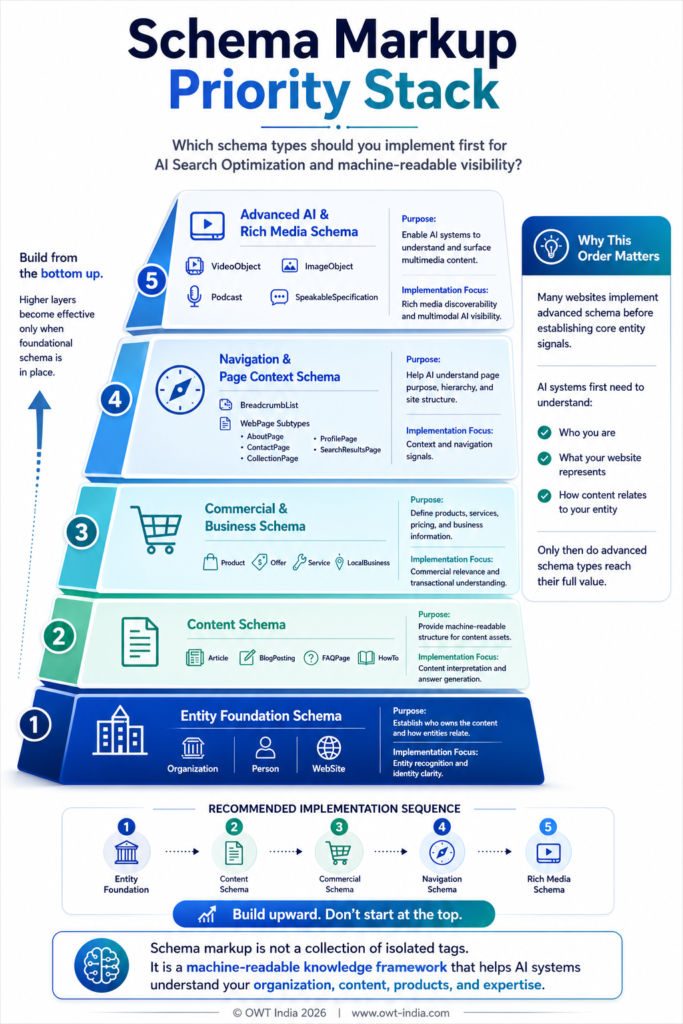
Which schema types should you implement, and in what order?
Priority 1 — Entity anchors. Implement immediately on homepage and author profile pages.
Organization schema declares your business entity. At minimum: name, url, logo (as an ImageObject), description, sameAs (array of all verified external profiles), and contactPoint. Add foundingDate, areaServed, and alternateName if applicable. This schema goes on every page of your site — not just the homepage — because it anchors every piece of content to your verified entity.
Person schema goes on every author profile page. At minimum: name, url, jobTitle, worksFor (linked to your Organization via @id), and sameAs (LinkedIn, professional profiles, Wikidata if applicable). Add knowsAbout as an array of your primary expertise areas.
WebSite schema enables the sitelinks search box in Google and signals your site’s overall identity to AI crawlers. Include potentialAction with a SearchAction pointing to your site’s search URL.
Priority 2 — Content schemas. Implement on every piece of published content.
Article or BlogPosting schema should be on every blog post and article page. The most impactful properties: headline, author (linked via @id to your Person entity), datePublished, dateModified, image (linked via @id to your ImageObject entity), and publisher (linked via @id to your Organization entity).
The dateModified property deserves specific attention. AI systems are sensitive to content freshness, and an accurate, current dateModified date signals ongoing editorial attention. Every time you update a page — adding new data, updating examples, refreshing statistics — update the dateModified date on that day. A page with a dateModified date that matches the current month signals living, maintained content. A page with a dateModified date from three years ago signals abandonment.
FAQPage schema marks up question-and-answer content for direct extraction into AI answers. The question text should be written exactly as a real user would type or speak it — not formal passive-voice phrasing, but natural conversational language. Each answer should be complete, self-contained, and written as if it might be the only thing an AI extracts from your page.
HowTo schema structures step-by-step guides for procedural query responses. Include name, description, totalTime, estimatedCost (even if zero), tool (an array of tools referenced), and the step array with each HowToStep containing name, a HowToDirection with detailed text, and a url pointing to the specific anchor on your page.
Priority 3 — Commercial schemas. Implement on service and product pages.
Service schema for service-based businesses. Product with nested Offer schema for defined service packages or products with pricing. LocalBusiness schema — from Schema.org’s library of over 200 subtypes — using the most specific applicable type for your business. A digital marketing agency is more accurately described as ProfessionalService than as a generic LocalBusiness. A restaurant should use Restaurant, not FoodEstablishment. The more specific the subtype, the clearer the signal.
AggregateRating connected to your Organization or individual Service entities signals real-world customer validation. If you have verifiable ratings from a recognized platform, this schema type directly supports the trustworthiness dimension of E-E-A-T.
Priority 4 — Structural schemas. Implement sitewide.
BreadcrumbList on every page, consistent with your URL structure and your visual breadcrumb display. The breadcrumb trail communicates site hierarchy to AI crawlers and appears in Google search results as visual navigation context. Inconsistency between visual breadcrumbs, URL structure, and BreadcrumbList schema creates conflicting signals — all three should match exactly.
Priority 5 — Media schemas. Implement on media-rich pages.
VideoObject on every video page. ImageObject as a standalone entity for featured images with creditText, creator, license, and acquireLicensePage. Podcast and PodcastEpisode for any audio content. SpeakableSpecification on pages where specific sections are intended for text-to-speech AI output.
How do you use the @graph approach to connect all schemas?
The @graph approach places all schema types for a given page in a single <script type=”application/ld+json”> block. Each entity is assigned an @id — a unique URL that identifies it. Other schemas reference entities using that @id rather than repeating all the entity’s properties.
This means your BlogPosting schema doesn’t need to repeat Sachin Saxena’s full credentials — it simply references “author”: { “@id”: “https://owt-india.com/orca-team/sachin-saxena/#person” }. The AI crawler follows that reference to the full Person schema and reads all the credentials there. The result is a connected graph of mutually reinforcing entity relationships — which is exactly how AI knowledge systems represent the real world.
How do you test and validate your schema implementation?
Three tools, used in sequence. First, validator.schema.org — paste your JSON-LD and confirm zero syntax errors before deploying. A single misplaced comma or unclosed bracket silently invalidates the entire block. Second, Google Rich Results Test — test the live URL and confirm which schema types are detected and eligible for rich results. Third, Google Search Console’s Enhancements tab — monitor the sitewide health of your schema implementation and catch errors on pages you haven’t manually tested.
Common errors to watch for: numeric values stored as strings (reviewCount: “48” instead of 48), @type values misspelled, @id references that point to non-existent entities, and missing required properties on schema types that have conditional requirements (Product requires either offers, review, or aggregateRating).
Step 5 — Build a Content Strategy Designed for AI Search
With your entity foundation established, your architecture optimized, and your schema infrastructure in place, you are ready to build the content layer. This is where the long-term compounding advantage of AI search optimization is created — not through publishing volume, but through systematic depth on the topics that matter most to your business.
What makes AI search content strategy different from traditional keyword-based strategy?
Traditional content strategy starts with keyword research — finding terms with search volume and building content to rank for them. This approach is not wrong, but it is incomplete for AI search. AI systems do not respond to keyword optimization. They respond to topical completeness — the extent to which your content library answers, with genuine depth, every question a user might realistically ask about a given subject.
The shift is from keyword clusters to entity question ecosystems. Instead of building content around “AI search optimization” as a keyword, you build content around “AI search optimization” as an entity — mapping every question a potential customer might ask an AI assistant about that topic, from first awareness through to detailed implementation.
How do you map your entity’s question ecosystem?
Start by mapping four categories of questions for each of your primary topic entities:
Awareness questions are the entry point — questions someone asks when they first encounter a concept. “What is AI search optimization?” “Why does AI search visibility matter?” “How is AI search different from Google?” Content answering awareness questions builds the top of your topical authority.
Consideration questions are asked by someone actively exploring a topic. “How do I optimize for AI search?” “What schema markup types matter most?” “How do I know if my content is AI-citable?” These queries drive the most AI citation opportunities because they are specific, actionable, and frequently asked.
Decision questions are asked by someone ready to act. “Which AI search optimization agency should I hire?” “What does an AI search audit cost?” “How long does AI search optimization take?” Decision-stage content is where entity authority converts into leads and clients.
Troubleshooting questions are asked when something is not working. “Why is my business not appearing in ChatGPT answers?” “Why does my schema validation pass but AI still doesn’t cite me?” “How do I fix low AI search visibility for a new website?” Troubleshooting content builds deep authority and trust because it demonstrates real practitioner knowledge.
How do you research conversational keywords for AI search?
The conversational keyword test is simple: can you type the keyword into an AI assistant as a complete sentence and have it make sense? “AI search optimization” fails — it is a fragment, not a question. “How do I optimize my business website for AI search?” passes. Target the latter. It is longer, more specific, and maps directly to the queries AI users actually ask.
Four sources for conversational keywords: Google’s People Also Ask boxes (expand every box you see — these are real user questions); AlsoAsked.com for topic question tree mapping; your Google Search Console query data filtered for question words (how, what, why, when, which, can, does, should); and your own customer questions from sales calls, support tickets, and social media comments. The questions your customers ask you directly are the highest-value keywords you can have — someone is asking an AI assistant the same question right now.
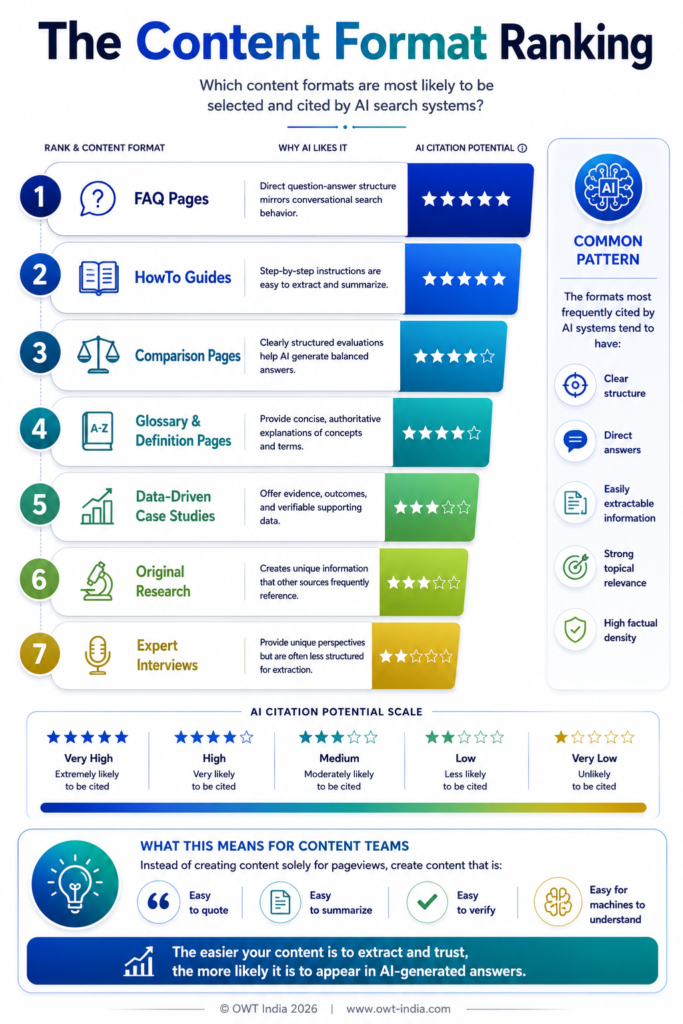
What content formats does AI search reward most?
Not all content formats perform equally in AI search. Some are highly extractable — AI systems can identify a clean answer and cite it with confidence. Others require interpretation that reduces citation likelihood.
Comprehensive FAQ pages perform best because they mirror the query-answer pattern AI systems are built to recognize. When you mark them up with FAQPage schema, you create both a structural and a semantic signal for direct extraction.
Step-by-step HowTo guides perform strongly for procedural queries. When paired with HowTo schema, each step becomes individually citable by AI systems — dramatically expanding the number of queries your content can appear for.
Comparison and versus pages perform well for evaluation-stage queries. Structured comparison tables, clear evaluation criteria, and explicit conclusions give AI systems exactly what they need to synthesize a recommendation.
Definition and glossary pages perform disproportionately well relative to their length. A precise, entity-anchored definition of an industry term is one of the most reliable AI citation targets available. If you have a glossary on your site and it is not being cited regularly, the issue is usually structure — not content quality.
Original research and data is the highest-authority content format. Unique data that no other source has is inherently citable — AI systems cannot synthesize an answer about your proprietary research without referencing you. Even modest original research (a survey of your clients, an analysis of publicly available data) creates citation opportunities that generic content cannot.
Why does content depth outperform content volume in AI search?
One 3,000-word guide that comprehensively answers a topic cluster outperforms ten 500-word posts each targeting a keyword variant. AI systems implicitly reward topical completeness. A source that answers all the related questions on a topic — not just one — is trusted more than a source that answers one and refers elsewhere for the rest.
This has a specific implication for publishing cadence. Publishing one comprehensive, deeply researched piece per month consistently outperforms publishing four shallow pieces per week. The depth signals are cumulative. The authority compounds. And the internal linking opportunities that come from a rich library of comprehensive content are far more valuable than those from a high volume of thin posts.
Step 6 — Write Every Page for AI Citability
The content strategy in Step 5 tells you what to write. This step tells you how to write it so that AI systems can extract, trust, and cite it. The principles here apply to every page you write or rewrite going forward — and to every existing page you update.
What is the answer-first principle and why does it matter?
The most important structural shift in writing for AI search is also the simplest to state: answer first, explain second.
Most content is written the other way around. Context is established, background is provided, nuance is acknowledged, and the answer arrives several paragraphs in. This approach works reasonably well for human readers who have chosen to read a piece from beginning to end. It fails for AI extraction, which evaluates the first 80 to 120 words of each section with disproportionate weight. If the direct, complete answer is not there in the opening sentences, the AI moves to the next source — regardless of how good the rest of your content is.
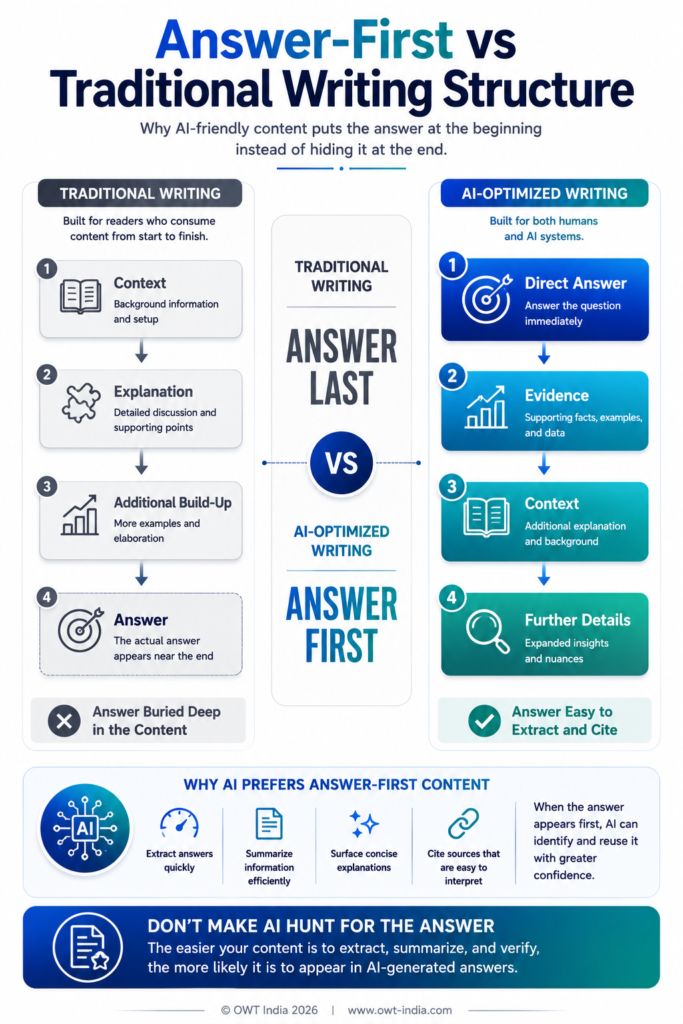
The rewrite is a discipline more than a technique. When you sit down to write a section, identify the single most important thing a reader needs to know, and make that sentence one. Everything that follows — the evidence, the nuance, the examples, the edge cases — supports and extends that answer rather than building toward it.
❌ Traditional structure: “AI search has become increasingly important for businesses in recent years. With the rise of tools like ChatGPT and Perplexity, more and more consumers are turning to AI assistants for product and service recommendations. This trend is particularly pronounced in B2B categories where decision-making cycles are longer. It is therefore worth considering how your business appears in AI-generated answers.”
✅ Answer-first structure: “AI search directly influences buying decisions in 2026. Decision-makers use ChatGPT and Perplexity to shortlist vendors, compare services, and validate providers before contacting any business. If your business is absent from those AI-generated answers, you are absent from the consideration process — regardless of your Google ranking.”
Both contain the same information. Only the second is structured for AI extraction.
How do you make every section self-contained?
AI systems frequently extract a single section from a longer page and present it without surrounding context. That means every section needs to make complete sense on its own — without the reader having seen what came before.
This requirement eliminates three common writing patterns: cross-references (“as we discussed in the previous section”), forward references (“we will cover this in detail later”), and pronoun chains that refer to nouns established several paragraphs earlier. Every entity mentioned in a section should be named explicitly within that section. Every concept referenced should be explained within that section. A reader who skips directly to any section should leave that section with a complete, accurate understanding of the answer it provides.
The self-contained test is simple: read any section of your page in isolation. Does it make complete sense? Does it fully answer the question implied by its heading? If the answer to either question is no, the section needs revision.
How should you format sections for different query types?
Format is not an aesthetic choice in AI-optimized content — it is a structural signal that helps AI systems match your content to the right type of query.
How-to and step-by-step queries should use numbered lists. Each step should be actionable and specific — not “configure your settings” but “in your WordPress dashboard, navigate to Settings → Permalinks, select Post name, and click Save Changes.” The specificity is the signal. Generic instructions are harder to trust and cite than precise, verifiable ones.
“What are the types of X?” queries should use bullet lists with brief, distinct descriptions for each type. The parallel structure signals to AI systems that each item is a discrete, coordinate element — which is exactly the structure AI needs to extract a “types of” answer accurately.
Comparison queries should use structured tables. Headers as evaluation criteria, rows as options being compared. Tables are among the most AI-extractable content formats because their structure makes the comparison logic explicit.
“What is X?” and definition queries should use definition paragraphs — a single, precise, entity-anchored definition in the first sentence, followed by elaboration. The definition should be accurate and complete enough to stand alone as a citation.
“Why does X happen?” and causal queries should use short explanatory paragraphs with explicit causal language: “because,” “as a result,” “which leads to.” Causal chains written explicitly are easier to extract than those implied.
What makes content E-E-A-T rich in practice?
Experience, Expertise, Authoritativeness, and Trustworthiness are not abstract concepts — they have specific, practical expressions in content that AI systems can evaluate.
Experience shows in first-person specificity. “When we implemented this for a professional services client in Delhi, the FAQPage schema changes produced a measurable increase in AI Overview appearances within six weeks” is an experience signal. “Schema markup can improve AI visibility” is not.
Expertise shows in depth and nuance. Content that addresses edge cases, exceptions, and the conditions under which advice changes demonstrates genuine practitioner knowledge. Content that presents one-size-fits-all guidance suggests surface familiarity.
Authoritativeness shows in external validation. Being named, quoted, or cited by credible third parties, having your data referenced in other publications, and maintaining a publication record on your topic all build the external recognition dimension of authority.
Trustworthiness shows in accuracy, transparency, and consistency. Citing primary sources for statistics, acknowledging when evidence is limited, correcting errors visibly, and maintaining content that is consistently accurate across time all build trust signals that AI systems cross-reference against external validation.
Step 7 — Optimize for AI Local Search
If your business serves a specific geographic area or serves clients who search with location-based intent, local AI search optimization deserves its own focused effort. The opportunity is significant — and most local businesses have done very little of the work required to appear in AI local answers.
How does AI answer local search queries?
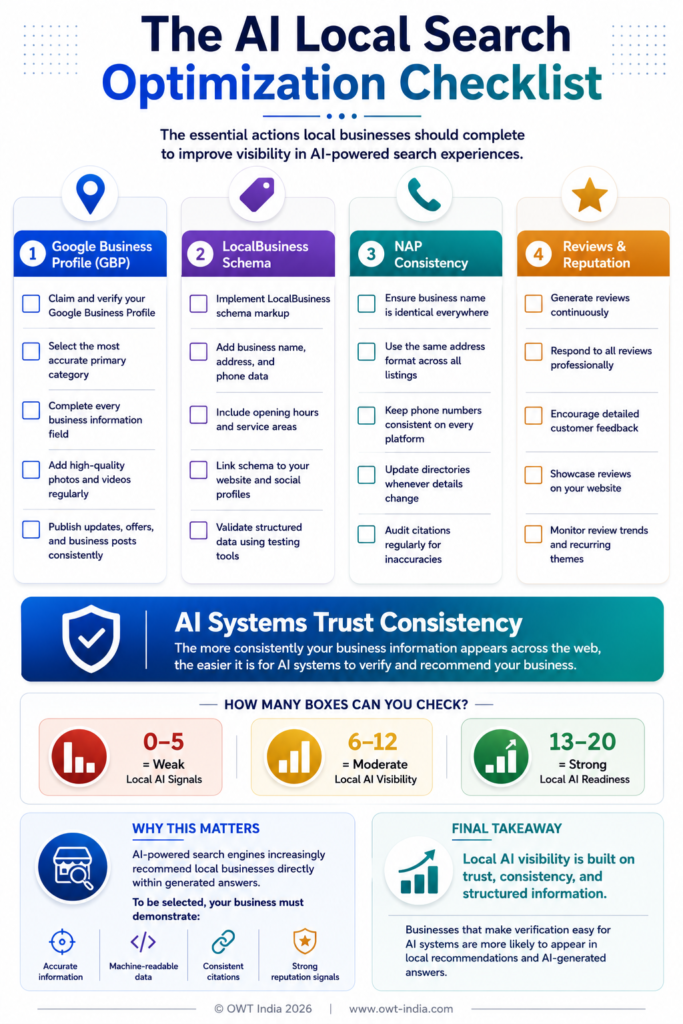
When someone asks “best AI search optimization agency in Jaipur” or “who should I hire for website development in Delhi,” the AI draws from a combination of Google Business Profile data, LocalBusiness schema, review signals, and NAP consistency across citation sources. The businesses that appear in those answers have typically done two things: completed their GBP comprehensively, and implemented LocalBusiness schema with sufficient specificity.
The “near me” optimization approach that dominated local SEO thinking for years is not directly relevant to AI local search. You do not optimize for the phrase “near me” — you optimize your entity signals so thoroughly that AI systems are confident enough in your location and relevance to surface you for proximity queries. That confidence comes from the combination of complete GBP data, accurate LocalBusiness schema, consistent NAP, and review content that mentions specific services.
How do you optimize your Google Business Profile for AI local search?
Complete every field — not as a formality, but as a data source. AI systems treat GBP as an authoritative declaration of your business’s identity, location, and service offering. An incomplete GBP is a weak entity signal.
Business name: exactly as it appears on your website and all other listings. Not your tagline, not your URL, not your keyword target — your actual business name.
Primary category: the most specific applicable option available. “Digital Marketing Agency” is more specific than “Marketing Agency.” “AI Search Optimization Consultant” is more specific than “Consultant.” Specificity is a signal — it tells AI systems exactly what type of business you are and what queries you are relevant for.
Business description: written for extraction rather than marketing. Clear statement of what you do, who you serve, where you operate, and what distinguishes your approach. Every sentence should add factual information that an AI system could use to describe your business accurately.
Services: each service individually listed with its own name and description. If you offer AI search optimization, schema markup implementation, and technical SEO audits as distinct services, list them as distinct services — not as a single “SEO services” line item.
Reviews: respond to every review, positive and negative. AI systems read responses as well as reviews. A business that engages consistently with customer feedback signals active management and care — which is a trustworthiness indicator.
How do you choose the right LocalBusiness schema subtype?
Schema.org’s LocalBusiness hierarchy has over 200 specific subtypes. The most specific applicable subtype always outperforms the most general. A physiotherapy clinic should use MedicalBusiness → Physician (or the more specific subtype for physiotherapy) rather than simply LocalBusiness. A family law firm should use LegalService with legalName and areaServed rather than a generic ProfessionalService.
The logic is the same as GBP category specificity: the more precisely you define what you are, the more confidently AI systems can match you to specific queries. A business defined as RestaurantGroup → ItalianRestaurant appears in “best Italian restaurant in [city]” answers more reliably than one defined only as FoodEstablishment.
Add geo coordinates to your LocalBusiness schema. Accurate latitude and longitude provide AI systems with verifiable location data that is independent of your address text — which is valuable precisely because it cannot be fabricated.
How do review signals influence AI local answers?
Review quantity, recency, and content relevance all influence AI local visibility — but content relevance is the most underappreciated of the three.
A review that says “great agency, highly recommend” provides very little signal to an AI system beyond general satisfaction. A review that says “OWT India’s AI search optimization work resulted in our business appearing in ChatGPT recommendations within two months — the schema implementation was particularly thorough” provides specific service attribution, a named outcome, and a confirmation that the business delivers on its stated expertise. AI systems read that level of specificity and incorporate it into their confidence about what the business is actually good at.
You cannot and should not dictate what customers write in reviews. But you can ask for specific feedback: “If you’re happy to leave us a review, it would be particularly helpful if you mentioned which service you used and what result you noticed.” That guidance, delivered naturally in a follow-up conversation or email, consistently produces more informative reviews without manufacturing them.
Step 8 — Optimize Images, Video, and Multimedia for AI Search
AI search is text-dominant — but it is not text-only, and the multimedia gap is one of the largest untapped opportunities in AI search optimization. Most businesses have rich visual and video content that is completely invisible to AI systems because it lacks the supporting structure that makes non-text content machine-readable.
Why is multimedia the biggest AI search blind spot?
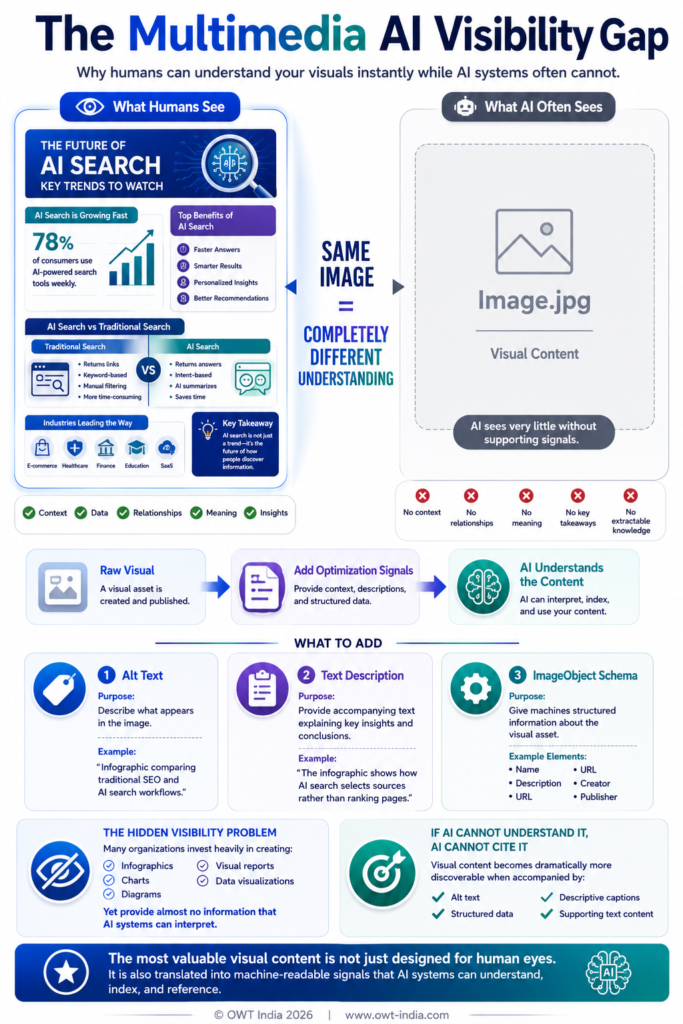
AI systems cannot read the text inside an image. A beautifully designed infographic containing detailed, accurate, well-researched information about AI search optimization is, from the perspective of an AI crawler, a blank square. The visual content exists. The information exists. But without alt text, a supporting text description, and ImageObject schema, none of that information is available to AI systems for extraction and citation.
The same gap applies to video. A twenty-minute tutorial video containing expert insights on schema markup implementation is, without a transcript, a duration. AI systems see the video exists. They cannot access its content.
This is both a problem and an opportunity. The problem: significant amounts of your best content may currently be invisible to AI search. The opportunity: fixing this gap requires relatively modest effort and has immediate, measurable impact on AI citation rates for the topics your multimedia covers.
How do you optimize images for AI search?
Every image on your website should have three things in place: a descriptive file name, complete alt text, and ImageObject schema for featured images and key visual assets.
File names should describe the image content in plain language: 5-layer-ai-search-readiness-audit-infographic-owt-india-blog.jpg is a signal. IMG_4823.jpg is noise. Use hyphens between words, keep it lowercase, and include the brand name for images that function as shareable assets.
Alt text should be a complete sentence describing what the image shows — written for a person who cannot see the image. “Infographic showing the five-layer AI search readiness audit framework with Entity, Schema, Content Structure, Multimedia, and Freshness layers in order of implementation priority” is correct. “ai-search-infographic” is not. The test: would someone who reads only your alt text understand what information the image conveys?
ImageObject schema for featured images and key visual assets should include url, contentUrl, name, description, creator (linked to your Organization via @id), creditText (your business name), copyrightNotice, and license. The creditText field specifically addresses the Google Search Console warning that most websites generating ImageObject schema currently receive.
Image compression protects your page speed, which protects your AI crawl depth. Target under 150KB per image without visible quality loss. WebP format delivers better compression than JPEG at equivalent quality for most image types.
How do you make infographics visible to AI search?
Every infographic needs a text shadow — a complete, HTML-rendered description of the information the infographic contains. This is not a caption. It is a full restatement of the infographic’s content in readable text, positioned below or near the infographic on the page.
The text shadow does not need to be visually prominent. A collapsible section, a styled note, or a simple unordered list of the infographic’s key points all serve the purpose. AI systems can read it. Human readers who prefer the visual can use the infographic. Both audiences are served.
For the twelve infographics embedded in this guide, each should have a text shadow that covers the specific information visualized — so that a reader (or an AI system) who cannot see the infographic still receives the complete information it contains.
How do you optimize video content for AI search?
Three elements make video content AI-visible: VideoObject schema, transcripts, and chapter timestamps.
VideoObject schema provides AI systems with structured information about the video: its name, description, upload date, duration, thumbnail URL, and content URL or embed URL. Without VideoObject schema, an AI crawler sees a page that contains a video object — and very little else.
Transcripts are the highest-impact video optimization available. A full episode transcript, published in the page HTML as a collapsible section or accessible block, converts every minute of your video into indexed, extractable text. A thirty-minute tutorial video with a full transcript gives AI systems access to thirty minutes’ worth of expert content — potentially generating dozens of AI citation opportunities across the topics discussed.
Chapter timestamps on YouTube and in the hasPart property of your VideoObject schema allow individual chapters to be cited independently from the full video. A video chapter titled “How to implement FAQPage schema in WordPress” can be cited for that specific query even if the broader video covers a wider topic. This dramatically expands the number of queries your video content can appear for.
Step 9 — Build the Authority and Credibility Signals That AI Systems Look For
Entity foundation establishes who you are. Content establishes what you know. Authority signals establish why AI systems should trust your content enough to cite it over sources that cover the same topics. This step is the long game — it takes the longest to build and the longest to lose.
Why do AI systems verify authority through external signals?
AI systems do not take your word for your own expertise. They cross-reference your self-declared expertise against external validation: are you named as an expert by sources independent of your own website? Is your content cited by others? Do third parties describe your business as authoritative in your claimed domain?
This cross-referencing reflects how trustworthy information actually works in the world. A person who tells you they are the best accountant in the city is providing self-assessment. A person who has been named in three industry directories, quoted in two business publications, and rated five stars by forty clients is providing externally validated credibility. AI systems prefer external validation for the same reason you do.
How do you build content authority over time?
Content authority is built cumulatively, through consistent publishing of genuinely deep content on a focused topic cluster. A single well-structured article rarely changes citation patterns on its own. A structured library of fifteen to twenty deeply researched, well-written pieces on a specific topic cluster begins to establish the kind of sustained topical authority that AI systems recognize and reward.
The most underused authority-building content format is original research. If you have access to data that no other source has — survey results from your clients, analysis of proprietary project data, aggregated observations from your work — publishing that data with clear methodology creates citation opportunities that no amount of well-structured generic content can replicate. AI systems cannot synthesize an answer about your proprietary research without citing you as the source.
Updating existing content with genuine new information also builds authority over time. A guide that has been updated four times over two years, each time with substantive new data or insights, signals ongoing editorial attention and growing expertise. The same guide left unchanged for three years signals stagnation.
How do you build external citation authority?
The types of external citations that carry the most weight for AI search are those from sources with their own strong entity signals: established industry publications, recognized professional organizations, academic institutions, government databases, and news outlets with verifiable editorial standards.
Guest articles in reputable industry publications are among the most reliable authority-building activities available. An article published under your name on a recognized platform gives you: a byline that strengthens your Person entity, a link that strengthens your domain authority, a citation that AI systems can cross-reference, and an external entity describing your expertise in the third person — exactly what AI systems look for.
Podcast appearances serve a similar function. Being invited to speak as an expert on an established podcast generates show notes that name you and your business, a back-reference to your website, and an external entity describing your domain expertise. The compound effect of multiple podcast appearances — each with show notes, each naming you as an expert on specific topics — accumulates into a significant authority signal over time.
Step 10 — Build a System to Monitor Your AI Search Visibility
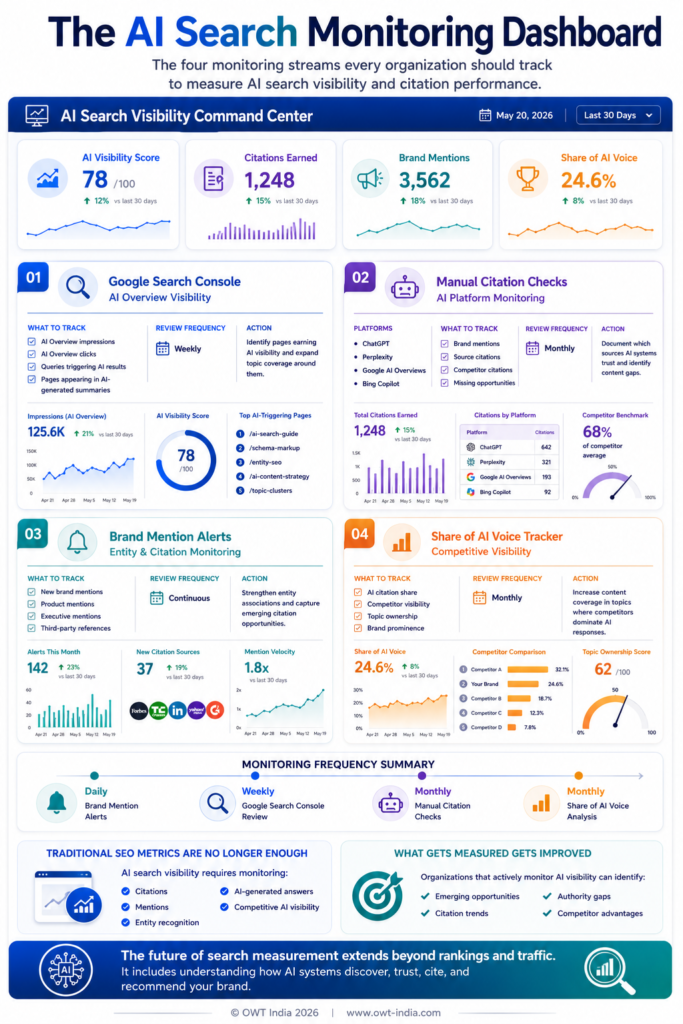
You cannot manage what you cannot measure. AI search visibility is harder to measure than traditional SEO rankings — there is no universal position tracker for AI answers. But there are practical, systematic ways to track your AI citation rates, measure your progress, and identify where your optimization efforts are and are not working.
How do you use Google Search Console for AI search monitoring?
Google Search Console is your most accessible AI search data source. In the Search Results performance report, filter for queries where your pages appear in AI Overviews. As of 2026, Search Console reports AI Overview impressions and clicks separately from traditional organic results for accounts where this data is available.
Set up a monthly tracking routine: pull your AI Overview impression and click data, record the queries triggering AI Overview appearances for your domain, and note which pages are being included. Compare month over month to identify trends. An increasing number of AI Overview appearances for your target queries is the clearest leading indicator that your optimization work is producing results.
The CTR diagnostic is equally important. If you see queries where impressions are stable but click-through rate is falling, check whether AI Overviews have appeared for those queries. The pattern — impressions stable, CTR falling — is the strongest indicator of AI Overview displacement of organic clicks. The appropriate response is not to try to outrank the AI Overview but to optimize your content to appear inside it.
How do you run manual citation checks across AI platforms?
Once a week, open ChatGPT, Perplexity, Google AI, and Bing Copilot in separate browser tabs and run your ten to fifteen priority queries across all four platforms. Record in your tracking spreadsheet: which queries you appear for, which you do not, how you are described when you do appear, and which competitors appear for the queries where you do not.
This manual check provides intelligence that no tool can replicate. You will see exactly how AI systems describe your business, which specific content is being cited, and which competitor content is being selected over yours for specific queries. That intelligence tells you specifically what to change — not that your AI visibility is generally low, but that for the query “best AI search optimization agency in Jaipur,” Perplexity is citing your competitor because their content has a more direct, extractable answer to the question.
What is the share-of-AI-voice metric and how do you calculate it?
Share of AI voice is the percentage of your defined priority query set for which your domain appears in AI-generated answers. It is the most useful directional metric for measuring the overall health of your AI search visibility strategy.
Define a set of twenty to thirty queries that matter most to your business — a mix of category queries, expertise topic queries, and local queries. Run all of them across your four platforms quarterly. Record which queries return a citation of your domain. Your share of AI voice is the percentage of those queries for which you appear.
Track this quarterly. An increasing share of AI voice over successive quarters confirms that your optimization efforts are working. A stagnant or decreasing share tells you to look for what has changed — either your content or the content of competitors who are now appearing where you were.
Step 11 — Establish Your Ongoing Maintenance Calendar
AI search visibility is not a project with a finish line. It is infrastructure — built systematically and maintained consistently. The optimization work done in Steps 1 through 10 creates an advantage that compounds over time. That advantage can also erode if the maintenance is neglected. This step builds the habits and rhythms that protect and grow what you have built.
What should you do weekly?
Thirty minutes, every week.
Run your manual AI citation checks for priority queries across ChatGPT, Perplexity, Google AI, and Bing Copilot. Review brand mention alerts from Google Alerts or your monitoring tool of choice. Respond to any new Google Business Profile reviews — positive and negative. Check for any new Search Console errors in the Enhancements tab.
These weekly checks are the early warning system. They catch problems before they compound and surfaces opportunities — a new query where you have appeared for the first time, a competitor whose appearance has changed, a review that mentions your business in an AI-relevant context.
What should you do monthly?
Two to three hours, every month.
Pull your Search Console AI Overview data and update your tracking spreadsheet. Review the top ten pages for content freshness — are statistics, tool references, and examples still current? Update dateModified on any pages where genuine content changes have been made. Publish at least one new piece of content in your primary topic cluster. Review the last month’s manual citation check data for patterns — are there queries where your appearance is improving? Queries where it is declining? Act on what the patterns show.
What should you do quarterly?
Half a day, every quarter.
Run the full share-of-AI-voice analysis across your twenty to thirty priority queries. Conduct a schema audit on any new pages published in the quarter — every new template should have schema built in, not added retrospectively. Update your conversational keyword list to reflect what customers are asking now that they were not asking three months ago. Update fast-moving content — anything covering AI search, technology tools, or current practice — with new data and examples. Review competitor AI visibility changes: what new queries are they appearing for? What content have they published that is being cited?
What should you do annually?
A full day, once a year.
Full entity audit: GBP review, NAP consistency check across your top twenty citation sources, sameAs links verified and still active, Knowledge Panel status confirmed. Schema audit across the entire site — validate every template, check for broken @id references, update priceValidUntil dates in Offer schema, and review review counts in aggregateRating blocks. Content library review: identify every page over eighteen months old and assess whether it needs substantive updating. Strategy review: which topic clusters have strong AI citation rates? Which need more content depth? Which new topics should be added to the content plan based on changes in customer questions?
One specific calendar reminder to set today: priceValidUntil dates in your Offer schema. If you set these when implementing schema and then never update them, they will eventually expire and create a discrepancy between your schema and your live pricing. Set an annual recurring reminder for the last week of the year to review and update all priceValidUntil dates in your schema.
Step 12 — Advanced AI Search Optimization Techniques
The eleven steps above create a comprehensive, well-optimized AI search presence for a business website. This step covers the techniques that take a strong AI search presence to an exceptional one — the approaches that separate businesses actively investing in AI search from those that have done the baseline work.
What is Generative Engine Optimization (GEO)?
Generative Engine Optimization is the practice of structuring content to influence not just whether AI systems cite you, but how they use your content in their generated responses. The distinction matters: being cited means the AI mentions your source. Being synthesized means the AI uses your content to build the substance of its answer.
GEO techniques overlap significantly with the content structure principles in Step 6, but they go further. They include citing authoritative sources within your own content — which makes your content itself a more credible synthesis point for AI systems. They include using statistical claims and quotable data that AI systems can lift directly into a generated response. And they include structuring content as recombinable units — sections that can be recombined with information from other sources to produce a coherent AI-generated answer.
The businesses that master GEO are not just being cited at the end of AI responses — they are contributing the substance of the response itself.
What is Answer Engine Optimization (AEO)?
Answer Engine Optimization is the practice of optimizing content specifically for direct answer extraction — prioritizing the goal of being the cited source in a direct AI answer over the goal of driving clicks. For many business types, this represents a strategic shift: traffic to the website is no longer the primary objective; appearing as the trusted expert in AI-generated responses is.
AEO content formats center on the question-answer pair as the fundamental unit of content. Every section of an AEO-optimized page can be described as a question and its answer. The question is the heading. The answer is the first paragraph. Everything else elaborates, evidences, or extends the answer. When combined with FAQPage schema, AEO content consistently produces among the highest AI citation rates of any content format.
How does SpeakableSpecification work and when should you use it?
SpeakableSpecification schema marks content as suitable for text-to-speech AI output. It uses CSS selectors to identify which parts of a page — typically the summary, key headings, and core answers — are the most appropriate for audio rendering.
The most relevant use case is for content that is likely to be consumed via voice assistants or AI-powered audio interfaces — product descriptions, key service summaries, critical how-to steps. On content pages that answer high-value questions directly, marking the answer sections with SpeakableSpecification creates a combined structural and semantic signal that consistently increases AI citation rates for voice and audio interfaces.
What is ProfilePage schema and why does it matter for authors?
ProfilePage is a schema type introduced in 2023 that strengthens author entity signals specifically on profile and about pages. When implemented on an author’s profile page — connected to the Person schema for that author, and referencing the BlogPosting schemas for that author’s published content — ProfilePage creates a complete authorship signal chain that AI systems can traverse.
The compound effect of ProfilePage + Person schema + Article author attribution is significantly stronger than any of the three elements alone. The AI can navigate from a cited article to the author’s profile, from the profile to their credentials and external links, and from the external links to independent corroboration of their expertise. That chain of verifiable connections is exactly what high-confidence AI citation looks like from the inside.
How do you build a systematic competitor gap analysis for AI search?
A competitor gap analysis for AI search has three steps: identify the queries where your competitors appear and you do not, analyze what is different about their cited content compared to yours, and build a systematic program to close each identified gap.
The identification step comes from your weekly manual citation checks. Over time, a pattern emerges: certain queries consistently return competitor citations but not yours. Those are your gap queries.
The analysis step requires opening the competitor’s cited page and comparing it, honestly, to your equivalent content. Is their answer more direct? Is their section more self-contained? Do they have FAQPage schema that you do not? Is their content more recently updated? Is their author entity stronger? The gap is usually specific and fixable.
The build step is simply executing the fix — restructuring your content, adding schema, updating the page, or publishing content that covers the topic with greater depth. Competitor gap analysis is not about copying; it is about understanding the precise signals that are causing AI systems to select another source, and eliminating that difference systematically.
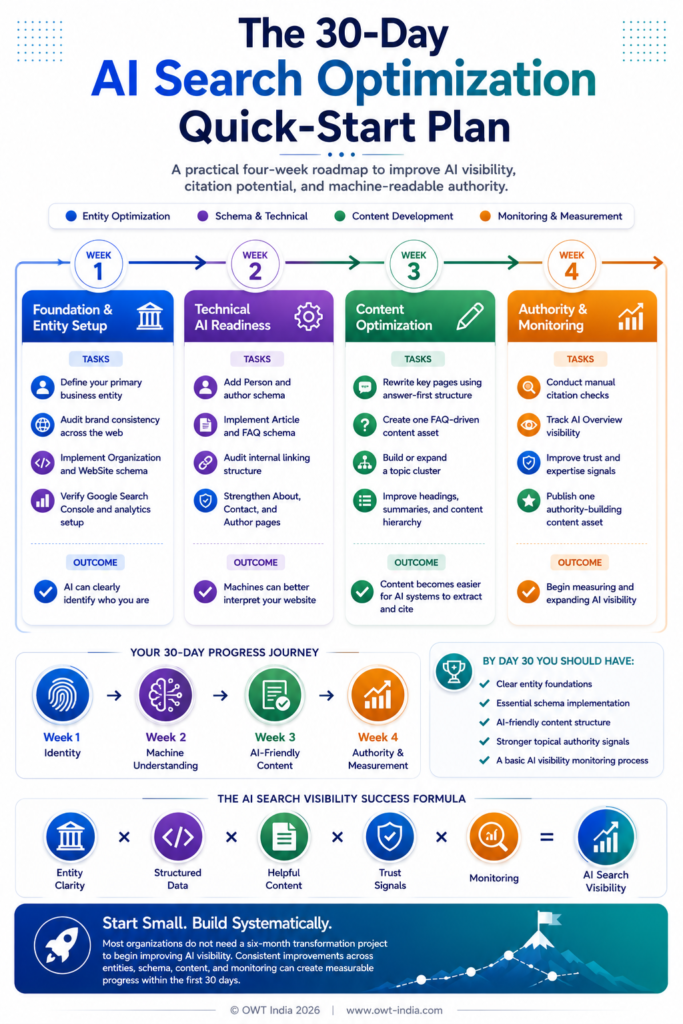
Your Complete AI Search Optimization Checklist
Five layers. Work through them in order. Layer 1 problems affect the credibility of every page on your site — fix them first.
Layer 1 — Entity
- [ ] Google Business Profile claimed, verified, and every field complete
- [ ] About page comprehensive, structured, and machine-readable
- [ ] NAP — name, address, phone — identical across your website, GBP, and top twenty citation sources
- [ ] Organization schema on homepage and every page with name, url, logo, description, sameAs, contactPoint
- [ ] Person schema on all author and key team member profile pages
- [ ] sameAs links verified — click each one and confirm accuracy
- [ ] Knowledge Panel present in Google brand name search
- [ ] Author profiles current, externally linked, and cross-referenced to Organization via worksFor
Layer 2 — Schema
- [ ] Article or BlogPosting schema on all content pages with headline, author, datePublished, dateModified, image, publisher
- [ ] FAQPage schema on all pages containing FAQ sections, with natural-language questions and self-contained answers
- [ ] HowTo schema on all step-by-step and tutorial content
- [ ] BreadcrumbList on every page, consistent with URL structure and visual breadcrumbs
- [ ] Service or Product + Offer schema on all commercial pages with accurate availability and price
- [ ] LocalBusiness schema on all location pages using most specific applicable subtype with geo coordinates
- [ ] VideoObject schema on all video pages with description, thumbnailUrl, and hasPart chapters
- [ ] ImageObject schema on featured images with creditText, creator, copyrightNotice, license
- [ ] Zero errors at validator.schema.org — validate before every deployment
- [ ] Rich Results Test passing for Article, FAQPage, HowTo, BreadcrumbList on all target pages
- [ ] Google Search Console Enhancements tab showing no critical schema errors sitewide
Layer 3 — Content structure
- [ ] H2 headers written as question-format headings matching real user queries
- [ ] Direct, complete answer in the first 80-120 words of every section
- [ ] Every section self-contained — readable without surrounding context
- [ ] Sections under 300 words before next subheading on informational pages
- [ ] Format matches query type throughout: how-to → numbered list, types → bullet list, compare → table, definition → paragraph
- [ ] Table of contents with anchor links on all long-form content over 1,500 words
- [ ] FAQ sections present on key service and information pages
- [ ] No cross-references between sections (“as we covered above,” “we will discuss this later”)
Layer 4 — Multimedia
- [ ] Every image has descriptive alt text written as a complete sentence
- [ ] Every image has a descriptive file name using hyphens and lowercase
- [ ] Every infographic has a full text description below it in readable HTML
- [ ] All videos have accurate transcripts in page HTML or via YouTube
- [ ] Chapter timestamps implemented on YouTube and in VideoObject hasPart schema
- [ ] All images compressed under 150KB — WebP format where supported
- [ ] Core pages loading under 3 seconds on mobile (test with Google PageSpeed Insights)
- [ ] ImageObject schema on featured images with creditText field
Layer 5 — Freshness and authority
- [ ] dateModified updated on every genuinely edited page, reflecting actual content changes
- [ ] All content over 18 months old reviewed for accuracy and updated where needed
- [ ] Quarterly update calendar in place for fast-moving topics
- [ ] Annual review calendar in place for stable evergreen topics
- [ ] Author credentials current and externally linked
- [ ] External citation monitoring active (Google Alerts or equivalent)
- [ ] priceValidUntil dates in Offer schema reviewed annually
- [ ] reviewCount in aggregateRating blocks updated to reflect current review volume
Frequently Asked Questions
How long does AI search optimization take from scratch to first results?
The honest timeline has three layers. Schema markup and entity foundation changes can produce measurable results within four to eight weeks — because they give AI crawlers explicit information they did not previously have, and that new information is processed relatively quickly on re-crawl. Content authority takes longer because it is cumulative — a consistent publishing programme of genuinely deep content typically begins generating new AI citation patterns within three to six months. Full topical authority on a competitive topic cluster is a six to twelve month project.
What most businesses miss is that these timelines compound. Schema implemented in month one makes every piece of content published in months two through six more effective. Entity signals built in weeks one through four make content authority built in months two through twelve more credible. The work done earliest has the highest compounding effect — which is the strongest argument for starting immediately rather than waiting until conditions feel ideal.
Can I do AI search optimization myself, or do I need an agency?
Everything in this guide is implementable by a business owner or in-house marketing manager with time, attention, and willingness to learn. The entity foundation work, GBP optimization, and content restructuring require no specialist tools. FAQPage and HowTo schema can be implemented through RankMath or Yoast without coding knowledge. Manual citation monitoring requires a browser and a spreadsheet.
The areas where specialist expertise consistently adds value are schema architecture (particularly the @graph cross-referencing pattern for complex sites), technical schema debugging when errors are not immediately obvious, and content strategy at scale (building a comprehensive topic cluster for a competitive industry requires research and planning time that most businesses do not have in-house). These are investable rather than essential — the question is whether your time is better spent learning and implementing, or delegating to specialists and focusing on your core business.
Which is more important: schema markup or content structure?
Neither. They work together and each makes the other more effective. Schema without well-structured content tells AI systems your page contains a FAQ — but if the FAQ answers are vague and poorly written, the schema will not save the citation rate. Well-structured content without schema forces AI to infer what it could know with certainty — which reduces citation confidence.
If you have limited time and must sequence them: implement Organization and Person schema first (because they affect the credibility of everything else), then restructure your highest-traffic content pages for answer-first extraction, then add FAQPage and HowTo schema to pages that have clear FAQ and how-to content. The sequence that combines entity schema + content restructuring + content schema will outperform either schema or content work done in isolation.
How do I know when my entity foundation is strong enough to move to the next step?
Four indicators suggest your entity foundation is sufficiently established to build on:
A Knowledge Panel appears when you search your business name in Google. AI assistants return accurate, specific information about your business when queried by name. Your NAP is consistent across your top twenty citation sources. And your Organization schema passes validation with zero errors at validator.schema.org.
You do not need all four to be perfect before moving forward — optimization is iterative, not sequential. But if you are getting “no information found” responses from ChatGPT when you search your business name, entity foundation should remain your primary focus until that changes.
How many articles do I need before AI systems start citing my content?
There is no threshold number. A single exceptionally well-structured, deeply researched article on a specific topic can begin generating AI citations immediately if it answers a specific question better than any other indexed source. Quantity without quality produces nothing.
What creates topical authority is not article count but coverage — the extent to which your published content addresses, with genuine depth, the full ecosystem of questions associated with your primary topics. Ten deeply researched, interlinked articles that together cover a topic cluster from every angle will consistently outperform fifty thin posts that each touch a topic superficially.
Can AI search optimization work for a new business with a new website?
Yes — with adjusted expectations for timeline. A new business without an established domain authority or citation history needs to prioritize entity foundation work more heavily and for longer than an established business. The schema implementation, content structure, and GBP optimization work is identical. What takes longer is accumulating the third-party citations and topical authority signals that AI systems use to validate expertise.
The practical implication: new businesses should focus the first three months almost entirely on entity establishment (GBP, About page, Organization schema, NAP consistency, sameAs links, initial external citations) and begin content publishing once that foundation is solid. Building content on an entity-weak foundation is less effective than it sounds — the content exists but the entity signals that make it credible are not yet there.
What is the single most common mistake businesses make when starting AI search optimization?
Starting with content when the entity foundation has not been established. This mistake is extremely common because content feels like the most natural starting point — everyone understands that you need to publish to be visible, and writing new content feels more productive than auditing citations or setting up schema.
The problem is that content published before your entity is established performs below its potential. AI systems encounter good content from a business they cannot verify, written by an author they cannot identify, on a domain whose claims they cannot corroborate against third-party sources. The content may be excellent. The citation confidence is low.
Fix the entity first. Then the content you publish — even if it is the same content you would have published anyway — earns a higher baseline of AI trust from the moment it is indexed.
How do I measure whether my AI search optimization is working?
Three metrics, tracked regularly. First, your share of AI voice on your defined priority query set, measured quarterly — the percentage of your twenty to thirty target queries for which your domain appears in AI-generated answers. Second, Google Search Console AI Overview impression data, tracked monthly — the number of queries for which your pages appear in AI Overviews. Third, your manual citation check results, recorded weekly — the specific queries on which you appear, in which platforms, and how you are described.
The combination of these three data sources gives you a directional view of overall progress (share of AI voice), a quantitative measure of Google-specific performance (Search Console data), and qualitative intelligence about specific query-level performance (manual checks). No single metric tells the complete story — all three together do.
Your First 30 Days — A Practical Action Plan
Twelve steps and a complete implementation guide can feel overwhelming as a starting point. This plan makes it actionable: the most impactful work, in the right sequence, over thirty days.
Week 1 — Baseline and entity foundation
Run your baseline AI visibility test across ChatGPT, Perplexity, Google AI, and Bing Copilot. Document the results in a spreadsheet — this is your starting point for everything that follows. Then begin your entity foundation work: audit your Google Business Profile and complete every incomplete field. Run your NAP consistency check across your top ten citation sources and fix every inconsistency you find. Begin rewriting or completing your About page with the structure and content described in Step 2.
Week 2 — Schema infrastructure
Implement Organization schema on your homepage — start with the entity anchor and get it validated with zero errors before moving forward. Add BreadcrumbList to every page sitewide (this can be done through your SEO plugin’s template settings). Add Article or BlogPosting schema to your ten highest-traffic content pages. Validate everything at validator.schema.org and fix every error before adding more schema.
Week 3 — Content audit and restructuring
Audit your ten highest-traffic pages for answer-first structure. For each page, identify whether the direct answer to the page’s primary question appears in the first 80 to 120 words of each section. Rewrite the openings of sections that bury their conclusions. Identify FAQ content on each page and ensure it is clearly structured as question-answer pairs. Add FAQPage schema to every page that has a clear FAQ section, and HowTo schema to every step-by-step page.
Week 4 — Monitoring setup and forward planning
Set up your monthly Search Console AI Overview monitoring routine. Begin your weekly manual citation check and record your first baseline results. Draft your conversational keyword research list — the twenty to thirty questions your customers realistically ask AI assistants about your topic areas. Map your first topic cluster: identify which questions your existing content already answers, which questions have content gaps, and what you will publish over the next eight weeks to fill those gaps.
AI search visibility is not built in thirty days. What this plan builds in thirty days is the foundation from which everything else compounds — the entity signals that make your content credible, the schema infrastructure that makes it machine-readable, the content structure that makes it extractable, and the monitoring system that tells you whether it is working.
Start with Step 1. Run the test. Know where you stand. Then build from there — systematically, in sequence, without skipping the steps that feel less exciting than publishing new content.
The businesses that understand this shift today are building a structural advantage. The ones that understand it in twelve months will find that advantage significantly harder to close.
This guide was written by Sachin Saxena (Founder & CEO – OWT India). OWT India is an AI search optimization and SEO agency based in Jaipur, India, with over 20 years of experience helping businesses build search-ready digital platforms. To request an AI Search Optimization Audit for your website, visit owt-india.com/contact or reach the team at info@owt-india.com.
Companion resources: Schema Markup in 2026 · AI Search Optimization in 2026: 10 How-To Guides · The 5-Minute AI Visibility Test