E-E-A-T in 2026: How to Prove Experience and Expertise to Both Google and AI Systems
Why E-E-A-T Matters More Than Ever
Google’s Quality Rater Guidelines have always shaped search, but the introduction of the fourth ‘E’ — Experience — marked a meaningful philosophical shift. Google was signaling that it was no longer enough to demonstrate theoretical expertise. The search ecosystem now places a premium on content that reflects first-hand, lived engagement with a topic. You must not only know about something; you must have done it, encountered it, or been directly affected by it.
The arrival of AI-generated content at scale has made this shift urgent. AI systems can produce plausible-sounding content on virtually any topic without any actual experience or expertise behind it. To maintain the integrity of search results, Google and other AI-powered search platforms have had to double down on signals that distinguish genuine human authority from algorithmic content production. E-E-A-T — Experience, Expertise, Authoritativeness, and Trustworthiness — is the framework at the center of this effort.
Understanding E-E-A-T is not just important for ranking in traditional search. As AI assistants increasingly serve as the first point of information discovery, the same principles that determine whether Google trusts your content now determine whether AI systems cite you, recommend you, or include you in AI-generated answers. The businesses and individuals who invest in demonstrating genuine E-E-A-T are building the kind of digital authority that will compound in value as AI search optimizaton process matures.
Breaking Down the Four Components
Experience: The Newest and Most Misunderstood Signal
Experience is about demonstrating that content comes from someone who has actually engaged with the subject matter in the real world. This is distinct from expertise, which can be theoretical. A cardiologist can have expertise in heart disease without personal experience of having a heart attack — but a patient who has navigated a cardiac event, researched treatment options, worked with multiple specialists, and managed a long recovery has a different kind of experiential authority on the subject of living with heart disease.
For businesses, experience signals often manifest in ways that are easy to overlook. Case studies that include specific details — actual problems encountered, unexpected challenges, how decisions were made, what the measurable outcome was — demonstrate experience far more credibly than generic success stories. Content that acknowledges complexity, trade-offs, or situations where a standard approach did not work reflects the kind of judgment that only comes from real engagement. Process documentation that includes practical specifics — actual tools used, approximate timelines, common sticking points — is another strong experience signal.
First-person content, where appropriate, is one of the clearest experience signals available. When a financial advisor writes about a specific client situation (anonymized appropriately), or a web developer describes debugging a particularly stubborn technical issue they actually encountered, or a food brand shares a genuine story about how a recipe was developed through multiple failed iterations, these narratives carry an authenticity that no amount of keyword optimization can replicate.
Expertise: Demonstrating Depth, Not Just Breadth
Expertise signals in 2026 are much more nuanced than they were in the early days of content marketing. Simply publishing a lot of content on a topic no longer establishes expertise — AI systems can produce that volume effortlessly. What signals genuine expertise is depth, specificity, and the demonstrated ability to handle complexity.
Deep expertise shows up in several ways: the ability to address nuanced edge cases and exceptions rather than only covering the standard scenario; content that correctly situates a topic within its broader professional or technical context; the use of accurate, domain-appropriate terminology without over-explaining basics to professionals or under-explaining them to laypeople; and the capacity to synthesize information from multiple sources and perspectives into a coherent, well-reasoned position rather than simply summarizing what others have said.
One of the most powerful expertise signals that businesses consistently underuse is demonstrating awareness of what they do not know. Expert practitioners know the edges of their competence. A genuinely expert tax advisor who says ‘this is at the boundary of standard interpretation and I’d recommend getting a specific ruling’ is demonstrating more expertise than one who projects uniform confidence across every scenario. AI systems are increasingly sensitive to appropriate hedging and epistemic accuracy as markers of genuine expertise.
Authoritativeness: Built Through Others, Not Just Yourself
Authority is the component of E-E-A-T that you cannot self-certify. It is earned through how others reference, cite, and engage with your work. Traditional SEO understood this through the lens of backlinks, but authoritativeness in 2026 is broader and richer than link-counting.
Editorial coverage in credible publications — even industry-specific ones rather than major national outlets — is a significant authority signal. Speaking at conferences or being quoted in industry reports establishes a public record of your expertise being recognized by others. Academic or professional credentials, where relevant, serve as institutional authority signals. Partnerships or certifications from recognized bodies in your industry create the kind of third-party endorsement that both human readers and AI systems interpret as authoritative validation.
For AI search systems specifically, authoritativeness is heavily correlated with being cited as a source. When other websites, publications, or AI-generated content reference your work as the origin of a claim or data point, this creates a clear signal that your content is authoritative enough to be used as a primary source. Building this kind of citation authority is a long-term project, but it starts with producing content that is genuinely worth citing — original research, unique data, clearly sourced expert analysis, or comprehensive guides that become the definitive reference on a topic in your niche.
Trustworthiness: The Foundation Everything Else Rests On
Trustworthiness is the most fundamental of the four components because the others can only function if a baseline of trust has been established. Google has been explicit that T (Trustworthiness) is the most critical of the four, underpinning all the others. An entity with experience, expertise, and authority but lacking trustworthiness is simply a competent bad actor.
Trust signals range from the technical (SSL, clear privacy policy, accurate contact information, transparent ownership) to the editorial (clearly attributed authorship, disclosed conflicts of interest, accurate and up-to-date information, correction policies) to the reputational (consistent track record, absence of complaints or regulatory actions, verified business credentials). For businesses operating in YMYL — Your Money or Your Life — categories like finance, health, legal services, or education, trustworthiness standards are substantially higher.
One trust signal that is frequently overlooked is transparency about content authorship and methodology. Who wrote this content? What is their background? When was it last reviewed? Was it fact-checked, and by whom? These questions, when answered clearly and honestly, build a layer of institutional trust that AI systems interpret very favorably. In an environment flooded with anonymous, undated, and unattributed AI-generated content, clear human authorship with verifiable credentials stands out sharply.
Practical Steps to Demonstrate E-E-A-T on Your Website
Understanding the framework is one thing; building it into your digital presence is another. The most effective approach treats E-E-A-T not as a checklist but as an organizational philosophy about how you communicate your expertise and build your reputation online.
Author pages are one of the highest-leverage improvements most businesses can make. Every piece of substantive content should have a clearly identified author with a complete, linked biography that includes relevant credentials, experience, and professional history. The author page itself should link to external validation — LinkedIn profiles, professional association memberships, published works, credentials, or other third-party references. For organizations, clearly identifying subject-matter experts and attributing content to specific individuals (rather than a generic brand voice) dramatically strengthens E-E-A-T signals.
Content strategy and implementation, review and update processes are another critical but often neglected area. Stale content is a trust signal in the wrong direction. Establishing and communicating a regular review schedule — particularly for technical, medical, legal, or financial content — demonstrates institutional commitment to accuracy. Adding a ‘Last reviewed by [expert name] on [date]’ notation to your key pages is a simple change that carries meaningful weight with both users and AI systems.
In an environment where AI can produce unlimited plausible-sounding content, genuine human expertise — documented, attributed, and externally validated — becomes the most valuable and defensible differentiator.
Original research and proprietary data are among the most powerful E-E-A-T investments a business can make. An annual industry survey, original data analysis, or a benchmark report gives your organization a legitimate claim to being a primary source on a topic — which is exactly what AI systems look for when deciding whose content to reference in AI-generated answers. The investment in producing original data pays dividends that compound over time as other publications cite your research.
E-E-A-T for Different Business Contexts
The specific manifestation of E-E-A-T varies considerably depending on what kind of business or organization is involved, and it is worth thinking through what the framework means for your particular context rather than applying a generic template.
For service businesses — consultants, agencies, law firms, medical practices, financial advisors — E-E-A-T is primarily built through demonstrable practitioner credentials, detailed case documentation, client testimonials that describe specific outcomes, and active participation in professional communities. The emphasis is on proving that real, qualified people with verifiable track records are delivering the work.
For e-commerce businesses and product brands, experience signals are particularly important. Content that reflects genuine knowledge of how products are made, used, and chosen — written or overseen by people who have genuine hands-on experience — performs far better than generic product descriptions. Brands that invest in editorial content created by genuine subject-matter experts, rather than keyword-optimized filler, build the kind of E-E-A-T that sustains long-term organic visibility.
For information publishers and content-driven businesses, the authoritativeness component is central. Building a recognizable editorial brand with clearly established expertise in a specific topic area — demonstrated through consistent depth, original research, and recognition from other credible sources — is the primary E-E-A-T work. This is a slower process than technical SEO but produces authority that is substantially more durable.
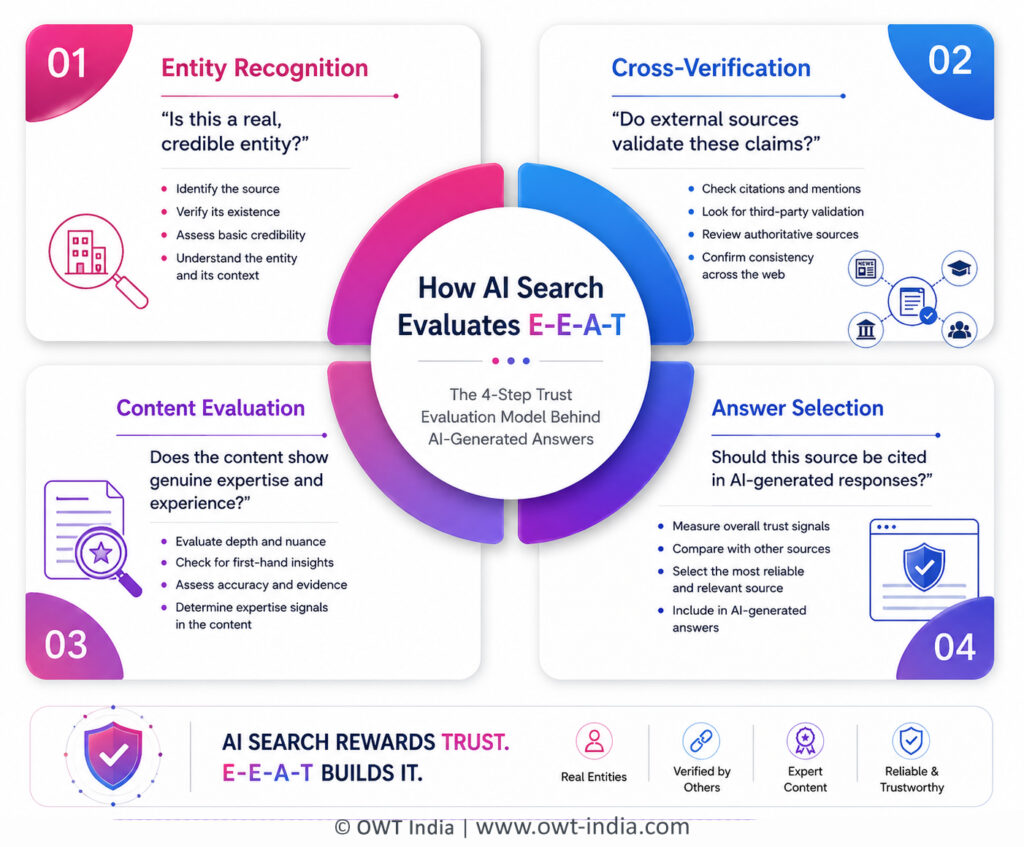
How AI Search Evaluates E-E-A-T Signals
AI search systems are not reading E-E-A-T as a structured data format — they are inferring it from the combination of signals your digital presence generates. Understanding how this inference works helps you prioritize where to focus your E-E-A-T building efforts.
Entity recognition is a crucial starting point. AI systems build knowledge graphs of entities — people, organizations, places, and concepts — and their relationships. When your business entity is clearly defined and consistent across your website, your Google Business Profile, your LinkedIn presence, industry directories, and media mentions, AI systems can confidently identify you as a real, established entity. This entity confidence is the prerequisite for any E-E-A-T evaluation.
From there, AI systems look for corroborating evidence that your claimed expertise and authority are genuine. They cross-reference your stated credentials against external validation. They look for consistency between what you claim to do and what your reviews, case studies, and third-party mentions actually describe. They evaluate whether the specificity and accuracy of your content reflects genuine knowledge or plausible-sounding generality.
The practical implication is that building E-E-A-T for AI search requires creating a coherent, consistent, and externally validated narrative about who you are and what you genuinely do. Every piece of content, every author bio, every case study, and every third-party mention should be working together to tell the same story — one that is specific enough to be credible and consistent enough to be trusted.
Key Takeaways: E-E-A-T in 2026
- E-E-A-T is the primary differentiator between human and AI-generated content. Genuine human authority is now the core competitive advantage in search.
- Experience means first-hand engagement — not theoretical knowledge. Specific case studies, acknowledged trade-offs, and real-world narratives are the clearest signals.
- Expertise is measured by depth, not volume. The ability to handle nuance, edge cases, and the limits of your own competence matters far more than how much you publish.
- Authoritativeness cannot be self-certified. It is built through citations, editorial coverage, credentials, and being referenced as a primary source by others.
- Trustworthiness is the foundation everything else rests on. Clear authorship, accurate information, and verifiable credentials underpin all other E-E-A-T signals.
- AI search evaluates E-E-A-T through inference. A consistent, externally validated narrative across your website and third-party mentions is the prerequisite for AI trust.
- Author pages and original research are your two highest-leverage E-E-A-T investments. Both establish your organisation as a primary source worth citing.