How AI Search Engines Evaluate Content: Key Signals That Matter
Search behavior is steadily shifting from browsing links to consuming answers. As AI systems generate responses directly, content is no longer evaluated only for ranking positions but for how effectively it can be understood, trusted, and used within answers. This change is redefining how content should be created, organized, and optimized.
Structuring content for AI search and featured answers requires a combination of clarity, logical organization, and strong authority signals. Businesses that adapt to this approach improve not only their rankings but also their chances of being included in AI-generated responses and zero-click results.
Ideal Content Formats for AI Search
AI systems favor content that is predictable, modular, and easy to interpret. Instead of long, dense paragraphs, information should be divided into clearly defined sections that can be extracted independently.
Formats built around questions and answers are highly effective because they mirror how users interact with AI search. Each section should address a specific query and provide a concise response before expanding into supporting details.
Short summaries and definitions also perform well. When a section begins with a direct explanation, it increases the likelihood of being selected for featured answers.
Structured formats such as step-by-step guides, numbered frameworks, and bullet-based explanations help AI systems recognize sequences and relationships. These formats make content easier to process and reuse in generated responses.
How to Write Content That Gets Picked in AI Answers
Writing for AI search requires a shift from keyword-heavy content to intent-driven communication. The focus should be on answering real questions with clarity and precision.
Each section should begin with a clear, direct response. This allows AI systems to quickly identify relevant information. Supporting content can then expand on the answer without introducing unnecessary complexity.
Language should remain natural and semantically clear. Instead of repeating keywords, use variations and context-driven phrasing that reflects how people actually ask questions. This improves both readability and alignment with AI interpretation.
Content that demonstrates depth, accuracy, and consistency is more likely to be trusted. Including examples, structured explanations, and clear reasoning strengthens credibility and increases the chances of being selected in AI-generated answers.
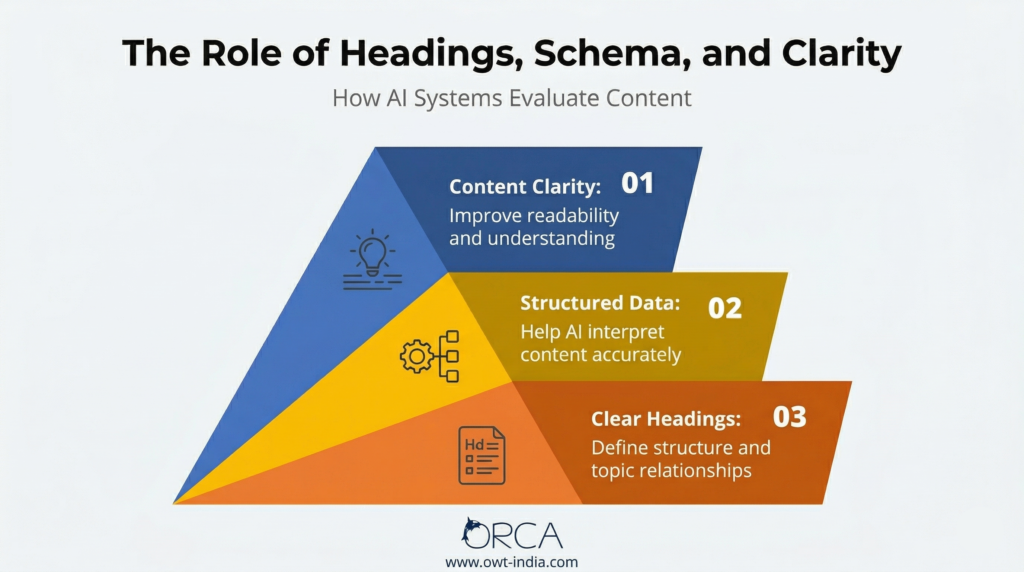
The Role of Headings, Schema, and Clarity
Structure plays a central role in how AI systems evaluate content.
Headings define the hierarchy of information. Well-written headings signal what each section is about and help AI systems map relationships between ideas. Each heading should be specific and followed by content that directly addresses it.
Schema markup provides additional context for machines. Using structured data such as FAQ or Article schema helps search engines interpret content more effectively and improves the likelihood of appearing in featured answers.
Clarity is equally important. Content should avoid ambiguity and focus on communicating one idea at a time. Short, well-formed paragraphs and logically connected sections make it easier for both users and AI systems to process information.
Key Signals AI Search Systems Look For
To perform well in AI-driven search, content must align with a set of evaluation signals that go beyond traditional ranking factors:
- Intent alignment: Directly addressing user queries
- Structured formatting: Clear sections, headings, and flow
- Answer-first approach: Immediate responses followed by context
- Semantic clarity: Natural and meaningful language
- Topical depth: Comprehensive coverage of the subject
- Entity consistency: Clear and consistent brand association
- Authority signals: Demonstrated expertise and reliability
- Content consistency: Uniform messaging across pages
- Freshness: Updated and relevant information
- Contextual linking: Strong internal connections between topics
These signals influence both search rankings and AI answer inclusion, making them essential for modern content strategy.
Common Mistakes Businesses Make
Many businesses continue to rely on outdated approaches that limit their visibility in AI search environments.
One of the most common issues is publishing unstructured content. Even when the information is valuable, lack of organization makes it difficult for AI systems to extract key insights.
Overuse of keywords is another problem. While keywords remain important, excessive repetition often reduces clarity and weakens the overall quality of content.
Inconsistent messaging across pages can also reduce trust. When a brand presents conflicting information, it becomes harder for AI systems to recognize it as a reliable source.
Ignoring structured data and clear formatting further limits discoverability. Without these elements, content may not qualify for featured answers even if it is relevant.
Building Content for AI Visibility
Structuring content for AI search is about improving how information is presented, not just how it is optimized. Businesses that focus on clarity, structure, and authority create content that is easier to interpret and more likely to be trusted.
This approach enhances visibility across both traditional search results and AI-generated answers. Over time, it helps shift content from simply being indexed to being actively used as a source of information.
As AI continues to influence search behavior, structured and well-organized content will play a key role in building sustainable digital visibility.
From the Author
Sachin Saxena, founder of OWT India, shares practical insights on improving search performance and content effectiveness in his book The SEO Audit Checklist. The book outlines structured approaches to analyzing websites, improving content quality, and strengthening foundational SEO elements.
For businesses looking to refine their content strategy and adapt to evolving search behavior, The SEO Audit Checklist provides a clear and actionable framework for building stronger, more effective digital presence.