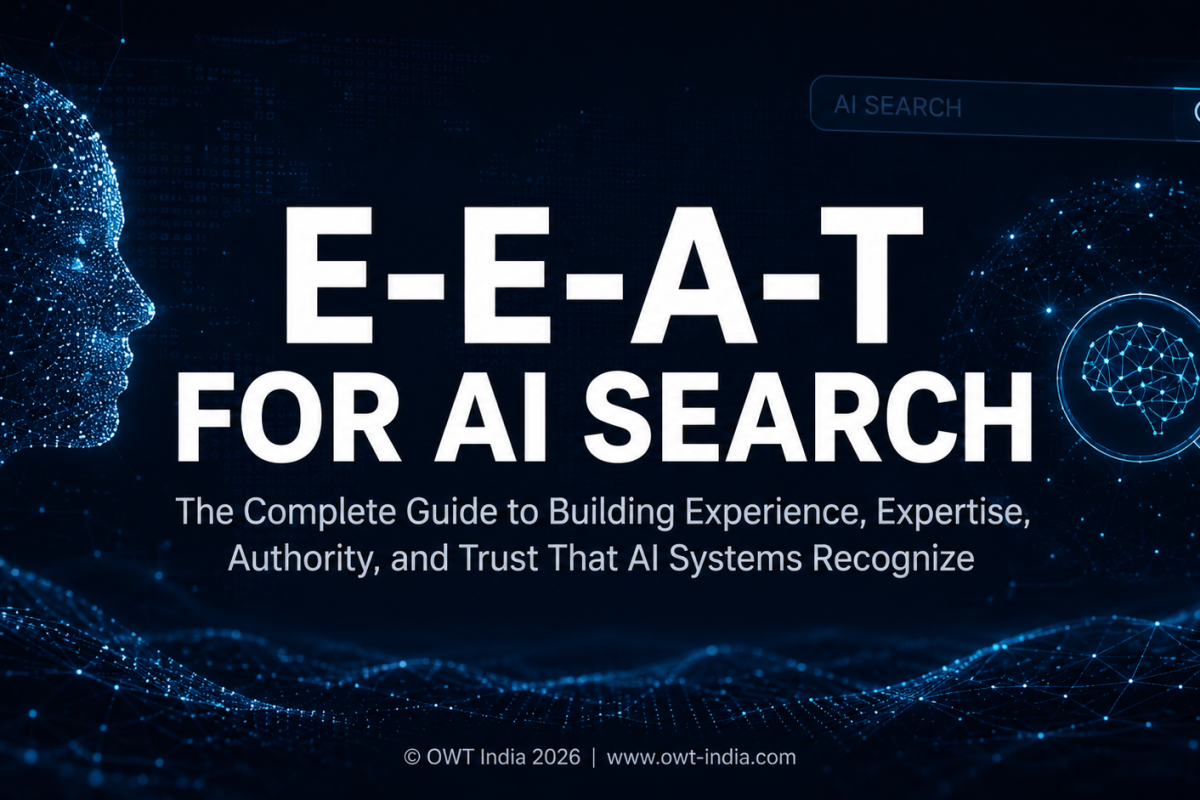
E-E-A-T for AI Search: The Complete Guide to Building Experience, Expertise, Authority, and Trust That AI Systems Recognize
What this guide covers: How AI search systems evaluate Experience, Expertise, Authoritativeness, and Trustworthiness — and exactly what to build across all four dimensions to become a source AI consistently selects and cites.
Read alongside: From Invisibility to AI Citations: The Complete AI Search Optimization Guide — the pillar post that covers all twelve implementation steps, with E-E-A-T referenced throughout.
E-E-A-T was introduced by Google as a content quality framework for human evaluators. It has since become the de facto standard for how AI search systems decide which sources to trust.
The critical difference between how Google uses it and how AI search uses it: Google weighs E-E-A-T as one signal among hundreds. A page with weak E-E-A-T can still rank — just lower. AI search systems use E-E-A-T as a filter before the citation decision. A source that fails the credibility threshold is not cited. There is no position seven equivalent in an AI-generated answer. You are either trusted enough to be selected, or you are not.
This guide covers what each dimension of E-E-A-T means in the context of AI search, how AI systems evaluate each one, and exactly what to build so that AI assistants — ChatGPT, Perplexity, Google AI Overviews, Bing Copilot — treat your content as a trusted, citable source.
What E-E-A-T Actually Means — and Why AI Search Raises the Stakes
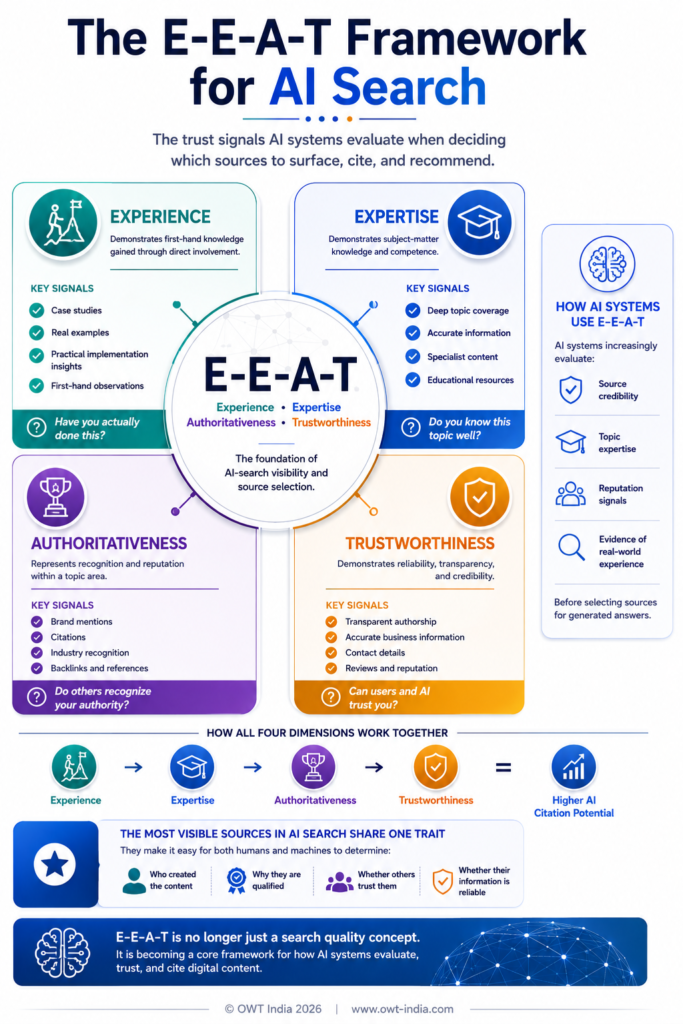
What are the four dimensions of E-E-A-T?
Experience is evidence that the content creator has direct, first-hand involvement with the topic being written about. Not research. Not reading. Actual doing — implementing, testing, failing, fixing, and producing real outcomes. Google added Experience to the original E-A-T framework in December 2022 specifically to distinguish between people who know about a topic and people who have lived it. That distinction is significant for AI search because AI systems can detect experiential specificity in ways that are difficult to fake.
Expertise is demonstrated depth of knowledge in a specific domain. It shows in technical accuracy, in the ability to address nuance and edge cases, in the consistency between what you claim to know and what your published content actually demonstrates. Expertise can come from formal credentials — qualifications, certifications, academic training — or from sustained practitioner experience that produces equivalent depth. AI systems evaluate both.
Authoritativeness is external recognition of your expertise. You cannot declare yourself authoritative. Authority is assigned by others — when credible external sources independently reference you as a trusted source on a specific topic, cite your content, quote your insights, or list you in recognized directories and publications. It is the hardest E-E-A-T dimension to build because it depends on actions taken outside your own website.
Trustworthiness is accuracy, transparency, consistency, and the absence of deceptive signals. Google’s own guidelines identify trustworthiness as the most important of the four dimensions — because expertise and authority from an untrustworthy source is not just unhelpful, it is potentially harmful. AI systems are particularly sensitive to trust signals because they are synthesizing information to present as fact to users who may act on it.
How is E-E-A-T for AI search different from E-E-A-T for Google?
The signals are largely the same. The consequences of weak signals are dramatically different.
In traditional Google search, E-E-A-T influences ranking position. A page with weak E-E-A-T signals might rank eighth instead of second. It still appears. Users can still find it. The penalty is reduced visibility, not invisibility.
In AI search, E-E-A-T functions as a binary filter. Before an AI system considers whether your content answers a query, it evaluates whether your source is credible enough to cite. A source that does not pass that evaluation is not included in the generated answer — regardless of how relevant or well-written the content is. The penalty is complete absence from the AI response.
This binary effect has a specific practical implication: investing in content quality without investing in E-E-A-T signals produces content that AI systems encounter, evaluate, and decline to cite. The content exists. The AI found it. The AI chose not to use it. That is the gap this guide closes.
Which types of content are most affected by E-E-A-T in AI search?
YMYL content — Your Money or Your Life, the categories where inaccurate information could cause real harm — is evaluated most strictly. Health, finance, legal, and safety topics require the strongest E-E-A-T signals because the cost of a wrong citation is highest.
B2B professional services are evaluated at near-YMYL standards. When a business decision-maker asks an AI assistant to recommend a digital marketing agency, a software provider, or a consulting firm, the AI is effectively influencing a significant business and financial decision. The threshold for citation is high.
Even in lower-stakes categories, AI systems consistently prefer attributed, verifiable content over anonymous content. A well-written anonymous blog post and an equally well-written post attributed to a named expert with verifiable credentials will not perform equally in AI search. The named, attributed source wins — not because the content is better, but because the source is more trustworthy.
How AI Systems Actually Evaluate E-E-A-T
What is the three-layer evaluation process AI systems use?
AI systems evaluate E-E-A-T in three sequential layers. Weakness in any layer reduces citation likelihood regardless of strength in the others.
Layer 1 — Entity verification: Can the AI confirm who is behind this content? Is there a named author with a verifiable profile? Is the publishing organization a recognizable entity with consistent external presence? If entity verification fails — if the AI cannot confirm that a real, verifiable person or organization produced this content — the evaluation stops here.
Layer 2 — Content credibility assessment: Does the content demonstrate genuine knowledge? Does it address nuance? Does it cite sources for its claims? Is it consistent with what other credible sources say about the same topic? At this layer, AI systems are effectively asking: “Is this content accurate enough and specific enough that I would be comfortable presenting it as fact?”
Layer 3 — External corroboration: Do third-party sources independently confirm this entity’s expertise? Are they cited elsewhere? Are they mentioned in recognized publications or directories without prompting? External corroboration is what converts AI confidence from “this seems credible” to “this is verifiably credible” — and that distinction drives the citation decision.
What is the difference between AI inference and declaration for E-E-A-T?
AI systems can infer E-E-A-T signals from unstructured content — reading your About page, your author bio, and your published posts and drawing conclusions about your credibility. But inferences carry uncertainty. A system that infers your expertise is less confident than a system that has read a machine-readable declaration of it.
Structured data converts inference to declaration. When your Person schema explicitly states your job title, your areas of expertise via knowsAbout, your affiliation with your organization via worksFor, and your verifiable external profiles via sameAs — the AI does not need to infer. It reads a direct declaration. That shift from inference to declaration consistently increases citation confidence and, consequently, citation rates.
The practical implication: the E-E-A-T you have built organically through content and external presence becomes significantly more impactful when made explicit through schema markup. Both are required. Schema without genuine E-E-A-T signals is hollow. Genuine E-E-A-T without schema is underutilized.
What cannot be verified by AI systems — and why those gaps matter?
Three categories of content are systematically undervalued by AI systems because they cannot be independently verified:
Anonymous content — AI cannot verify the credentials of an unnamed author. The content may be excellent, accurate, and deeply researched. But an unverifiable source is a less trustworthy source, and AI systems treat it accordingly.
Unattributed statistics — a claim presented as fact without a source citation cannot be cross-referenced for accuracy. AI systems that encounter “studies show that 73% of businesses…” with no linked study cannot verify the figure. Unverified statistics reduce trust in the entire piece.
Self-declared expertise — claims made only on your own website, without external corroboration, are treated as assertions rather than verified facts. Saying “we are experts in AI search optimization” on your own About page is an assertion. Being cited as an AI search optimization expert by Search Engine Journal is corroboration. The second is worth significantly more to AI systems evaluating your credibility.
All three gaps are fixable. None of them require significant budget. They require deliberate attention — to attribution, to source citation, and to building the external presence that transforms self-declaration into corroboration.
How to Build Experience Signals for AI Search
What do experience signals look like in content?
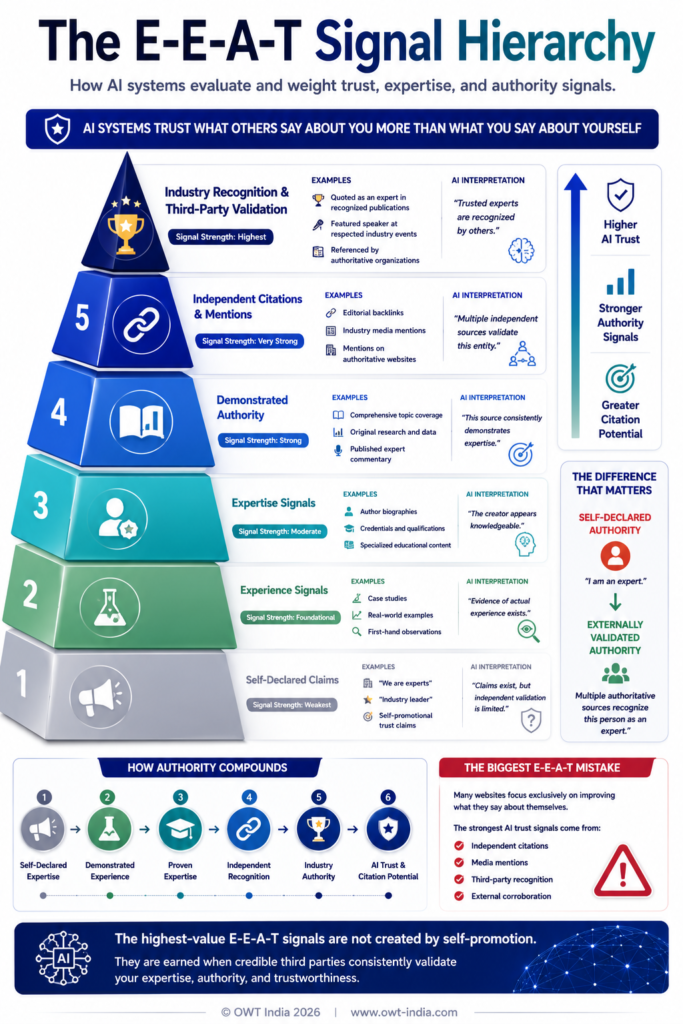
Experience signals are specific, verifiable details that could only come from direct involvement with a topic. They are the difference between content written by someone who understands a subject and content written by someone who has implemented, tested, and observed results in the real world.
Specific outcomes with real numbers: “The client’s AI Overview appearances increased by 40% within six weeks of implementing FAQPage and HowTo schema” is an experience signal. “Schema markup can improve AI visibility” is not. The first could only be written by someone who measured a real result. The second could be written by anyone who read about schema markup for thirty minutes.
Named tools and versions: “Using RankMath’s Schema module in WordPress 6.5, with Organization schema implemented via functions.php as a fallback” is an experience signal. “Using an SEO plugin” is not. Practitioners know the specifics because they have used the tools. Researchers know the generics because they have read about them.
Edge cases and failure modes: Every implementation has edge cases — the conditions under which the standard advice breaks down. Only people who have done the work know where it breaks and why. Content that addresses these edge cases — “this approach works well except when the post type is a custom type, in which case is_singular(‘product’) returns false and the entire function silently fails” — signals practitioner knowledge at a level no amount of research can fake.
First-person account language: “When we restructured the content hierarchy for a professional services client in Delhi” is an experience signal. “Businesses should consider restructuring their content hierarchy” is not. The first anchors the advice in real work. The second presents advice from nowhere in particular.
How do you write with experience signals consistently?
Three practices produce consistent experience-signal content without requiring you to fabricate or exaggerate.
Use client work as source material. Every project you complete is potential experience content. The problem solved, the approach taken, the result achieved, and the lessons learned — each element of real work is a building block for experience-rich content. Anonymize where necessary, but retain the specifics that make the account credible.
Document as you implement. The act of documenting your own implementation process as you do it produces content that no amount of after-the-fact writing can replicate. Notes taken during an implementation — what you tried, what failed, what you adjusted, what worked — are the raw material for some of the most credible content available.
Acknowledge what you do not know. Counterintuitively, acknowledging the limits of your experience builds more trust than claiming omniscience. “We have implemented this approach for professional services and B2B businesses. We have not yet tested it comprehensively for e-commerce, where the product schema variables are different” is more credible than presenting a universal claim. AI systems, like human readers, recognize the difference between confident expertise and overreach.
What content formats carry the strongest experience signals?
Case studies are the highest-experience-signal format. A case study that names the client (where permissible), describes the situation before intervention, details the approach taken, and documents the measurable outcome is the clearest possible signal that the author has done the work. Even anonymized case studies — “a professional services firm based in Delhi with 15 employees and an underperforming website” — retain their experience signal if the detail is specific.
Process documentation written from direct implementation experience carries strong experience signals. The difference between generic how-to content (“add schema markup to your pages”) and practitioner process documentation (“open your functions.php file, add the following code block at the bottom, save, and test immediately at validator.schema.org before checking your site for any white screen errors”) is the difference between instruction and experience.
Lessons learned sections are among the most underused experience-signal formats. A paragraph at the end of any implementation guide that explicitly addresses what went wrong during testing, what the fix was, and what you would do differently next time signals direct practitioner involvement more clearly than any amount of polished process description.
How to Build Expertise Signals for AI Search
What does expertise look like to an AI system?
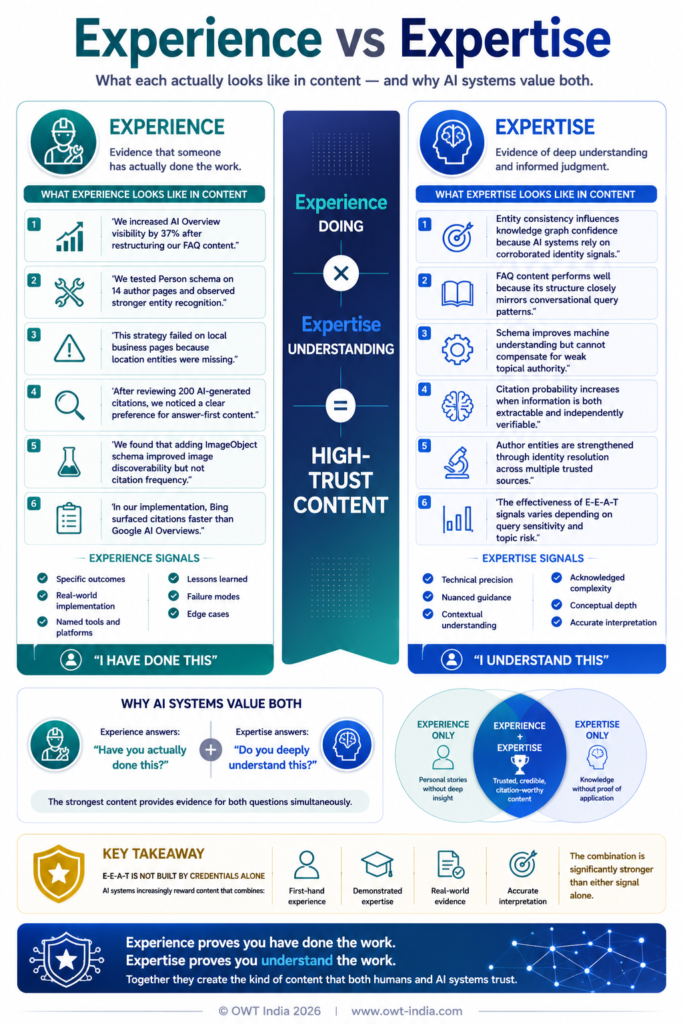
Expertise is demonstrated through coverage depth, technical accuracy, and the specificity of knowledge that only genuine practitioners possess.
Coverage depth: A source that covers a topic from every angle — including nuance, edge cases, and conflicting expert views — demonstrates expertise that surface-level content cannot. A comprehensive guide to schema markup that covers Organization schema, Person schema, FAQPage, HowTo, BreadcrumbList, VideoObject, ImageObject, and SpeakableSpecification — with implementation code, common errors, and validation methodology for each — demonstrates expertise. A 500-word overview of “what schema markup is” does not.
Technical accuracy: AI systems cross-reference your content against other credible sources on the same topic. Content that is technically accurate and consistent with expert consensus is trusted. Content that contains inaccuracies — even minor ones — reduces the AI’s confidence in the entire source, not just the inaccurate claim.
Terminology precision: Every field has a vocabulary. Using that vocabulary correctly and consistently is a signal of insider knowledge. Using terms incorrectly, interchangeably, or imprecisely signals familiarity without mastery. In AI search optimization specifically: “schema markup” and “structured data” are not identical — schema markup is a vocabulary for structured data; structured data is the broader category. Using them precisely signals expertise. Using them interchangeably signals surface familiarity.
How do you build topical expertise signals through content?
Topical expertise is built cumulatively, through consistent publication of genuinely deep content on a focused subject. One well-written article on AI search optimization establishes presence. A structured library of fifteen interconnected pieces — covering entity SEO, schema implementation, content structure for AI, local AI search, multimedia optimization, E-E-A-T, and monitoring — establishes expertise.
The specialist advantage is significant. A website that covers AI search optimization in exhaustive depth is more credible as an AI search optimization expert than a website that covers digital marketing broadly with AI search as one of thirty topics. AI systems reward topical depth. Generalist coverage produces generalist citation rates. Specialist coverage produces specialist authority.
The expertise depth test is practical: after reading your content on a topic, could a reader ask a follow-up question and find the answer in your other published content on the same subject? Does your content address the conditions under which the standard advice does not apply? Does it acknowledge when expert opinion is divided rather than presenting one view as universal? These are the hallmarks of expert coverage that AI systems are trained to recognize.
How do author credentials function as expertise signals?
Author credentials are one of the most directly impactful expertise signals available — and one of the most commonly neglected. The credentials themselves matter less than their visibility and verifiability.
Formal credentials — qualifications, certifications, academic training, professional association memberships — should be listed explicitly on the author’s profile page and referenced in their Person schema’s description field. A credential that exists but is invisible to AI crawlers produces no signal. A credential made explicit in structured data and on the author profile page is machine-readable and verifiable.
Practical credentials — years of experience, notable client work, case study outcomes, published books — are often more relevant than formal credentials for practitioner-led expertise. A twenty-year practitioner in SEO with documented client outcomes and three published books on the subject is a more credible source on AI search optimization than a recently certified professional with no documented track record, regardless of which has the formal qualification.
The credential verification chain: credentials mentioned on your website + confirmed on LinkedIn + referenced in press coverage = AI-verified expertise. Each link in the chain is a corroborating signal from a different source. Three independent confirmations of the same credential are significantly more powerful than one self-declaration of it.
Why are published books the strongest individual expertise signal?
A published book is the highest-authority individual expertise signal available for a business practitioner. It signals a level of expertise that warranted long-form treatment, was sufficient for a publisher (even a self-publisher on Kindle) to bring to market, and has been reviewed and referenced by others.
For AI search specifically, books create entity records. A book listed on Open Library with an associated author entity, connected to a Wikidata entry for both the book and the author, cross-referenced with the author’s website and LinkedIn profile — creates a machine-readable expertise signal web that no collection of blog posts can replicate.
If you have published books, ensure they are listed on Open Library with correct metadata, connected to your author Wikidata entry, referenced in your Person schema’s sameAs array, and mentioned explicitly on your About page and author profile. These connections transform a book from a credential you mention into a machine-readable expertise signal that AI systems can traverse and verify.
How do you build expertise signals without formal credentials?
Formal credentials are one route to demonstrated expertise. Deep practitioner knowledge is another — and for most business topics, the more relevant of the two.
The named methodology approach is particularly powerful. A defined, named framework that you have developed through practice — the 5-Layer AI Search Readiness Audit, the Entity Web model, the pillar-cluster content architecture — is a citable intellectual contribution in its own right. When your framework is referenced by others, taught in industry courses, or cited in external content, the framework itself becomes an expertise signal. The author of a recognized framework is, by definition, an expert.
Original research with proprietary data is equally powerful. If you have surveyed your clients, analyzed anonymized project outcomes, or produced any original data that no other source has — publish it. AI systems cannot synthesize an answer about your proprietary research without citing you as the source. A benchmark study on AI search citation rates across industries, based on your own client data, is more valuable than twenty well-written posts synthesizing existing research.
How to Build Authoritativeness Signals for AI Search
What does authority actually mean and why can it only come from external sources?
Authority is the E-E-A-T dimension that cannot be self-declared. You can describe your experience in your own content. You can demonstrate your expertise through the depth of your published work. But authority is assigned by others — it exists only when credible external sources independently reference you as a trusted source on a specific topic.
This is why authority is the hardest dimension to build and the most valuable to have. It requires consistent effort over time to accumulate the external presence that AI systems cross-reference when evaluating citation credibility. A business that has been cited in three recognized industry publications, referenced in ten credible external websites, and named as an expert in two podcast episodes has authority that no amount of on-site optimization can replicate.
What is the authority signal hierarchy and how should you prioritize it?
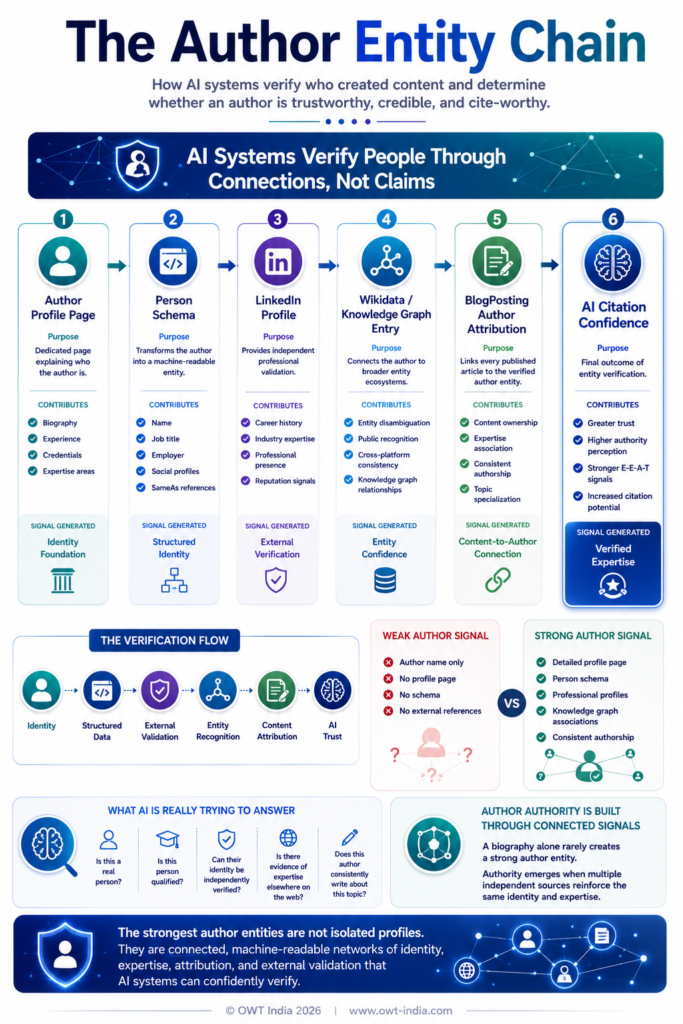
Not all authority signals carry equal weight. Understanding the hierarchy allows you to invest your effort where it produces the strongest signal.
Tier 1 — Being cited as an expert source in a recognized industry publication. A named quote in Search Engine Journal, Economic Times, YourStory, or an equivalent recognized publication — where a journalist or editor sought you out as an expert — is the highest-authority signal available. It is third-party validation from a source with its own verifiable authority. AI systems weight this signal heavily precisely because it is so difficult to manufacture.
Tier 2 — Guest authorship with a named byline in a credible publication. An article published under your name in a recognized platform signals that an editorial team found your expertise sufficient to publish. The byline, the author bio, and the link back to your website all contribute to your authority signal. Guest articles in relevant Indian digital marketing and business publications — Inc42, YourStory, Entrackr, Search Engine Land — are high-value authority signals for OWT India’s specific audience.
Tier 3 — Speaking credits at recognized industry events. Being listed as a speaker, panelist, or workshop leader at a recognized conference or event produces an external entity — the event website — that describes you as an expert on a specific topic and links your name to your organization. Even online webinars and virtual summits produce these records if the event has a public-facing program page.
Tier 4 — Being referenced or linked to from credible business websites. When a recognized publication, a credible business, or an established practitioner links to your content as a reference, they are implicitly endorsing your authority on the linked topic. Quality matters more than quantity — one editorial link from a domain with genuine authority outweighs fifty links from low-quality sources.
Tier 5 and below — Industry directory listings, social citations, and community recognition. These contribute to the overall authority signal web but carry less individual weight. They are valuable as cumulative signals and for NAP consistency, but should not be the primary focus of authority-building investment.
How do you build authority through content that earns external citations?
The content formats that most reliably earn external citations share a common characteristic: they contain something that other content cannot replicate — original data, a named framework, a definitive treatment of a topic, or a perspective that shifts how practitioners think about a subject.
Original research is the most reliable citation magnet. Data that no other source has is inherently citable — anyone writing about the topic you studied has to reference you to cite your findings. Even modest original research — a survey of twenty clients, an analysis of your own project data, a benchmark built from anonymized work — creates citation opportunities that generic content cannot.
The definitive guide approach works by being the most comprehensive treatment of a topic available. When your guide on schema markup for AI search covers every schema type, every implementation pattern, every common error, and every validation methodology — in greater depth than any other single resource — it becomes the default reference that other writers link to rather than writing their own version of.
Named frameworks and methodologies get cited because they give practitioners a shorthand. The 5-Layer AI Search Readiness Audit is more citable than “a comprehensive approach to auditing AI search readiness.” Named things can be referenced. Unnamed approaches cannot. When you develop and name a framework, you create a citable intellectual contribution.
How do you build authority through external presence?
Guest articles require identifying the right publications for your audience and expertise, pitching with a specific, relevant angle rather than a generic offer, and maximizing the authority signal from each placement by including a complete author bio with links to your website and professional profiles. The most effective pitch format: one paragraph on the specific topic and angle, one paragraph on why you are qualified to write it, and one paragraph on why their audience will find it valuable.
Podcast appearances generate show notes that name you, describe your expertise, and link to your website — creating an external entity record that AI systems can find and reference. Select shows whose audience overlaps with your target clients and whose episode content is published with detailed, searchable show notes. A podcast with thorough show notes that include your name, your organization, your specific topic, and links to your website generates significantly more authority signal than one that publishes only a brief episode description.
Press coverage is the highest-leverage authority-building activity — and the most dependent on having a distinct point of view. Journalists and editors are not looking for companies to feature; they are looking for experts who can provide insight, data, or perspective that serves their readers. Having a clear, consistent, differentiated point of view on AI search optimization — and being willing to share it plainly when asked — is what generates press coverage. Responding to journalist queries through platforms that connect sources with journalists is one of the most time-efficient ways to begin building press citation authority.
How to Build Trustworthiness Signals for AI Search
Why is trustworthiness the most important E-E-A-T dimension?
Trustworthiness underpins the other three dimensions. Expertise and authority from an untrustworthy source is not just unhelpful — it is dangerous. A source that is highly authoritative but systematically misleading is worse than a source with no authority at all, because the authority amplifies the reach of the misleading content.
AI systems are particularly sensitive to trust signals for this reason. They are presenting synthesized information to users who may act on it — making purchasing decisions, medical decisions, financial decisions. The cost of citing an untrustworthy source is higher for AI than for traditional search, where the user at least has the opportunity to evaluate the source directly before acting on the information.
Google’s guidelines explicitly identify trustworthiness as the most foundational E-E-A-T dimension — the one that, without which, the others cannot be fully credited. AI systems appear to apply the same logic. A source that fails the trust evaluation is not cited, regardless of its experience, expertise, or authority.
How do you build factual accuracy as a trust signal?
Cite primary sources for every statistic and factual claim. This is the single most important factual accuracy practice. When you cite a statistic, link to the original research — not to a blog post that cited the research, not to a news article that reported on the research, but to the original paper, report, or dataset. Statistic laundering — citing a secondary source that cited a tertiary source that originally cited a study — is widespread and detectable. AI systems that trace citation chains find laundered statistics less trustworthy than directly cited primary sources.
When you cannot find the primary source, do not use the statistic. The temptation to include a widely circulated statistic without a reliable source is strong — these statistics often appear convincingly authoritative precisely because they have been repeated so many times. Resist it. An unverifiable statistic is a trust liability. A specific, verifiable claim is a trust asset.
Correct errors visibly and transparently. Mistakes in published content are inevitable. How they are handled is a trust signal. A visible correction notice — “Update [date]: An earlier version of this post stated X. The correct figure is Y, per [source]” — signals editorial integrity. Quietly editing errors without acknowledgment, or leaving errors uncorrected, signals the opposite.
How do you build transparency as a trust signal?
Transparency is about making the “who, what, and why” of your content visible and verifiable.
About page completeness: Your About page should tell AI systems — and human readers — exactly who is behind your content. This means your legal business name, your trading name if different, your founding date, your founders and key team members by name and with their credentials, your physical address, your contact information, your primary services, and the areas in which you have genuine expertise. Vague mission statements and marketing slogans are not transparency signals. Specific, verifiable facts are.
Author disclosure: Every piece of content should be attributed to a named author with a visible link to their profile. The profile should include their professional background, their relevant credentials, and their contact information or a professional profile link. Content attributed to “The OWT India Team” or published without any author attribution is anonymous content from AI’s perspective — regardless of how well-written it is.
Conflict of interest acknowledgment: Where you have a financial or professional interest in a recommendation you are making — recommending a tool you use affiliate links for, recommending an approach your service implements — acknowledging that relationship is a transparency signal. Its absence, where the relationship exists, is a trust liability.
How do you build consistency as a trust signal?
Consistent NAP: Your business name, address, and phone number must be identical across every platform where your business appears. Inconsistencies create conflicting entity signals. AI systems that encounter three different phone numbers associated with OWT India across three different platforms treat that inconsistency as a trust signal failure — they cannot determine which record is accurate.
Consistent entity information: Your business description, your service offerings, your founding date, and your team information should say the same things everywhere they appear — on your website, your GBP, your LinkedIn, your Facebook, and every directory listing. Inconsistencies between platforms suggest either poor management or, in a worst-case inference, deliberate misrepresentation.
Consistent publishing: A website that publishes regularly and consistently signals active, maintained editorial attention. A website that published fifteen posts in 2023 and nothing since signals abandonment — regardless of the quality of the original fifteen posts. Consistent publishing is not about volume; a single post per month maintained consistently over two years is a stronger freshness signal than twenty posts published in a burst followed by silence.
Consistent positioning: If your content on AI search optimization consistently argues for entity-first optimization, and then a later post argues the opposite without explanation, that inconsistency reduces trust in your expertise. Practitioners refine their positions over time — that is legitimate — but changes in position should be acknowledged and explained, not silently substituted.
What website-level trust signals matter for AI search?
HTTPS is baseline. An unencrypted website (HTTP) is not a competitive disadvantage — it is a disqualifier. Every credible source in 2026 uses HTTPS. A website without it fails a fundamental trust check.
Privacy policy and terms of service pages signal that the business operates transparently and takes its legal obligations seriously. Their absence is a minor trust signal failure on its own; in combination with other weak trust signals, it compounds into a credibility problem.
No broken links or 404 errors on key pages. A website that links to resources that no longer exist signals inattention. For AI crawlers, broken internal links are navigational failures — they interrupt the topical mapping process. For human readers and AI evaluators alike, they signal that the content is not being maintained.
Accurate, current schema. Schema that accurately reflects your live page content is a trust signal. Schema that contradicts visible content — an AggregateRating showing 4.9 stars on a page with no visible reviews, a price in schema that differs from the price on the page — is a trust failure that is often worse than having no schema. Inaccurate schema signals either carelessness or deliberate misrepresentation.
E-E-A-T for Organizations vs Individuals — Building Both in Parallel
Why do both organizational and individual E-E-A-T matter?
AI search systems evaluate two parallel E-E-A-T tracks simultaneously: the credibility of the organization publishing the content, and the credibility of the individual who authored it. Both must be sufficient. Strong organizational E-E-A-T does not compensate for anonymous, unattributed content. Strong individual E-E-A-T from an author with no organizational affiliation is less credible than the same expertise backed by a verifiable organization.
The interaction between the two tracks creates a compounding effect. Sachin Saxena’s expertise as an author makes every piece of content published on owt-india.com more credible. OWT India’s organizational authority as an entity makes every piece of content attributed to Sachin Saxena more credible. The two reinforce each other — which is why building both in parallel consistently outperforms focusing exclusively on one.
How do you build organizational E-E-A-T?
Organizational E-E-A-T is built through the entity signals described in the entity foundation step of the AI search optimization guide — but it extends beyond basic entity establishment into sustained organizational credibility.
Track record documentation: How long has the organization operated? What notable clients has it served? What measurable outcomes has it produced? This information should be present and verifiable on the About page, in case studies, and through external references. An organization with twenty years of history and documented client outcomes has organizational E-E-A-T that a newly formed entity cannot match — but the twenty-year history only counts if it is documented and verifiable.
Public-facing leadership: Organizations whose leadership team is publicly identified, professionally profiled, and verifiable are more trustworthy than organizations that present no human face. The leadership team page — with named individuals, their roles, their credentials, and their professional profiles — is an organizational trust signal as much as an individual expertise signal.
Organizational schema completeness: Organization schema with foundingDate, numberOfEmployees where applicable, award for recognized achievements, areaServed, and complete sameAs links to all verified external profiles presents a machine-readable organizational identity that AI systems can evaluate as a complete entity.
How do you build individual E-E-A-T for the expert-founder model?
For businesses where the founder is the primary expert — where Sachin Saxena is OWT India, and OWT India is Sachin Saxena — individual and organizational E-E-A-T are effectively unified. Every signal that strengthens Sachin’s individual authority also strengthens OWT India’s organizational credibility.
This model has distinct advantages for AI search. A named expert-founder creates a strong, singular entity that AI systems can verify comprehensively. The attribution chain is simple: content → named author → author profile → Organization affiliation → Organization entity → verified external profiles. Every link is traceable and verifiable.
The primary risk of the expert-founder model is single-point dependency. If the founder’s credibility is challenged, the entire organization’s credibility is affected. The mitigation is diversification over time — building team member profiles, attributing some content to other named experts within the organization, and gradually building organizational authority that exists independently of any single individual.
What is the named author requirement and why does it matter so much?
Every piece of content published on your website should be attributed to a named author. Not “OWT India Team.” Not “Editorial Staff.” A specific named person with a verifiable professional profile.
This requirement is not bureaucratic. It is the difference between content that AI systems can evaluate for E-E-A-T and content they cannot. When an article is attributed to Sachin Saxena and linked to his profile page — which links to his LinkedIn, his Wikidata entry, his published books, and his organizational affiliation — the AI can traverse a complete verification chain. When the same article is attributed to “OWT India Team,” the verification chain ends at the organization level. The individual expertise signal is absent.
The practical implementation: review your published content and add named author attribution to every post that currently lacks it. Update author profile pages to be complete entity pages rather than brief bios. Implement Person schema for every named author with @id, worksFor, sameAs, and knowsAbout populated. These changes are low-effort relative to their E-E-A-T impact.
The Eight Most Common E-E-A-T Mistakes That Kill AI Citation Rates
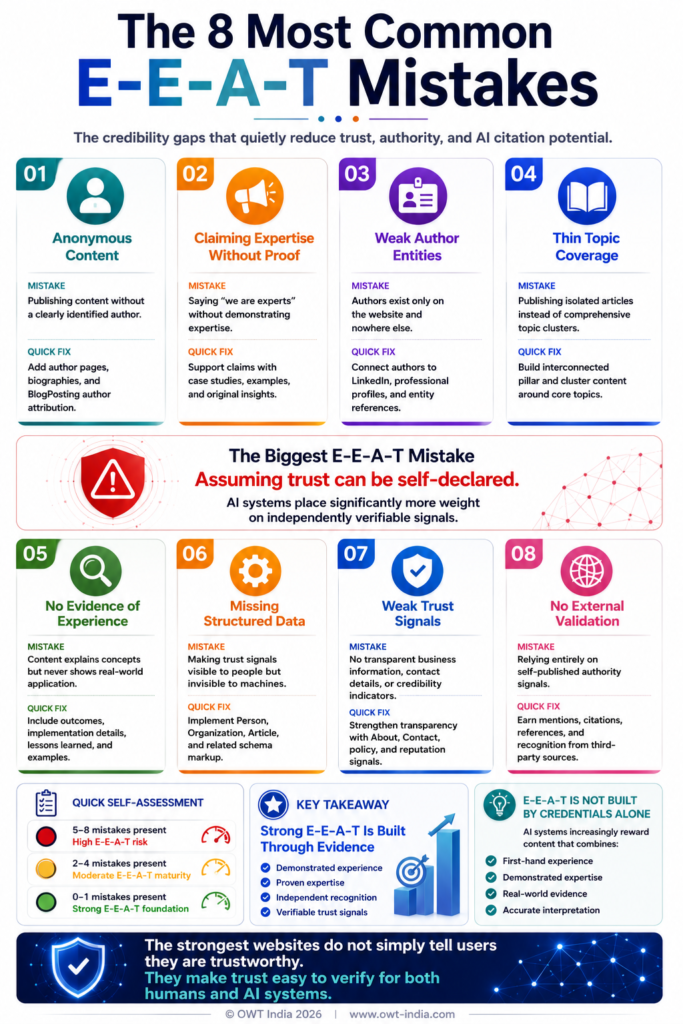
Mistake 1 — Publishing content without named author attribution
Every piece of content attributed to a generic team byline or published with no author attribution is anonymous from AI’s perspective. The content may be excellent. The source is unverifiable. Fix: add a named author to every published piece and link every byline to a complete author profile page.
Mistake 2 — An About page that reads like a marketing brochure
Vague mission statements, aspirational language, and the absence of specific verifiable facts produce an About page that is useless for AI entity verification. Fix: rewrite the About page with your legal business name, founding date, named founders, physical address, specific service descriptions, credentials, and notable client outcomes. Write for machine readability, not marketing persuasion.
Mistake 3 — Citing secondary sources instead of primary research
“According to a study, 73% of businesses…” with no linked source is a trust liability. AI systems that cannot verify the statistic trust the entire piece less. Fix: link to the primary research source for every statistic and factual claim. If you cannot find the primary source, do not use the statistic.
Mistake 4 — Inconsistent NAP and business information across platforms
Different spellings, different phone numbers, and different addresses across platforms create conflicting entity signals. AI systems that encounter inconsistencies treat them as verification failures. Fix: run a NAP consistency audit across your top twenty citation sources and correct every inconsistency before building further.
Mistake 5 — Schema that contradicts visible page content
An AggregateRating schema showing 4.8 stars on a page with no visible reviews. A price in Offer schema that differs from the price on the page. A dateModified date that has not been updated in eighteen months despite visible content changes. Any of these contradictions signal to AI systems that the schema is inaccurate — which undermines the trust function of schema entirely. Fix: audit schema against live content regularly and ensure every schema value accurately reflects the current state of the visible page.
Mistake 6 — No external citations for statistics or factual claims
Content that presents facts and figures without source links forces AI systems to treat every claim as an unverified assertion. Fix: cite all statistics to primary sources. When primary sources are unavailable, acknowledge the limitation explicitly rather than presenting unverified claims as fact.
Mistake 7 — Stale content with no visible update date
A post from 2021 presenting information about AI search optimization as current practice — with no update notice, no revised date, and no acknowledgment that the field has changed — signals to AI systems that the content is unreliable for current queries. Fix: review fast-moving content quarterly, update with genuine new information, and update both the visible “last updated” notice and the dateModified schema value on the same day.
Mistake 8 — Building domain authority while ignoring author authority
Investing in backlinks, content volume, and domain metrics while authors remain anonymous or uncredentialed produces domain-level authority without the author-level E-E-A-T that AI systems use to evaluate individual pieces of content. Fix: name and credential every author. Build complete author profile pages. Add Person schema with full sameAs links. Cite authors’ external profiles prominently on their profile pages and in their article bylines.
How to Measure Your E-E-A-T Strength
Why is there no single E-E-A-T score and what do you use instead?
No tool gives you a reliable E-E-A-T score. E-E-A-T is a composite of signals across four dimensions, evaluated differently by different AI systems, and expressed differently across different content types. A single metric cannot capture it.
What you use instead is a structured four-dimension audit, conducted quarterly, that assesses your current signal strength in each dimension, identifies your most critical gaps, and prioritizes the fixes that will have the greatest impact on AI citation rates.
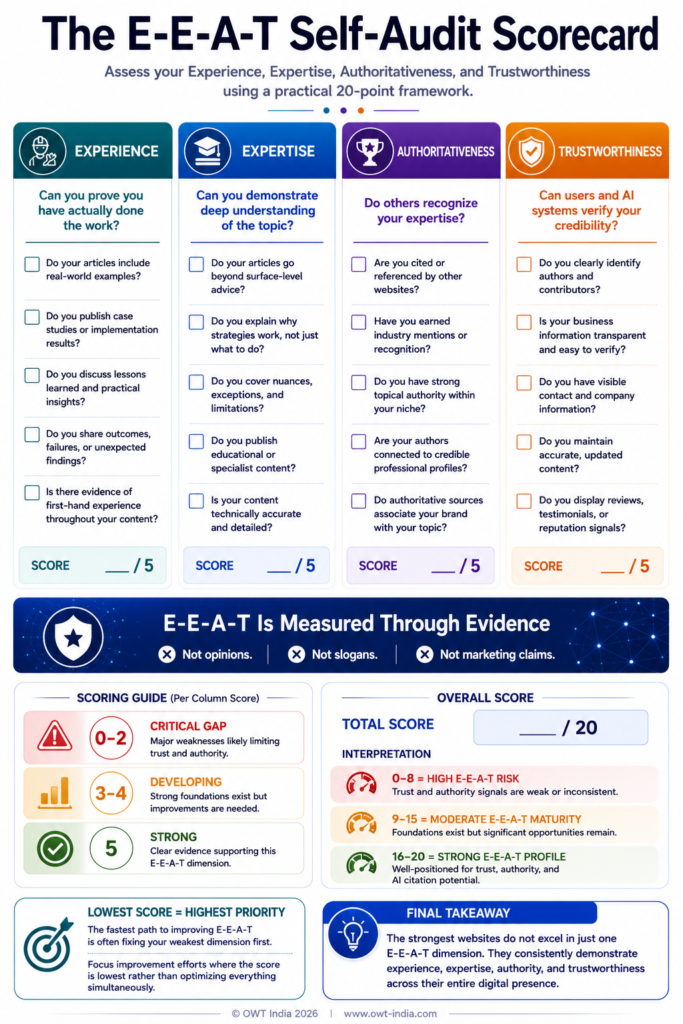
How do you conduct the E-E-A-T self-audit?
The Experience audit — five questions:
Does your most important content contain first-person specific examples from actual client or project work? Do your case studies include named outcomes with real numbers? Does your how-to content acknowledge edge cases and failure modes? Are all authors named and credited on every piece of content? Could a reader tell from your content that you have done this work — not just researched it?
The Expertise audit — five questions:
Does your content cover your primary topics with sufficient depth to address follow-up questions? Are your authors’ credentials clearly visible and verifiable on their profile pages? Does your Person schema include knowsAbout populated with genuine expertise areas? Have you published any original research, named frameworks, or unique data on your primary topics? Does your content address the conditions under which standard advice does not apply?
The Authoritativeness audit — five questions:
Are you cited by name in any external publications on your primary topics? Do you have guest articles published under your byline on credible external platforms? Are your pages linked to from domains with their own verifiable authority? Do your authors have external profiles — LinkedIn, Open Library, Wikidata — that corroborate their expertise? Are you mentioned in any industry directory, award listing, or recognition platform?
The Trustworthiness audit — five questions:
Is every statistic in your content cited to a primary source? Is your About page factual, complete, and machine-readable with specific verifiable information? Is your NAP consistent across your top twenty citation sources? Does your schema accurately reflect the current state of your visible page content? Has your fast-moving content been reviewed and updated in the last six months?
Score each question as 0 (not in place), 1 (partially in place), or 2 (fully in place). Maximum score per dimension: 10. A score of 0–4 indicates a critical gap. 5–7 indicates developing signals. 8–10 indicates strong signals. Total maximum score: 40.
How do you use AI search results as an E-E-A-T proxy?
Your AI citation patterns are the most direct available proxy for your E-E-A-T strength — more reliable than any tool-based assessment because they reflect how AI systems are actually evaluating you.
If AI systems cite you consistently for your primary topics: your E-E-A-T signals are sufficient for those topics. Maintain and expand.
If AI systems know your name but do not include you in category recommendations: your entity signals are established but your expertise and authority signals for competitive queries are insufficient. Focus on topical depth and external citation building.
If AI systems return accurate but generic information about you: your entity is recognized but your content signals are weak. Focus on content structure, author attribution, and schema implementation.
If AI systems have no information about you or return inaccurate information: your entity and trust foundation has not been established. Start at entity foundation before addressing any other E-E-A-T dimension.
How long does it take to build E-E-A-T signals that AI systems recognize?
The timeline varies by dimension and by your current starting point. Schema and structured data changes can produce measurable effects within four to eight weeks — because they give AI crawlers explicit declarations they did not previously have. Author profile page completion and attribution changes similarly take effect within weeks.
External authority signals take longer. A guest article submitted, edited, and published takes weeks to months depending on the publication’s editorial cycle. A press mention that emerges from a journalist query can appear within days. Building the cumulative authority signal of multiple external citations typically takes three to twelve months of sustained effort.
The compound effect is the most important concept in E-E-A-T development: each signal you build makes the next signal more credible and more impactful. The entity foundation you build in month one makes the content you publish in month three more trustworthy. The guest article published in month four makes the press coverage in month eight more likely. The work compounds. Start early.
Your Complete E-E-A-T Implementation Checklist
Four dimensions. Forty items. Work through them in the order that addresses your most critical audit gaps first.
Experience
- Named author on every piece of published content, linked to a complete profile page
- Author profile pages include photo, professional bio, and credentials
- Primary content pages contain first-person specific examples from actual client or project work
- At least one published case study with a specific named outcome and real numbers
- How-to content acknowledges edge cases and conditions under which standard advice does not apply
- At least one before-and-after comparison from real client or implementation work
- Lessons learned section present in at least one major implementation guide
- Client feedback quotes present on at least one content page with attribution where permissible
- Documentation of the implementation process for your primary service areas
- Fast-moving content reviewed and updated with new observations from recent work at least quarterly
Expertise
- Person schema on all author profile pages with
knowsAboutpopulated with genuine expertise areas - Author credentials visible and verifiable on profile pages — qualifications, years of experience, published works
- Minimum three depth pieces published on each primary expertise topic
- Original research, survey data, or benchmark data published at least once per year
- At least one named methodology or framework published and referenced across content
- Published books listed on Open Library with author entity connection and in Person schema
sameAs - Wikidata entries for business and authors where applicable with accurate, sourced information
- Content addresses nuance and edge cases rather than presenting one-size-fits-all guidance
- Technical terminology used accurately and consistently throughout all published content
- At least one piece of content per primary topic acknowledges where expert opinion is divided
- Person schema on all author profile pages with
Authoritativeness
- At least one guest article published on a recognized external platform with named byline
- Author listed as speaker, contributor, or expert guest on at least one external event or podcast
- Business listed in relevant industry directories with consistent information
- External mentions monitored monthly and unlinked citations converted to linked citations where possible
sameAslinks in Organization and Person schema verified and active — all profiles current- LinkedIn company page complete, regularly updated, and consistent with website information
- At least one press mention or journalist citation documented and linked on the website
- Co-authored or collaborative content published with at least one recognized external practitioner
- Industry award or recognition listings included in schema and referenced on the About page where applicable
- Author’s name appears as a cited source or reference in at least one external piece of content
Trustworthiness
- Every statistic on primary content pages cited to a linked primary source
- About page includes founding date, founders by name, physical address, credentials, and specific service descriptions
- NAP consistent character-for-character across top twenty citation sources — verified and corrected
- Schema values verified against live page content — prices, ratings, and dates all accurate
- Privacy policy and terms of service pages present, current, and linked from the site footer
- Fast-moving content reviewed quarterly and updated with genuine new information
dateModifiedupdated in schema on every page where content has been genuinely changed- Broken links and 404 errors on key pages identified and fixed
- Author contact method or professional profile link visible on every author profile page
- No misleading headlines — every title accurately represents the content it introduces
Frequently Asked Questions
Is E-E-A-T a Google ranking algorithm or a content quality standard?
E-E-A-T is a content quality framework, not a direct algorithmic ranking factor in the traditional sense. It originated in Google’s Search Quality Evaluator Guidelines as a standard for human reviewers assessing search result quality. Over time, the signals that demonstrate E-E-A-T have been increasingly incorporated into algorithmic assessment — through author entity recognition, backlink quality signals, content depth evaluation, and structured data interpretation. For AI search, E-E-A-T functions as a credibility threshold: sources that demonstrate sufficient E-E-A-T signals are selected for citation; those that do not are filtered out.
How is E-E-A-T for AI search different from E-E-A-T for traditional Google SEO?
The signals are largely consistent — named authorship, external citations, content depth, factual accuracy, and entity verification matter for both. The consequences of weak signals differ significantly. In traditional Google search, E-E-A-T influences ranking position — weak signals produce lower rankings but not necessarily absence from results. In AI search, E-E-A-T functions as a binary filter — a source that does not clear the credibility threshold is not cited, regardless of its content relevance. There is no position seven in an AI-generated answer. This makes the stakes of weak E-E-A-T signals higher for AI search than for traditional SEO.
Can a small or new business build strong E-E-A-T signals?
Yes — with adjusted timeline expectations. Many of the highest-impact E-E-A-T improvements require expertise and attention rather than large budgets: named author attribution, author profile completion, About page rewriting, schema implementation, source citation, and NAP consistency are all achievable by any business regardless of size. The dimension that takes longest for new businesses is authoritativeness — external citations and recognition accumulate over time and cannot be accelerated dramatically. A new business should prioritize experience and expertise signals in its first year, building the trust foundation that makes authority signals credible when they begin to arrive.
Does E-E-A-T apply differently to different types of content?
Yes. YMYL content — health, finance, legal, safety — is evaluated against the highest E-E-A-T standard because the consequences of inaccurate information in these categories are most severe. Professional services content is evaluated at near-YMYL standards. General business and marketing content is evaluated against a lower standard — but the lower standard still requires named authorship, factual accuracy, and source citation. No category of content is E-E-A-T-exempt in AI search. The threshold varies; the requirement does not.
How important are formal credentials versus practical experience for E-E-A-T?
For most business topics, demonstrated practitioner expertise is at least as valuable as formal credentials — and often more so. A twenty-year SEO practitioner with documented client outcomes, published books, and external citations has expertise signals that a recently certified professional without a track record cannot match regardless of the credential’s formality. Formal credentials are valuable when they are recognized and verifiable in the relevant field. Where they do not exist, deep practitioner expertise demonstrated through original work, original research, named frameworks, and external recognition builds equivalent credibility over time.
Is author E-E-A-T more important than domain E-E-A-T for AI search?
Neither is sufficient on its own. Strong author E-E-A-T without organizational affiliation is credible but less authoritative than the same expertise backed by an established organization. Strong domain E-E-A-T without named author attribution produces credible content from an unverifiable source — which AI systems consistently undervalue relative to attributed content. The compound effect of building both in parallel — author E-E-A-T that strengthens organizational credibility, organizational E-E-A-T that amplifies author credibility — is significantly more powerful than focusing exclusively on either track.
What is the fastest E-E-A-T improvement a business can make today?
Add named author attribution to every published piece of content that currently lacks it, and complete the author’s profile page with credentials, professional background, and links to verifiable external profiles. This single change — from anonymous content to attributed, credentialed content — is the most impactful improvement most business websites can make immediately. It does not require new content, new schema, or new external citations. It requires reviewing existing content and adding the attribution information that should have been there from the start.
Can schema markup substitute for genuine E-E-A-T signals?
No. Schema markup makes genuine E-E-A-T signals machine-readable and explicit — it amplifies signals that already exist. Schema cannot create signals that do not exist in the underlying reality. Person schema that lists credentials the author does not have, or AggregateRating schema that reflects a rating count different from actual reviews, or Organization schema with founding date and credentials that cannot be verified externally — all of these are not just ineffective but actively counterproductive. They signal inaccuracy, which is a trust failure. Schema is a declaration tool, not a fabrication tool.
How do I build E-E-A-T as a solo founder with no team?
The solo founder model has specific advantages for E-E-A-T. The expert-founder is a unified entity — every signal built for Sachin Saxena as an individual directly strengthens OWT India as an organization, and vice versa. The attribution is clean, the expertise is singular and deep, and the personal brand amplifies the organizational brand.
The specific practices that matter most for solo founders: publish everything under your own name, invest heavily in your external profile (LinkedIn, Wikidata, Open Library if applicable, podcast appearances, guest articles), build your named methodology or framework, and document your practitioner experience through case studies and process guides. The solo founder who is a recognizable, credible named expert in their field generates AI citation rates that many larger organizations with anonymous content cannot match.
How do I measure whether my E-E-A-T building efforts are working?
Three indicators provide directional measurement. First, your manual AI citation check results — are you appearing for more queries, in more platforms, with more accurate descriptions of your expertise over time? Second, your E-E-A-T self-audit score, tracked quarterly across all four dimensions — are your scores improving? Third, proxy metrics including Knowledge Panel presence, external citation count (trackable via Ahrefs or Semrush), and branded search volume growth. Expect a four to eight week lag between implementation changes and measurable citation rate effects. The compound nature of E-E-A-T building means the rate of improvement typically accelerates over time as each new signal amplifies the value of existing signals.
Building E-E-A-T Is Not a Project — It Is a Standard
The businesses that appear consistently in AI-generated answers in 2026 are not there by accident. They have, deliberately or not, built the experience signals, expertise signals, authority signals, and trust signals that AI systems use to evaluate credibility. Their content is attributed. Their authors are verifiable. Their claims are sourced. Their external presence is consistent and growing.
That combination is not achieved through a one-time implementation. It is embedded in how content is written, how authors are credited, how statistics are cited, and how external presence is built — every week, consistently, over time.
The compound effect is the most important concept in E-E-A-T development. Each signal you build makes the next signal more credible. Each piece of attributed, sourced, expert-level content makes the next external citation more likely. Each external citation makes the next press mention more achievable. The work compounds — and it compounds fastest for the businesses that start earliest.
Start with the self-audit. Identify your most critical gap across the four dimensions. Fix that gap first. Then move to the next. The sequence matters less than the consistency.
Want to know exactly where your website stands across all five AI search optimization layers — including E-E-A-T?
The OWT India AI Search Optimization Audit covers entity recognition, schema implementation, content structure, multimedia visibility, and E-E-A-T signals — and provides a prioritized action plan specific to your business. Request your audit at owt-india.com/contact or reach the team at info@owt-india.com.
Companion resources:
From Invisibility to AI Citations: The Complete AI Search Optimization Guide — the 12-step implementation guide
this post expands on Schema Markup in 2026: The Complete Implementation Guide and The 5-Minute AI Visibility Test Every Business Should Run Today