
Schema Markup in 2026: The Only Structured Data Guide You Need to Win AI Search
Schema markup is no longer just about Google rich snippets. In 2026, it’s the primary way AI assistants decide whose content to cite. If your pages lack it, you’re invisible to the fastest-growing traffic source on the internet.
What Is Schema Markup — and Why Should I Care About It in 2026?
Schema markup is a standardized vocabulary of code (from Schema.org) that you add to your web pages so machines — search engines and AI assistants — can understand your content, not just read it.
For a decade, most businesses treated schema as an afterthought: add a little code, maybe get a star rating in Google results. That era is over.
Here’s what’s changed: When an AI assistant like ChatGPT, Gemini, or Google’s AI Overviews constructs an answer to a user’s question, it isn’t just skimming your text. It actively looks for structured, machine-readable signals that confirm:
- What your content is about
- Who wrote it and why they’re credible
- What specific claims the page makes
- How those claims match the user’s query
A page with clean schema gives AI systems a direct, reliable data channel. A page without it forces the AI to guess — and guesswork means your competitor’s better-structured page gets cited instead of yours.
Bottom line: Structured data has quietly become one of the highest-ROI investments in technical SEO. This guide shows you exactly what to implement and how.
Does Schema Markup Directly Guarantee AI Citations or Rich Results?
No — and understanding why is critical.
Schema markup is a powerful signal, not a guarantee. AI systems and search engines layer it alongside three other filters:
- Accuracy — Does your schema accurately represent what’s actually on the page?
- Quality — Is the underlying content genuinely helpful and well-written?
- Authority — Does the entity (person or organization) behind the content have credibility?
Schema that misrepresents page content gets ignored or penalized. Schema that accurately describes high-quality content from a credible source dramatically improves your odds of being cited.
Think of it this way: schema markup is the machine-readable equivalent of a strong CV. It won’t get you the job on its own — but showing up without one puts you out of the running entirely.
What Format Should I Use: JSON-LD, Microdata, or RDFa?
Always use JSON-LD. No exceptions.
Google explicitly recommends it. Every major AI search system prefers it. Here’s why it’s superior:
Format | Where It Lives | Ease of Maintenance | AI Preference |
JSON-LD | Separate <script> block in HTML | Very easy — no touching page content | ✅ Strongly preferred |
Microdata | Embedded in HTML content tags | Difficult to maintain | ❌ Harder to parse |
RDFa | Embedded in HTML attributes | Complex and verbose | ❌ Less common |
JSON-LD lets you add, edit, or remove schema without touching a single word of your visible page content. It’s cleaner, faster to deploy, and the industry standard.
Which Schema Types Actually Move the Needle for AI Visibility?
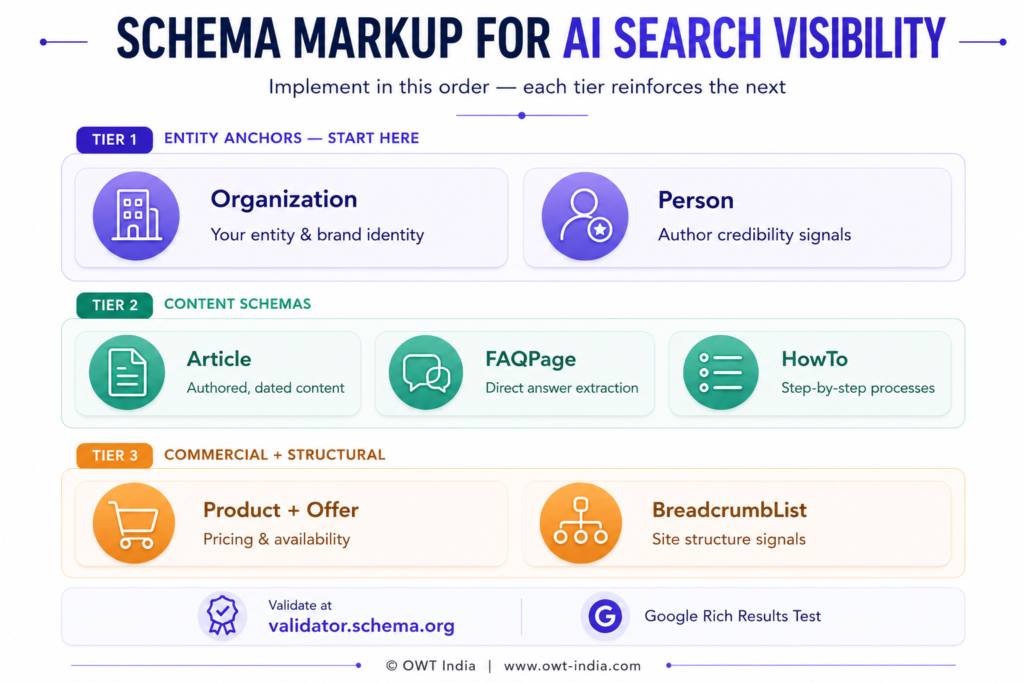
There are dozens of schema types. Most are irrelevant to AI search performance. These six are not.
- Article (and BlogPosting / NewsArticle) — The Content Foundation
Best for: Blog posts, guides, news articles, opinion pieces
When AI systems respond to informational queries, they prioritize content that is clearly authored, dated, and categorized. Article schema provides exactly that structure.
The properties that matter most:
- headline — Your article title
- author — Linked to a Person entity with its own rich schema (see below)
- datePublished — When the piece went live
- dateModified — When it was last updated (critically underused — more on this below)
- image — Featured image
- publisher — Linked to your Organization entity
- description — A clean summary of the article’s content
Why dateModified deserves special attention: AI systems are sensitive to content freshness, especially on fast-moving topics. Updating evergreen content and keeping accurate dateModified timestamps signals ongoing editorial care. Stale content with no modification date reads as abandoned — and gets treated accordingly.
- FAQPage — The Direct Answer Magnet
Best for: Any page that answers common questions in your niche
This is arguably the single highest-impact schema type for AI visibility, and the reason is fundamental: AI assistants are answer engines. When someone asks a question, the AI hunts for content that answers questions directly and in a structured format. FAQPage schema tells AI systems your page is exactly that — and encodes both the questions and answers in machine-readable format.
How to write effective FAQPage schema:
❌ Wrong: “What is the registration timeline for private limited companies?” ✅ Right: “How long does it take to register a private limited company in India?”
Write questions the way real people type or speak them. Formal, passive-voice FAQ phrasing matches almost nothing in real conversational queries.
For answers: Make them complete and self-contained. AI systems extract and display answers without surrounding page context, so each answer must make sense on its own. One to three focused paragraphs is the sweet spot — detailed enough to be useful, compact enough to be cited directly.
⚠️ Avoid answers that begin with “It depends…” without immediately explaining what it depends on. Vague answers get skipped.
- HowTo — The Step-by-Step Powerhouse
Best for: Tutorials, process guides, instructional content
Queries starting with “how to,” “how do I,” or “steps to” are among the most common in AI search. Voice assistants and AI chatbots frequently respond to these with numbered steps — and HowTo schema is what enables AI systems to extract and present your steps accurately.
Key components of a solid HowTo schema:
- name — The task being accomplished
- description — A brief framing of the overall process
- HowToStep array — Each step containing:
- name — Step title
- text — The detailed instruction
- image — Optional, but powerful for complex steps
The golden rule for HowTo steps: Every step must be genuinely actionable.
❌ Vague (useless): “Configure your settings appropriately.” ✅ Specific (AI-ready): “In your WordPress admin panel, navigate to Settings > Permalinks, select Post name as your permalink structure, and click Save Changes.”
Precise, verifiable instructions are exactly what AI systems value — and cite.
- Product + Offer — Commercial Visibility for E-Commerce and Service Businesses
Best for: Product pages, service packages with defined pricing
When a user asks an AI “where can I buy X” or “what does Y cost,” the AI draws heavily from structured product data. Without Product and Offer schema, your product and service pages are largely invisible to commercial intent queries.
Non-negotiable properties:
- Product: name, description, image, brand, offers
- Offer: price, priceCurrency, availability, url
Critical detail on availability: Keep this property scrupulously accurate. AI systems are cautious about recommending unavailable products. An entity whose schema consistently misreports availability gets deprioritized — and that trust is difficult to rebuild.
For service businesses: You don’t sell a physical product, but you can still benefit enormously. A digital marketing agency with defined monthly retainer tiers, a photography studio with published pricing packages, or a law firm with specific service offerings can implement Product + Offer schema just as effectively as any e-commerce store. This creates AI visibility that content optimization alone cannot replicate.
- BreadcrumbList — Site Structure as a Trust Signal
Best for: Every page on a structured website
This is the most overlooked schema type in most audits — and it has implications far beyond the visual breadcrumb trail in search results.
AI systems use BreadcrumbList data to evaluate where a page sits within your site’s content hierarchy. A page embedded in a logical, well-organized topic structure signals editorial intentionality — a marker AI systems associate with authoritative, trustworthy sources. An isolated page with no structural context gets evaluated with less confidence.
Implementation rule: Ensure your BreadcrumbList schema, your visual breadcrumbs, and your URL structure are all consistent with each other. Conflicting signals across these three reduce AI confidence in your site’s organization — the opposite of what you want.
- Organization + Person — The Entity Anchors Everything Else
Best for: Your homepage (Organization) and author/team profile pages (Person)
These two schema types are the foundation that makes every other schema type more powerful. They allow AI systems to build a coherent, verifiable picture of who is behind your content — and why that source should be trusted.
Your Organization schema should include:
- Legal name and any trading names
- Logo and URL
- Contact information
- Social media profiles via sameAs properties (LinkedIn, Twitter/X, Google Business Profile)
- Founding date and area of service
- A clear description of what your organization does
The sameAs property is strategically critical. Linking your Organization schema to verified external profiles creates a web of corroborating identity signals that significantly strengthens AI confidence in your entity.
Your Person schema (for content authors) should include:
- Full name and job title
- affiliation linked to your Organization schema
- Credentials, education, and professional background
- sameAs links to LinkedIn, professional profiles, and publications
Why this compounds: When an AI encounters an article by an author whose Person schema is rich and connected to a credible Organization, E-E-A-T signals reinforce each other. The author’s expertise validates the content. The organization’s authority validates the author. The external links validate both. It’s a trust loop — and schema is what closes it.
What Are the Biggest Schema Mistakes That Kill Its Effectiveness?
Mistake 1: Schema That Doesn’t Match Page Content
This is the most damaging error — and the most common. If your FAQPage schema includes questions that don’t appear on the visible page, or your Product schema lists a price that differs from what users see, AI systems identify the discrepancy and reduce trust in all of your structured data.
Google is explicit: Structured data must represent content actually visible to users. Always validate that your schema and your page content are in complete alignment.
Mistake 2: Implementing Schema on Only a Few Pages
Schema shouldn’t be a special treatment for your homepage and a handful of top pages. It should be a default part of your content production process:
- Every blog post → Article schema
- Every service page → Service or Product schema
- Every team member profile → Person schema
- Every location page → LocalBusiness schema
If you’re adding schema retrospectively, you’re always behind. Build it into your templates and publishing workflow.
Mistake 3: Implementing Schema Once and Never Updating It
Business information changes. Pricing, services, personnel, hours — all of it. Schema that no longer accurately reflects your current operations creates conflicting signals that actively harm your AI visibility.
Treat schema updates with the same priority as updating your website copy. When something on your site changes, the schema should change the same day.
How Do I Test and Validate My Schema Implementation?
Two tools are essential:
- Google Rich Results Test — Checks if your schema is eligible for rich results and surfaces any errors
- Schema Markup Validator — Validates syntax and structure against Schema.org specifications
Run every page’s schema through both tools before deployment and after any significant changes.
Ongoing monitoring: Check Google Search Console’s rich results reports regularly. Errors mean your schema is being ignored — fix them immediately. Warnings indicate missing recommended properties — they’re optimization opportunities, not optional noise.
Where Do I Start If My Site Has No Schema At All?
Prioritize in this order:
- Organization schema on your homepage — establishes your entity
- Article schema on all blog posts and guides — your content’s credibility foundation
- Person schema on author profiles — connects content to credible people
- FAQPage schema on high-traffic informational pages — directly targets AI answer extraction
- Product + Offer schema on service and product pages — commercial query visibility
- HowTo schema on any tutorial or instructional content
- BreadcrumbList across the entire site
This sequence builds from entity credibility outward to content-specific schema — the same way AI systems evaluate trust.
The Bottom Line: Schema Is Infrastructure, Not a Tactic
Most businesses treating schema as a checkbox are building on sand. The businesses investing in comprehensive, accurate, well-maintained structured data are building the machine-readable infrastructure that AI systems need to find, understand, and cite them.
The technical implementation is systematic and learnable. The competitive window is still open — most sites are poorly structured, inaccurate, or woefully incomplete in their schema coverage.
Start with entity schemas. Build outward. Validate everything. Update when things change.
That’s it. That’s the playbook.