
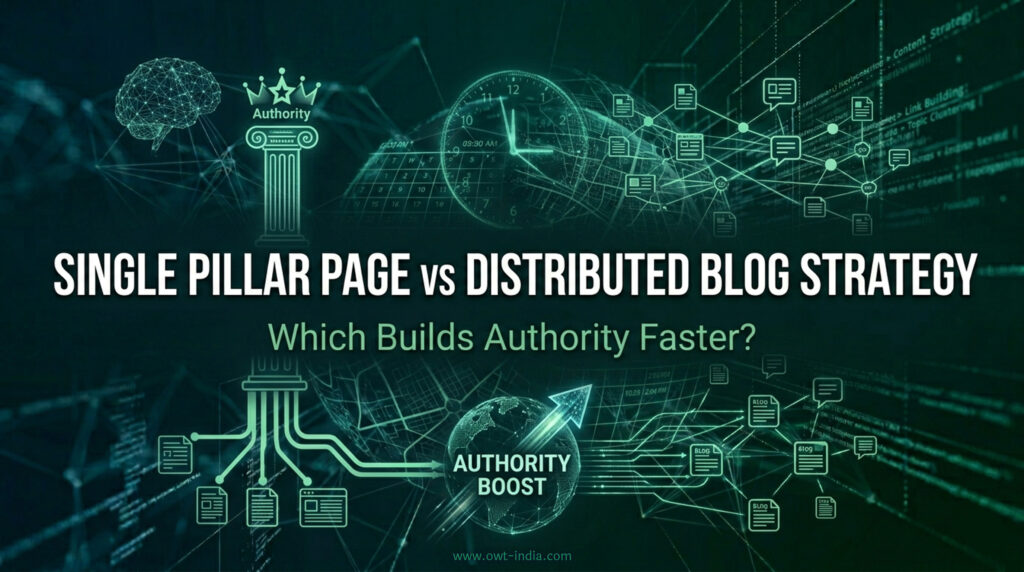
Pillar Page vs Distributed Content Strategy: Which Builds Topical Authority Faster and Drives Sustainable Organic Growth?
Is a single pillar page enough to build authority, or does a distributed content strategy perform better? This experiment compares both approaches to reveal how content structure impacts indexation, rankings, and traffic. The findings show why interconnected content systems outperform isolated pages in building authority.
Hypothesis
A distributed blog strategy builds topical authority faster than a single comprehensive pillar page.
Experiment Setup
To test how authority develops across different content structures, two parallel strategies were deployed within the same domain:
- Pillar Page Approach: A single, in-depth page targeting a broad keyword cluster with comprehensive coverage
- Distributed Strategy: Multiple interlinked articles, each targeting specific subtopics within the same cluster
Both approaches were aligned on:
- Keyword intent and thematic focus
- Internal linking principles
- Baseline domain authority
The objective was to isolate the impact of content structure on visibility and authority growth.
Variables
- Independent Variable: Content structure (Pillar vs Distributed cluster)
- Controlled Variables:
- Domain strength and history
- Keyword targeting and intent alignment
- Internal linking logic
- Publishing environment
Duration
10 weeks
Results
Each approach delivered distinct outcomes:
- Distributed Strategy:
- Faster indexation across multiple pages
- Broader keyword coverage
- ~2.1x higher organic traffic
- Pillar Page:
- Slower initial traction
- Stronger positioning for high-volume head terms over time
- Distributed Strategy:
While the pillar page demonstrated depth and strength in competitive keywords, the distributed model captured width and speed.
Analysis
The experiment highlights two different dimensions of authority:
- Depth (Pillar Page): Strong for central, high-volume queries
- Breadth (Distributed Strategy): Effective for long-tail coverage and faster visibility
Search systems increasingly rely on semantic relationships and topical coverage. A distributed content model signals:
- Consistent expertise across subtopics
- Clear relationships between concepts
- Ongoing content activity within a domain
This aligns with how modern search systems interpret authority—not as isolated depth, but as connected knowledge systems.
The pillar page, while powerful, operates as a standalone asset. Without supporting content, it lacks the reinforcing signals needed to scale authority quickly.
Insight
Topical authority is built through coverage and interconnectivity, not just depth. A single strong page can rank. A connected system can dominate.
Application
This experiment suggests a strategic shift in content planning:
- Use pillar pages as anchors, not as standalone solutions
- Build content clusters that support and reinforce the central topic
- Focus on internal linking structures that connect related ideas
Rather than choosing between pillar or distributed strategies, businesses should integrate both, using distributed content for reach and pillar pages for consolidation.
Authority is not built on pages. It is built on systems.
Still Relying on Single Pages to Build Authority?
Move beyond isolated pages and create interconnected content that drives sustainable growth.