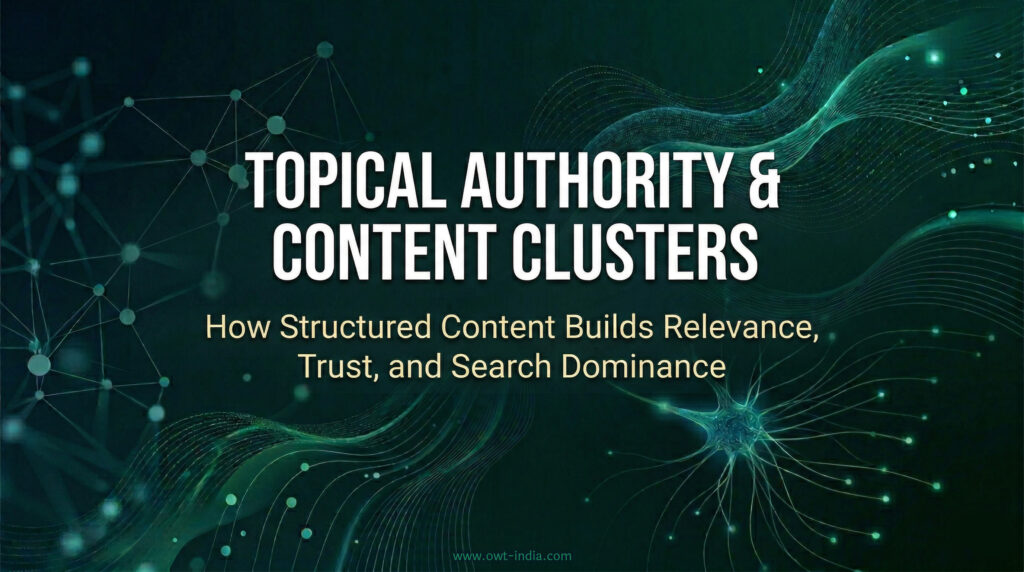
Topical Authority and Content Clusters: Building Structured Knowledge Systems for Long-Term Visibility and Trust in Modern Search Ecosystems
Topical authority is no longer built through isolated content but through structured, interconnected knowledge systems. Content clusters enable websites to demonstrate depth, relevance, and expertise by linking related topics under a unified framework. This approach helps search engines and AI systems understand relationships between concepts, improving both visibility and credibility. As search evolves toward semantic understanding and AI-driven discovery, businesses must move beyond keyword targeting and focus on building comprehensive content ecosystems. By aligning content with intent, structure, and context, topical authority becomes a sustainable strategy for long-term discoverability, trust, and consistent performance across search and AI-driven platforms.
Topical Authority and Content Clusters
Topical authority is the process of establishing a website as a trusted and comprehensive source within a specific subject area. Instead of relying on isolated pages targeting individual keywords, this approach focuses on building a connected body of knowledge that demonstrates depth, relevance, and expertise over time.
At its core, topical authority is achieved through content clusters—a structured framework where a central “pillar” topic is supported by multiple related subtopics. These subtopics are not standalone pieces; they are strategically interlinked to create a clear semantic relationship. This structure helps search engines and AI systems understand not just individual pages, but the broader context in which they exist.
For example, a website aiming to build authority in SEO would not stop at a single article on “SEO basics.” It would create a pillar page supported by clusters covering technical SEO, content optimization, link building, AI search, and case studies. When these pieces are interconnected through intentional internal linking, they signal topical depth and coherence.
Search systems increasingly rely on semantic relationships and entity connections rather than isolated keyword matches. Concepts like Knowledge Graph enable search engines to map how topics relate to each other. Content clusters align directly with this model, making it easier for systems to recognize a website as an authoritative source within a domain.
This approach also improves how users engage with content. Instead of navigating disconnected articles, users move through a guided journey—exploring related ideas, deepening their understanding, and spending more time within the ecosystem. This behavioral signal further reinforces credibility.
However, building topical authority is not about volume. Publishing more content without structure often leads to fragmentation. What matters is intent alignment and strategic organization:
- Each piece should serve a clear purpose within the cluster
- Internal links should reinforce relationships, not just navigation
- Content should progressively deepen the user’s understanding
A practical example can be seen in how platforms like HubSpot structure their knowledge base. They don’t just publish articles—they build interconnected ecosystems around marketing, sales, and CRM, making them go-to resources for both users and search systems.
In AI-driven environments, topical authority becomes even more critical. Systems that generate answers prefer sources that demonstrate consistency, clarity, and depth across a topic. A well-structured content cluster increases the likelihood of being referenced, summarized, and recommended.
Ultimately, topical authority transforms content from a collection of pages into a system of knowledge. It strengthens not just visibility, but credibility—ensuring that your content is not only found, but trusted.
Because in modern search ecosystems, topical authority is what turns structured content into sustained visibility and long-term trust.
Turn Content Into a System, Not Just Pages
Create structured, interconnected content that search engines and AI systems can understand and trust.