
Ecommerce Payment Gateway Integration: From Platform Development to National Payment Infrastructure
This case study explores how a large-scale ecommerce platform evolved into a foundational digital milestone, enabling the first native online payment ecosystem in Sierra Leone and transforming how local consumers transact, demonstrating the power of infrastructure-led execution in emerging markets.
Building the First Native Online Payment Ecosystem for E-Commerce Payment Gateway Integration
In emerging digital economies, the challenge is rarely just technology adoption. It is the absence of foundational systems required to support it.
This case reflects how a standard e-commerce deployment evolved into a nation-level digital infrastructure milestone, enabling online payments where no such system previously existed.
Context: Launching a Large-Scale E-Commerce Platform in West Africa
OWT India was engaged to develop a full-scale online shopping portal for a leading retail enterprise based in Freetown, Freetown. The client operated one of the largest supermarket and electronics retail networks in the region.
The platform was being built on Magento, with a defined scope covering:
- End-to-end e-commerce development
- Product catalog and inventory onboarding
- User experience and transaction flow setup
While the development phase progressed smoothly, one critical dependency remained pending: payment gateway integration.
The Problem: No Existing Payment Infrastructure
Despite multiple follow-ups, the client’s banking partner failed to provide the required API for payment integration.
When documentation finally arrived, it became evident that:
- The shared material was not an API, but regulatory documentation
- There was no existing API infrastructure within the bank
- More critically, no bank in the country had a system to support online payment processing via cards or direct bank integration
This was not a delay.
It was a complete absence of ecosystem readiness.
Strategic Shift: From Integration to Infrastructure Creation
Instead of treating this as a blocker, OWT India initiated direct engagement with bank authorities.
Through detailed discussions, the team:
- Clarified the concept and functional requirements of a payment API
- Mapped the gap between existing banking systems and required digital capabilities
- Established the need for a new system layer to support online transactions
The bank acknowledged the gap and expressed willingness to build the required infrastructure, seeking external expertise for execution.
Execution: Cross-Border Collaboration to Build a Payment System
Recognizing that building a banking-grade API ecosystem was beyond the defined project scope, OWT India took a facilitative role.
Within days:
- Technology partners across Bangalore, Hyderabad, and Pune were identified
- A specialized firm from Bangalore was finalized by the stakeholders
- A dedicated development effort was initiated to build:
- Payment processing APIs
- Backend transaction handling systems
- Integration layers aligned with the national banking framework
Within approximately 6 weeks, the system was:
- Developed
- Tested
- Made deployment-ready
OWT India then integrated the newly built API seamlessly into the e-commerce platform.
Outcome: A National First in Digital Commerce
The result was not just a functional website, but a first-of-its-kind digital commerce capability in Sierra Leone.
- The platform enabled direct payments via local bank accounts and cards
- It surpassed existing solutions that relied only on international gateways like PayPal, which had limited local usability
- It established a new benchmark for domestic e-commerce transactions
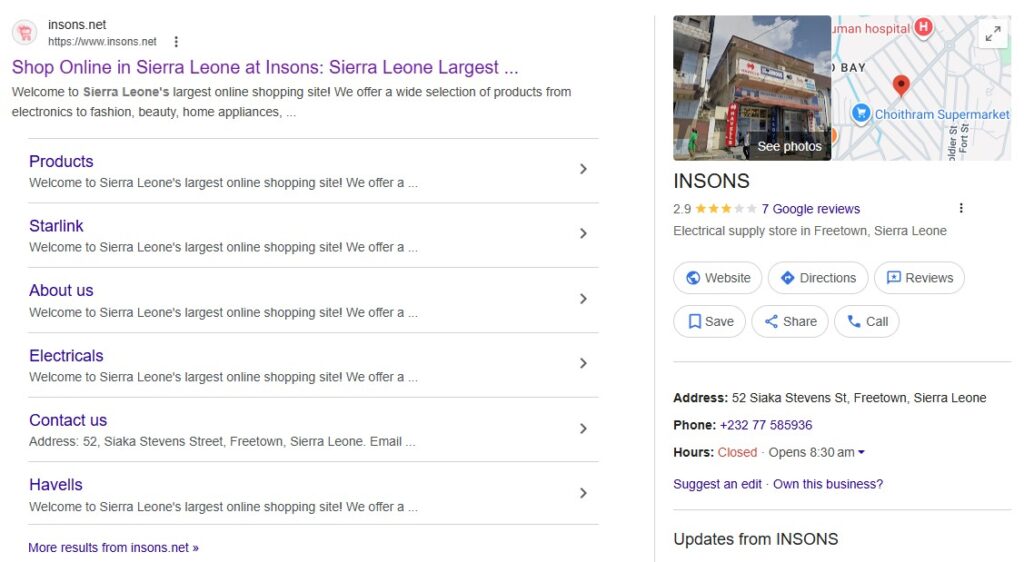
The platform, www.insons.net, was officially launched and inaugurated by the President of Sierra Leone, receiving extensive national media coverage.
Impact
- First operational native online payment-enabled e-commerce platform in the country
- Enabled local consumers to transact digitally using domestic banking systems
- Positioned the client as a market leader in digital retail transformation
- Demonstrated the viability of integrated e-commerce + banking ecosystems in emerging markets
Key Insight
Digital transformation in developing markets is not about deploying platforms.
It is about bridging systemic gaps that platforms depend on.
When infrastructure does not exist, execution demands:
- Problem reframing
- Multi-stakeholder alignment
- Cross-domain collaboration
What This Case Demonstrates
- Ability to operate beyond defined scope and solve ecosystem-level constraints
- Strength in stakeholder education and alignment, even in highly technical domains like banking systems
- Capability to enable first-mover advantage in untapped markets
- Execution discipline in cross-border, multi-vendor coordination
This case reflects OWT India’s approach to digital execution: not limited to platforms, but extended to building the conditions required for platforms to succeed.
Turn Your Ecommerce Vision Into a Functional Ecosystem
Go beyond websites, enable real transactions with robust, scalable payment infrastructure.