AI Search Optimization Is Not SEO. It Is Answer Engineering
Search is no longer a system that simply retrieves documents and orders them. It is increasingly a system that interprets intent, synthesizes information, and delivers a direct answer. That shift changes the unit of competition. You are no longer competing to rank a page. You are competing to become the answer a system chooses to present.
This is where most conversations around AI search go wrong. They treat it as an extension of traditional SEO, when in reality it is a structural shift in how visibility is earned. SEO was built on optimizing documents for ranking signals. AI search is built on selecting, validating, and assembling answers from entities it trusts. The implication is significant. Optimization is no longer about pages. It is about answer construction and answer eligibility.
The category needs reframing. AI search optimization is not SEO. It is answer engineering.
From Ranking Documents to Selecting Answers
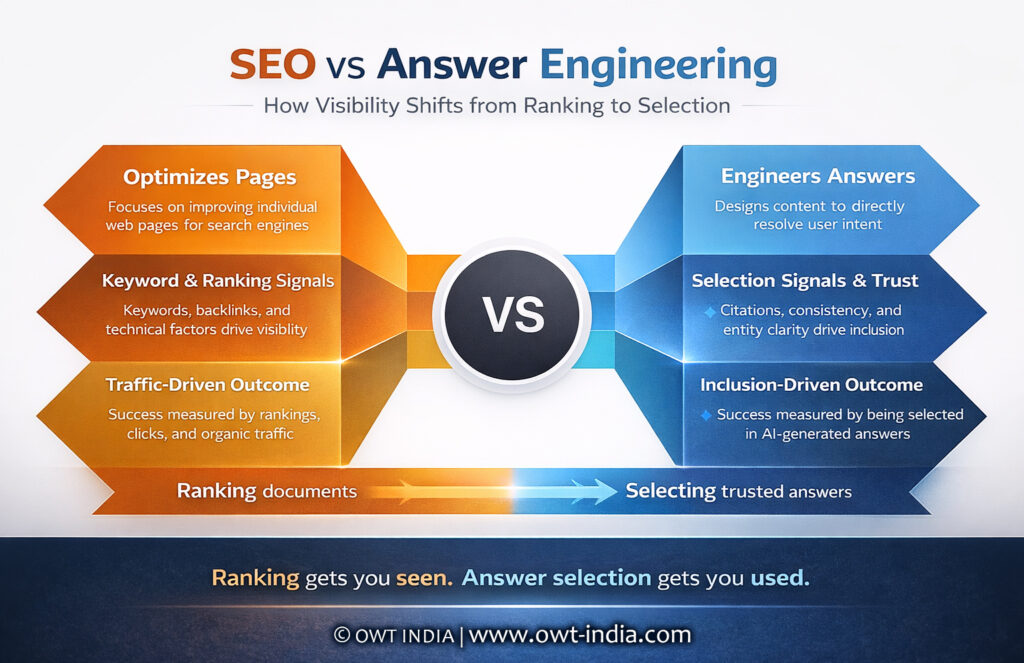
Traditional SEO operates on a relatively stable paradigm. A query is matched to documents, and those documents are ranked based on relevance, authority, and a range of technical and behavioral signals. Visibility is earned by outperforming other documents in that ranking system.
AI search changes the output layer. Instead of presenting a list of links as the primary interface, it often delivers a synthesized response. Even when links are present, they are supporting elements, not the core product. The system’s job is no longer just to find relevant pages. It is to construct a reliable answer.
This introduces a different evaluation model. The system must decide which sources are credible enough to be included in the answer, how to combine them, and how to resolve ambiguity. In this environment, ranking is only a precursor. Selection is the real gatekeeper.
The shift from ranking to selection means that being visible is not enough. Your content must be interpretable, extractable, and trustworthy at a granular level. A page can rank and still never be used. That is the gap most strategies fail to address.
Understanding Answer Selection Mechanics
To operate effectively in AI search, you need to understand how answers are selected, even if the exact algorithms remain opaque. The process can be broken down conceptually into three layers: eligibility, extraction, and synthesis.
Eligibility is about whether your content is considered a viable source. This is influenced by entity clarity, topical authority, consistency across the web, and alignment with known knowledge structures. If your site or brand is not recognized as a credible entity within a topic, it is unlikely to be considered.
Extraction is about whether the system can pull usable information from your content. This depends on how clearly ideas are expressed, how well concepts are structured, and whether the content resolves specific intents without ambiguity. Dense, unfocused writing or overly promotional language reduces extractability.
Synthesis is where multiple sources are combined into a final answer. At this stage, the system weighs consistency across sources, resolves conflicts, and prioritizes clarity. If your content aligns with other trusted sources, it reinforces your inclusion. If it contradicts or introduces noise, it is more likely to be excluded.
What emerges is a different kind of optimization target. You are not optimizing for a position. You are optimizing for inclusion in a reasoning process.
Citation Reinforcement Loops and Why They Matter
One of the most important dynamics in AI search is the emergence of citation reinforcement loops. These loops form when a set of sources repeatedly validate each other across contexts, strengthening their collective credibility.
When your content is cited alongside other authoritative sources, it signals alignment with established knowledge. Over time, repeated inclusion increases the likelihood of future selection. This is not just about backlinks in the traditional sense. It is about co-occurrence in trusted contexts.
These loops extend beyond your own site. Mentions in industry publications, consistent positioning across platforms, and alignment with recognized entities all contribute. The system is not evaluating your page in isolation. It is evaluating your presence within a broader knowledge graph.
The practical implication is that authority is no longer built only through direct signals like links. It is built through consistent validation across multiple surfaces. If your brand appears fragmented or inconsistent, it weakens your eligibility for inclusion in these loops.
Why Most “AI SEO Agencies” Are Misframing the Problem
A large portion of the market is approaching AI search with an outdated lens. They are applying traditional SEO tactics to a fundamentally different system. This leads to strategies that optimize for visibility metrics that no longer translate into actual presence within AI-generated answers.
The common misframing is treating AI search as a distribution problem rather than a qualification problem. Agencies focus on producing more content, targeting more keywords, or adapting surface-level formats. What they overlook is whether that content is structured in a way that makes it eligible for answer selection.
Another issue is the overemphasis on volume. In a ranking-based system, more content can increase coverage. In an answer-based system, redundancy without clarity reduces signal quality. The system does not need more content. It needs better answers.
There is also a misunderstanding of authority. Traditional SEO often equates authority with domain strength or backlink profiles. In AI search, authority is contextual and entity-driven. A strong domain does not guarantee inclusion if the content lacks clarity, consistency, or alignment with the system’s understanding of the topic.
The result is a gap between effort and outcome. Businesses invest in AI SEO initiatives that produce content but fail to achieve answer-level visibility.
What Answer Engineering Actually Means
Answer engineering is the discipline of designing content and digital presence in a way that makes it eligible, extractable, and trustworthy for AI-driven answer systems.
It starts with intent clarity. Every piece of content should resolve a specific question or decision point. This does not mean writing simplistic answers. It means structuring information so that key insights are explicit and unambiguous.
It extends to entity definition. Your brand, services, and expertise need to be clearly articulated and consistently represented across platforms. This helps the system understand who you are and what you are authoritative in.
It also involves structural design. Content should be organized in a way that supports extraction. Clear subheadings, logical flow, and well-developed explanations make it easier for systems to identify and use relevant segments.
Finally, it requires ecosystem thinking. Your site is one node in a larger network. Mentions, references, and alignment across that network reinforce your credibility. Answer engineering is not confined to on-page optimization. It is about shaping how your knowledge exists across the web.
How to Apply This Practically
Translating this into action requires a shift in how you plan and produce content. The first step is to map intent clusters rather than just keywords. Identify the core questions your audience is asking and the decisions they are trying to make. Build content around resolving those clusters comprehensively.
Next, audit your existing content for extractability. Look at whether key insights are clearly stated, whether sections answer specific questions, and whether the structure supports easy interpretation. Rewrite where necessary to improve clarity and focus.
Then, strengthen your entity signals. Ensure that your brand, services, and expertise are consistently described across your website, social profiles, and external mentions. Align terminology and positioning so that there is no ambiguity in how you are represented.
You should also invest in contextual authority. This means contributing to relevant conversations beyond your own site. Publish insights, collaborate with other credible entities, and ensure that your expertise is recognized in multiple contexts. The goal is to become part of the citation ecosystem, not just a standalone source.
Finally, measure differently. Instead of focusing only on rankings and traffic, look for signs of inclusion. Are your insights being referenced? Are your ideas appearing in synthesized answers? These signals are harder to track, but they are closer to the actual outcome that matters.
The Strategic Shift Ahead
The transition from SEO to answer engineering is not a minor evolution. It is a redefinition of how digital visibility is earned. As AI systems become more central to how users access information, the ability to be selected as a trusted answer will outweigh the ability to rank.
This does not make SEO irrelevant. It changes its role. SEO becomes the foundation that ensures your content is discoverable and credible. Answer engineering builds on that foundation to ensure your content is actually used.
Businesses that recognize this shift early will have a structural advantage. They will design their content and presence for how systems think, not just how they rank. Over time, that alignment compounds.
The future of search is not about being seen. It is about being chosen.